Ege’s Test (Weight-Bearing McMurray’s Test): How to Perform It and Interpret It
What Is Ege’s Test Used For?
Ege’s test is a clinical examination maneuver used to detect meniscal tears of the knee. It is also called the weight-bearing McMurray’s test. Most meniscal injuries occur under load, so the test reproduces the symptoms in a standing, weight-bearing squat. It can assess both the medial and the lateral meniscus. The first prospective study to describe it and compare it with McMurray’s test and joint line tenderness (JLT) was published in Arthroscopy in 2004 [1].
How to Perform Ege’s Test
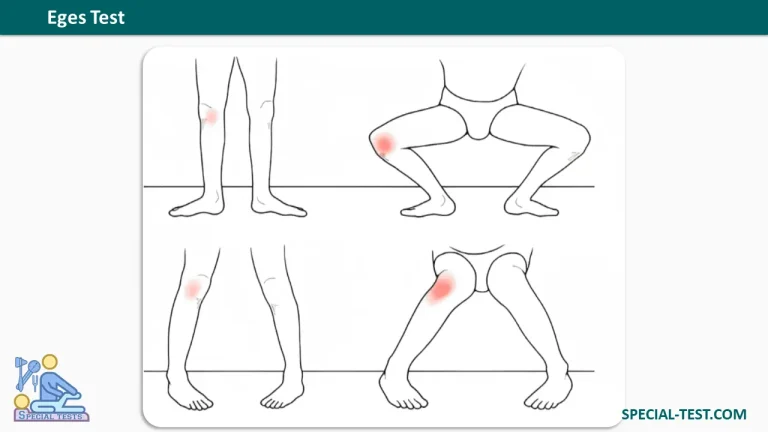
The test is done with the patient standing. The knees start in extension, and the feet are placed about 30 to 40 cm apart [1,2]. The two versions differ in the rotation of the lower limbs.
Testing the Medial Meniscus
- The patient squats with both lower legs in maximal external rotation.
- As the squat progresses, the distance between the knees increases and each knee rotates externally.
- Squatting in maximal external rotation induces a varus (genu varus) position, which loads the medial compartment.
- The patient squats as far as possible, then slowly returns to the starting position with the knees extended.
Testing the Lateral Meniscus
- The patient squats with both lower limbs held in maximal internal rotation.
- As the squat progresses, the distance between the knees decreases and each knee rotates internally.
- Squatting in maximal internal rotation induces a valgus (genu valgus) position, which loads the lateral compartment.
- The patient squats as far as possible, then returns to the starting position.
What Is a Positive Result?
The test is positive when the patient feels pain and/or a click at the joint line of the side being tested. This typically occurs at about 90° of knee flexion. The click is sometimes audible to the examiner. Pain on rising from the squat is also commonly scored as positive.
How Accurate Is Ege’s Test?
In the original study, 150 patients with suspected meniscal injury were examined and then underwent arthroscopy as the reference standard. A meniscal tear was found in 127 of them [1]. The reported figures are:
| Tear location | Sensitivity | Specificity | Accuracy |
|---|---|---|---|
| Medial meniscus | 67% | 81% | 71% |
| Lateral meniscus | 64% | 90% | 84% |
For medial tears, the specificity of Ege’s test (81%) was clearly higher than that of joint line tenderness (44%). Ege’s test also had the highest positive predictive value (86%), while JLT had the better negative predictive value (67%) [1]. The authors concluded that adding Ege’s test to the clinical examination may improve the accuracy of traditional meniscal tests [1].
The study did not find a statistically significant difference between the three tests (P > .05) [1]. Ege’s test is therefore a useful addition to the physical examination, not a replacement for it.
Clinical Pearls and Limitations
- Ability to squat is required. The patient must be able to bear weight and squat. In a very acute, painful, or swollen knee, the test may not be feasible, and a non-weight-bearing test such as McMurray’s may be more practical.
- A single study. The main diagnostic data come from one prospective study, so the findings still need independent confirmation.
- Combine with other findings. Accuracy improves when the test is interpreted together with history, JLT, other meniscal tests, and imaging when needed [1,3].
- Associated pathology matters. The original study examined how associated lesions affect test performance. Accuracy reportedly fell with degenerative arthritis and patellofemoral disease [1].
Frequently Asked Questions (FAQ)
1. What is Ege’s test used for?
It detects medial and lateral meniscus tears of the knee in a weight-bearing position.
2. Is Ege’s test the same as the weight-bearing McMurray’s test?
Yes. It is a weight-bearing version of McMurray’s test, performed as a standing squat with the legs rotated.
3. How do I tell if Ege’s test is positive?
The patient feels pain and/or a click at the joint line of the tested compartment, typically near 90° of knee flexion.
4. How accurate is Ege’s test?
For medial meniscus tears, sensitivity is 67%, specificity 81%, and accuracy 71%. For lateral tears, the figures are 64%, 90%, and 84% [1].
5. Is Ege’s test better than McMurray’s test?
It showed higher specificity than JLT and good predictive values in the original study, but the three tests did not differ significantly [1]. Use them together.
6. Can Ege’s test confirm a meniscus tear on its own?
No. A positive result raises suspicion, but diagnosis relies on history, a full examination, and imaging such as MRI when indicated. Arthroscopy was the reference standard in the study [1].
7. Who should not perform Ege’s test?
Patients who cannot bear weight or squat because of acute pain, swelling, or restricted motion.
References
- Akseki D, Özcan Ö, Boya H, Pınar H. A new weight-bearing meniscal test and a comparison with McMurray’s test and joint line tenderness. Arthroscopy. 2004;20(9):951-958. PMID: 15525928. https://pubmed.ncbi.nlm.nih.gov/15525928/
- Filardo G, Andriolo L, Naouri JF, Perdisa F, Lefevre N. Clinical Examination, Standard X-Rays. In: Hulet C, Pereira H, Peretti G, Denti M, eds. Surgery of the Meniscus. Springer; 2016. https://doi.org/10.1007/978-3-662-49188-1_13
- Campbell’s Operative Orthopaedics, 12th ed. (reference supplied with the source text).