Brush Test for Knee Effusion: How to Perform It and Read the Results
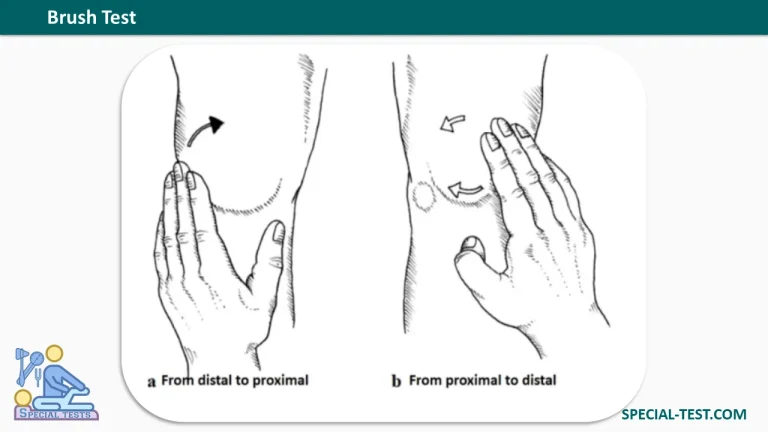
What is the brush test used for?
The brush test is a quick bedside orthopedic exam for detecting minimal effusion in the knee joint. It is also called the stroke test, bulge test, swipe test or sweep test. Effusion means extra fluid inside the joint. It often accompanies osteoarthritis, inflammatory arthritis, gout, ligament or meniscal injury, and other knee problems.
Many examiners prefer the brush test over the patellar tap (ballottement) test when only a small amount of fluid is suspected. The patellar tap is generally considered more suitable for moderate to large effusions.
How to perform the brush test
- Position the patient. The patient lies supine, relaxed, with the knee extended.
- Smooth the medial side. Using one hand, stroke the medial side of the knee from distal to proximal, toward the hip. Repeat 2–3 times to push fluid out of the medial compartment and into the suprapatellar recess.
- Press the superior recess. With the other hand, press the superior recess, moving distally from a proximal and lateral position.
- Watch and feel the medial knee. Look and feel just below the kneecap on the inner side for any returning fluid.
What is a positive brush test?
The test is positive when a wave or bulge of fluid appears on the medial, distal part of the knee after the downward stroke. A positive result can appear even with a mild effusion. No wave means the test is negative.
Grading the effusion
Sturgill and colleagues (2009) proposed a grading scale for the stroke test:
| Grade | Finding |
|---|---|
| 0 | No wave produced on the downstroke |
| Trace | Small wave on the medial side |
| 1+ | Larger bulge on the medial side |
| 2+ | Fluid returns to the medial side on its own after the upstroke |
| 3+ | So much fluid that it cannot be moved out of the medial knee |
How reliable is the brush test?
The Sturgill et al. study in the Journal of Orthopaedic & Sports Physical Therapy (2009) reported good agreement between examiners (kappa = 0.75). Physiotutors rates the test as having moderate clinical value. In the same body of work, the patellar tap and fluctuation tests showed much lower agreement (kappa 0.21 and 0.37).
The wider evidence is more cautious. A systematic review on PubMed Central found that many unstandardized knee effusion tests have relatively low intra- and inter-observer reliability, and it concluded there was not enough evidence to recommend any single test. A Journal of Rheumatology ultrasound validation study found that the physical exam has only moderate accuracy for knee effusion. Accuracy was lower in patients with a higher BMI, and ultrasound improved diagnosis, especially for small effusions.
Clinical tips
- Use a consistent, standardized technique every time you examine.
- Compare with the opposite knee.
- Combine the brush test with inspection, palpation and history.
- If the result is unclear, or the patient has a high BMI, consider ultrasound or MRI.
- Document the grade (0, trace, 1+, 2+, 3+) so follow-up exams are comparable.
Learn more about related knee tests on OrthoFixar: [insert link to your OrthoFixar page].
Frequently Asked Questions (FAQ)
What is the brush test used for?
It detects minimal effusion (excess fluid) in the knee joint.
Is the brush test the same as the stroke, sweep or bulge test?
Yes. These names describe the same fluid-displacement technique, with small variations in hand placement.
What does a positive brush test look like?
A wave of fluid is felt or seen in the medial, distal part of the knee after the downward stroke, even when the effusion is mild.
Can the brush test detect large effusions?
It is designed for minimal effusion. For moderate to large effusions, the patellar tap (ballottement) test is usually more suitable. At grade 3+, the fluid may be too abundant to displace.
How accurate is the brush test?
Examiner agreement was good in one study (kappa 0.75), but the overall evidence on clinical effusion tests is mixed. Diagnostic accuracy is moderate, and ultrasound is more reliable for confirmation.
Does the brush test diagnose the cause of knee swelling?
No. It only suggests that fluid is present. Finding the cause requires history, further exam, imaging and sometimes joint aspiration.
Is the brush test painful?
It is a gentle stroking and light-pressure maneuver and is usually painless. Tell the patient beforehand, especially if the knee is tender.
When should someone see a doctor about a swollen knee?
See a clinician if swelling follows an injury, lasts more than a few days, or comes with pain, warmth, redness, fever or difficulty bearing weight.
References
- Sturgill LP, et al. Interrater reliability of a clinical scale to assess knee joint effusion. J Orthop Sports Phys Ther. 2009;39(12):845–849 (search by title on PubMed).
- Systematic review of clinical tests for knee effusion in osteoarthritis, PubMed Central: PMC4823277
- Diagnostic accuracy of physical examination maneuvers for knee effusion: an ultrasound validation study. J Rheumatol. jrheum.org
- Physiotutors, Brush/Stroke/Bulge Test: physiotutors.com/wiki/brush-test