Dizziness Test: How to Tell Vertebral Artery from Inner Ear Dizziness
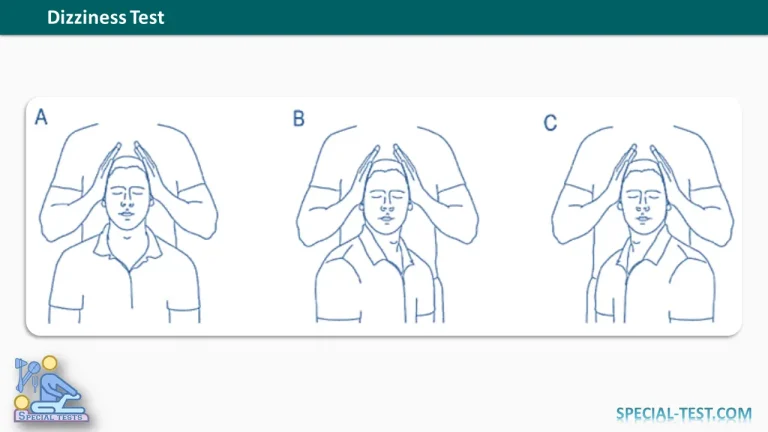
The dizziness test is a bedside orthopedic and neurological maneuver. It helps the examiner judge whether a patient’s dizziness comes from the vertebral arteries or from the semicircular canals of the inner ear. It uses two simple active movements, head rotation and shoulder rotation, and it needs no equipment.
What Is the Dizziness Test Used For?
The test screens dizziness of uncertain origin and separates two broad categories:
- Vascular causes: reduced blood flow through the vertebral arteries, which supply the posterior circulation of the brain (vertebrobasilar insufficiency).
- Vestibular causes: dysfunction of the semicircular canals in the inner ear.
This distinction matters because dizziness is a risk factor for transient ischemic events and stroke when it has a vascular cause [1]. It also affects decisions about cervical treatment, including manual therapy and exercise [1].
How to Perform the Dizziness Test
Step 1: Head rotation with the shoulders fixed
- The patient sits upright and the examiner holds the patient’s head.
- The patient actively rotates the head as far as possible to the right.
- The end position is held for 10 to 30 seconds while the shoulders stay still.
- The head returns to neutral, and the maneuver is repeated to the left with the same hold.
Step 2: Shoulder rotation with the head facing forward
- The patient keeps the head facing straight ahead.
- The shoulders are actively rotated as far as possible to the right and held for 10 to 30 seconds.
- The shoulders return to neutral, and the maneuver is repeated to the left with the same hold.
In Step 1 the head moves relative to the trunk. In Step 2 the trunk moves relative to the head, so the neck is rotated while the head stays still in space. That second step is what separates the vestibular and vascular explanations.
How to Interpret the Results
Dizziness in both head rotation and shoulder rotation
- This points toward the vertebral arteries.
- Neck rotation occurs in both steps, so the vertebral artery may be kinked and blood flow reduced either way.
Dizziness only with head rotation
- This points toward the semicircular canals of the inner ear.
- The vestibular system responds to head movement, and neck rotation alone does not provoke it.
Watch for other signs of vertebrobasilar compromise during the test, such as visual disturbance, nystagmus, nausea, slurred speech, difficulty swallowing, or fainting. Stop the maneuver and arrange urgent medical assessment if these appear [1,3].
Limitations: How Reliable Is the Dizziness Test?
Treat the test as a clinical screening aid, not a diagnostic standard.
- Vertebral artery flow varies considerably between individuals, and ultrasound studies show it changes with head position even in healthy people [1].
- Positional tests should not be treated as tests of arterial integrity. They cannot reliably show the risk of arterial damage or cervical artery dissection [1].
- A systematic review of premanipulative vertebrobasilar insufficiency tests found only four eligible studies. It concluded that the tests do not appear valid for premanipulative screening [2].
- Reviews of cervicogenic vertigo note that diagnostic methods remain few and unconvincing. There is still no test that proves a neck problem is causing vertigo [3].
A negative result therefore does not make cervical manipulation safe, and a positive result does not prove vertebral artery disease. Combine the test with the patient’s history, a neurological examination, and imaging when indicated.
Clinical Takeaways
- The test is quick and free of equipment, and it narrows the differential for dizziness.
- Dizziness in both steps suggests a vertebral artery cause, and dizziness with head rotation alone suggests an inner ear cause.
- Interpret the result in context and never in isolation.
- Refer urgently if neurological signs appear.
For related examination techniques, see the vertebral artery test and special cervical tests on Orthofixar.com. Add the exact page URLs when you publish.
Frequently Asked Questions (FAQ)
What is the dizziness test used for?
It helps determine whether dizziness comes from the vertebral arteries or from the semicircular canals of the inner ear.
How long should each position be held?
Hold each end-range position for 10 to 30 seconds, then return to neutral before the next direction.
What does dizziness in both head and shoulder rotation mean?
It suggests the vertebral arteries may be compressed or kinked during neck rotation, which reduces blood flow.
What does dizziness with head rotation only mean?
It suggests an inner ear (semicircular canal) problem, because the vestibular system reacts to head movement.
Is the dizziness test accurate enough to rule out stroke risk?
No. Positional tests do not assess arterial integrity or the risk of dissection, and a negative result does not guarantee safety [1,2].
Can the test be used before cervical manipulation?
It is commonly used that way, but evidence for its validity as a premanipulative screen is limited [2]. Use it alongside a full history and examination.
When should a patient be referred urgently?
Refer if dizziness comes with visual changes, nystagmus, speech or swallowing difficulty, drop attacks, or limb weakness.
References
- Should we abandon positional testing for vertebrobasilar insufficiency? Musculoskelet Sci Pract. 2020;46:102095. doi:10.1016/j.msksp.2019.102095. PubMed PMID: 31767531. https://pubmed.ncbi.nlm.nih.gov/31767531/
- Hutting N, et al. Diagnostic accuracy of premanipulative vertebrobasilar insufficiency tests: a systematic review. Man Ther. 2013;18(3):177-182. Search PubMed by title to confirm the PMID before publishing.
- Cervicogenic causes of vertigo. Curr Opin Neurol (review). PubMed PMID: 25502050. https://pubmed.ncbi.nlm.nih.gov/25502050/