Finger to Nose Test: How to Perform, Results & Clinical Significance
What Is the Finger to Nose Test?
The Finger-to-Nose Test is a simple neurological examination used to assess upper limb coordination, movement accuracy, and cerebellar function. It is commonly performed during neurological and musculoskeletal assessments to evaluate a patient’s ability to execute smooth, controlled, and purposeful movements.
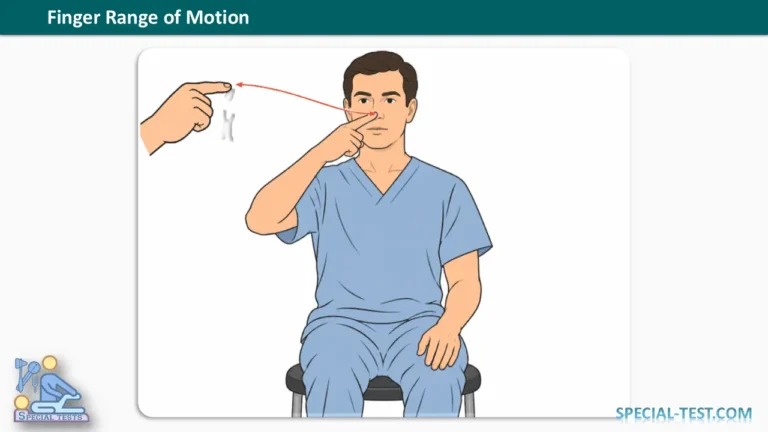
The test involves asking the patient to touch the tip of their nose with their index finger, initially with their eyes open and then with their eyes closed. Both upper limbs are examined separately, and the movement may be repeated at progressively increasing speeds.
The finger-to-nose test is particularly useful for identifying neurological abnormalities such as dysmetria, intention tremor, and ataxia, which can occur in patients with cerebellar dysfunction.
Because the procedure is quick, noninvasive, and requires no specialized equipment, it is widely used in clinical neurological examinations.
Purpose of the Finger to Nose Test
The primary purpose of the finger to nose test is to evaluate the coordination and precision of voluntary upper limb movements.
It helps clinicians assess several important neurological functions:
- Cerebellar function: Evaluates the cerebellum’s role in coordinating voluntary movements.
- Upper limb coordination: Assesses the ability to perform accurate, smooth, and controlled movements.
- Dysmetria: Identifies difficulty estimating the correct distance or force needed to reach a target.
- Intention tremor: Detects tremors that become more noticeable as the finger approaches the nose.
- Proprioception: Helps assess awareness of limb position, particularly when performed with the eyes closed.
- Movement symmetry: Allows comparison of coordination between the right and left upper extremities.
The test is frequently included in neurological assessments of patients presenting with dizziness, impaired balance, tremors, clumsiness, or suspected cerebellar disorders.
How to Perform the Finger to Nose Test
The finger to nose test can be performed with the patient sitting or standing. Sitting is generally preferable when balance is impaired or there is a risk of falling.
Step-by-Step Procedure
- Position the patient: Ask the patient to sit comfortably or stand in a stable position with their arms relaxed.
- Explain the procedure: Instruct the patient to extend one arm and bring the tip of their index finger toward the tip of their nose.
- Test with eyes open: Ask the patient to touch their nose accurately with their index finger and then return the arm to its starting position.
- Repeat the movement: Have the patient perform the movement several times, initially at a comfortable speed, while observing the accuracy and smoothness of the motion.
- Test with eyes closed: Ask the patient to close their eyes and repeat the same movement. Observe whether removing visual feedback affects the accuracy of finger placement.
- Examine the opposite arm: Repeat the entire procedure using the other hand to compare coordination between both sides.
- Gradually increase speed: Ask the patient to perform the movement more quickly while maintaining accuracy and coordination.
The examiner should observe for tremors, irregular movements, hesitation, overshooting, undershooting, and differences between the two upper limbs.
Clinical Tip: Start the test slowly and carefully before increasing the speed. Subtle signs of cerebellar dysfunction may be missed when the test is performed too rapidly.
Finger to Nose Test Results and Interpretation
Normal Finger to Nose Test (Negative Test)
A normal finger to nose test demonstrates smooth, accurate, coordinated, and controlled upper limb movements.
Expected findings include:
- The patient accurately touches the tip of the nose with the index finger.
- Movements are smooth and continuous without unnecessary corrections.
- Both upper limbs demonstrate comparable coordination.
- The patient can repeat the movement at increasing speeds without significant loss of accuracy.
- No intention tremor or significant dysmetria is observed.
- The patient performs the movement successfully with both eyes open and eyes closed.
These findings support intact upper limb coordination and appropriate integration of motor and sensory information.
However, a normal result does not completely exclude neurological disease.
Abnormal Finger to Nose Test (Positive Test)
An abnormal finger-to-nose test occurs when the patient demonstrates impaired accuracy, irregular movement, or difficulty reaching the intended target.
Common abnormal findings include:
1. Dysmetria
Dysmetria refers to the inability to accurately control the distance or extent of a voluntary movement.
Patients may overshoot the nose (hypermetria) or stop short of the target (hypometria). Dysmetria is an important sign of possible cerebellar dysfunction.
2. Intention Tremor
An intention tremor is a tremor that becomes more prominent as the finger approaches its intended target.
During the finger-to-nose test, the examiner may observe increasing oscillation of the hand or finger as it approaches the nose.
3. Ataxia
Ataxia describes impaired coordination of voluntary movements.
A patient with upper limb ataxia may perform the test with irregular, inaccurate, or poorly controlled movements despite having sufficient muscle strength.
4. Decomposition of Movement
Instead of performing one smooth movement, the patient may complete the task through several separate, jerky corrections.
This finding can suggest impaired cerebellar coordination.
5. Asymmetrical Performance
Significant differences between the right and left arms may indicate unilateral neurological impairment.
In cerebellar hemisphere lesions, coordination abnormalities commonly occur on the same side as the affected cerebellar hemisphere.
Clinical Significance of the Finger to Nose Test
The finger-to-nose test is an important component of the neurological examination, particularly when evaluating suspected cerebellar ataxia.
The cerebellum contributes to the timing, precision, and coordination of voluntary movements. Damage or dysfunction affecting cerebellar pathways can interfere with the ability to accurately control the movement of the upper extremities.
An abnormal finger-to-nose test may be associated with:
- Cerebellar lesions or disorders
- Cerebellar ataxia
- Impaired proprioception
- Sensory pathway dysfunction
- Other neurological conditions affecting motor control
The effect of eye closure may provide additional clinical information. A marked deterioration in coordination after closing the eyes can suggest impaired proprioceptive feedback or sensory ataxia. In contrast, cerebellar ataxia may remain evident even when visual guidance is available.
Nevertheless, the finger-to-nose test cannot independently determine the cause or exact location of a neurological abnormality.
The examiner should interpret the results alongside muscle strength, sensation, reflexes, gait, balance, and other coordination tests.
Finger-to-Nose Test vs. Finger-Nose-Finger Test
The finger-to-nose test and finger-nose-finger test are closely related neurological coordination assessments.
In the traditional finger-to-nose test, the patient repeatedly moves their index finger toward their own nose.
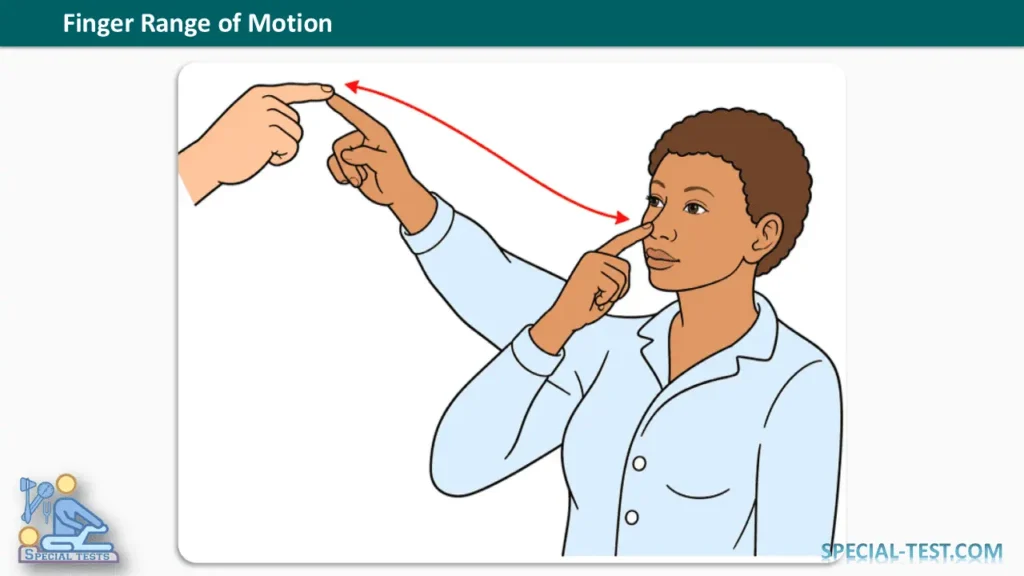
In the finger-nose-finger test, the examiner positions their index finger in front of the patient and asks the patient to alternate between touching their own nose and the examiner’s finger.
The examiner may change the position of the external target to further challenge movement accuracy and coordination.
Both variations are useful for detecting dysmetria and intention tremor during cerebellar examination.
Frequently Asked Questions (FAQ)
1. What does the finger-to-nose test assess?
The finger-to-nose test assesses upper limb coordination, movement accuracy, and cerebellar function. It helps clinicians identify abnormalities such as dysmetria, intention tremor, and ataxia.
2. How is the finger to nose test performed?
The patient is asked to touch the tip of their nose with their index finger while their eyes are open. The procedure is then repeated with the eyes closed. Both hands are assessed several times, and movement speed may be progressively increased.
3. What is a positive finger to nose test?
A positive or abnormal test indicates difficulty performing accurate, smooth, and coordinated movements. The patient may overshoot the target, miss the nose, demonstrate an intention tremor, or make repeated corrective movements.
4. Why is the finger-to-nose test performed with the eyes closed?
Closing the eyes removes visual guidance and increases reliance on proprioception, the body’s ability to detect the position and movement of its limbs. A marked deterioration with eye closure may suggest sensory or proprioceptive impairment.
5. What does an abnormal finger to nose test indicate?
An abnormal result may suggest cerebellar dysfunction, impaired proprioception, or another neurological disorder affecting movement coordination. Further neurological assessment is necessary to determine the underlying cause.
6. Is the finger to nose test used to assess the cerebellum?
Yes. The test is commonly included in cerebellar examinations because the cerebellum is essential for controlling movement accuracy, timing, and coordination.
7. Can the finger to nose test diagnose cerebellar ataxia?
No. Although abnormal findings can support a suspicion of cerebellar ataxia, the test alone cannot establish a diagnosis. Clinicians use additional neurological examinations and, when indicated, further investigations.
Conclusion
The Finger to Nose Test is a valuable bedside neurological assessment used to evaluate upper limb coordination and cerebellar function.
A normal result is characterized by smooth, accurate, and coordinated movements with the eyes both open and closed. Abnormal findings, including dysmetria, intention tremor, and impaired movement control, may suggest cerebellar or sensory pathway dysfunction.
When combined with other neurological tests, the finger-to-nose test provides useful clinical information for identifying and evaluating movement coordination disorders.
References
- Orthofixar. Coordination Tests: Finger-to-Nose Test, Procedure and Normal Findings. Orthofixar – Coordination Tests
- National Library of Medicine. Neurologic Exam. StatPearls, NCBI Bookshelf. https://www.ncbi.nlm.nih.gov/books/NBK557589/
- National Library of Medicine. Cerebellar Dysfunction. StatPearls, NCBI Bookshelf. https://www.ncbi.nlm.nih.gov/books/NBK562317/
- National Library of Medicine. The Cerebellum. Clinical Methods, NCBI Bookshelf. https://www.ncbi.nlm.nih.gov/books/NBK392/
- Bastian AJ. Mechanisms of Ataxia. Physical Therapy. 1997;77(6):672–675. PubMed PMID: 9184691
- Marsden JF. Cerebellar Ataxia. Handbook of Clinical Neurology. 2018;159:261–281. PubMed PMID: 30482319
- National Library of Medicine. Chapter 6: Neurological Assessment. Nursing Skills, NCBI Bookshelf. https://www.ncbi.nlm.nih.gov/books/NBK596731/