Arm Stopping Test: How to Perform It and Interpret Cerebellar Overshoot
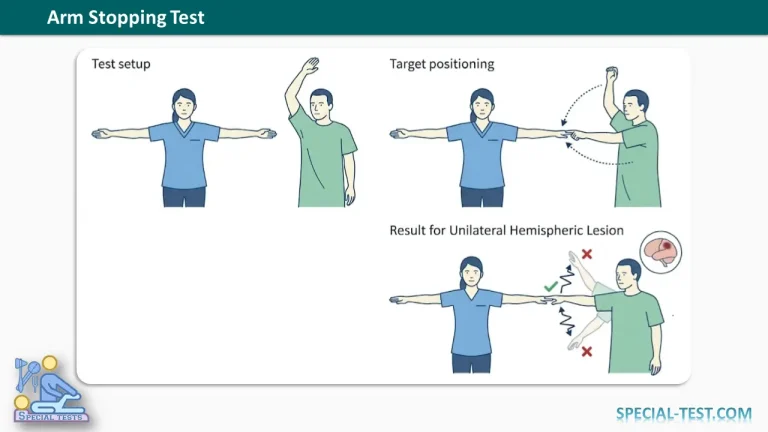
The arm stopping test is a bedside neurological maneuver for detecting a unilateral cerebellar hemisphere lesion. It checks whether each arm can stop accurately at a target after a fast, ballistic movement. The healthy arm halts precisely, while the affected arm overshoots, swings back and oscillates before settling. The test needs no equipment and takes under a minute, which makes it a quick supplement to the standard cerebellar examination.
Clinical Background
The test belongs to the family of “rebound” and “checking” signs. Gordon Holmes and Thomas Grainger Stewart described the rebound phenomenon in 40 patients with cerebellar disease, and the Stewart-Holmes test remains part of neurological diagnostics today [1]. Holmes also defined the cardinal cerebellar signs: ataxia, asthenia, adiadochokinesia and rebound [1]. The original description appeared in 1904, and the phenomenon was discussed again in the Archives of Neurology in 1977 [2].
Terminology varies between textbooks. Some authors reserve “rebound phenomenon” for the response when resistance is suddenly released, and they describe the normal response as the antagonist muscles stopping the limb [3]. The arm stopping test applies the same logic to a self-initiated movement toward a target.
How to Perform the Arm Stopping Test
- Have the patient hold both arms overhead or by the sides.
- Hold your own arms outstretched horizontally as the target.
- Ask the patient to bring both arms up or down quickly so the fingertips land at exactly your level.
- Compare the two arms: accuracy at the target, overshoot, and any oscillation before rest.
Demonstrate the movement first and ask for a fast, ballistic motion. A slow, cautious movement lets the patient correct under visual guidance and can mask the sign.
Interpreting the Result
In a unilateral hemispheric (cerebellar) lesion, the unaffected arm stops on target. The affected arm often overshoots, corrects in the opposite direction and oscillates around the target before it comes to rest. Cerebellar hemispheric deficits appear on the same side as the lesion.
Why the Arm Overshoots
Overshooting an intended target is called hypermetria, a form of dysmetria, which is the loss of accuracy in voluntary movement [4]. Dysmetria is often followed by corrective movements, which produces the back-and-forth oscillation seen in this test [4]. Hypermetria also worsens when the mass of the limb is increased, which distinguishes it from kinetic tremor [4].
Related Cerebellar Tests
The arm stopping test is most useful alongside other coordination tests, including:
- finger-to-nose test (dysmetria, intention tremor)
- rapid alternating movements (dysdiadochokinesia)
- rebound test of Stewart and Holmes
- heel-to-shin test and tandem gait
Visit orthofixar.com for related orthopedic and neurological examination articles.
Research Limitations
I found no PubMed-indexed study reporting sensitivity or specificity for this exact maneuver, so no accuracy figures are given. Most descriptions come from classical clinical teaching. The sign should support, not replace, a full neurological examination and imaging when a central lesion is suspected. Findings should also be read in context, because other conditions can alter motor control.
Frequently Asked Questions (FAQ)
What is the arm stopping test used for?
It helps identify a unilateral hemispheric (cerebellar) lesion by comparing how accurately each arm stops at a target.
What is a positive arm stopping test?
The affected arm overshoots, corrects in the opposite direction and oscillates before settling, while the other arm stops on target.
Is the arm stopping test the same as the Stewart-Holmes rebound test?
They are related but not identical. The rebound test releases resistance, while this test asks for a rapid movement to a target. Both assess the ability to check a limb’s motion [1,3].
Which side is affected if the test is abnormal?
Cerebellar hemisphere lesions produce signs on the same side of the body as the lesion.
What is hypermetria?
Hypermetria is overshooting an intended target during voluntary movement, a common form of cerebellar dysmetria [4].
Can this test diagnose a cerebellar stroke or tumor?
No. It is a screening sign, and imaging and a complete neurological examination are needed to confirm a diagnosis.
Why must the movement be fast?
A fast, ballistic movement leaves little time for visual correction, so errors in braking are easier to see.
References
- Sir Gordon Morgan Holmes (1876–1965): one of the founders of modern neurology. Neurol Sci. 2017. PMID: 29116546. PMCID: PMC5772127. doi:10.1007/s10072-017-3180-6.
- The rebound phenomenon of Gordon Holmes. Arch Neurol. 1977;34(4):250. PMID: 320970.
- Santifort KM. Head rebound test in the clinical neurological examination of veterinary patients: a case example and discussion of Stewart and Holmes’ rebound phenomenon. Front Vet Sci. 2023;10:1180132. PMCID: PMC10246560. doi:10.3389/fvets.2023.1180132.
- Mechanisms of human cerebellar dysmetria: experimental evidence and current conceptual bases. J Neuroeng Rehabil. 2009;6:10. doi:10.1186/1743-0003-6-10.