Schwabach Test: Procedure, Interpretation, and Clinical Significance in Hearing Loss
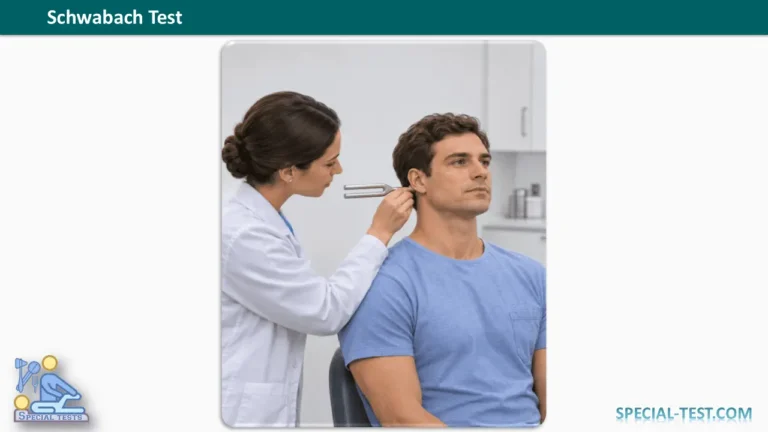
The Schwabach test is a traditional clinical hearing assessment used to help differentiate between conductive hearing loss and sensorineural hearing loss. It evaluates bone conduction by comparing how long a patient can hear a vibrating tuning fork with the duration perceived by an examiner who has normal hearing.
This simple, noninvasive bedside test provides preliminary information about auditory function without requiring sophisticated equipment. Although modern audiometry is more accurate, the Schwabach tuning fork test remains an important concept in clinical examination and medical education.
What Is the Schwabach Test?
The Schwabach test is a comparative bone conduction hearing test in which a vibrating tuning fork is placed against the mastoid process, the bony prominence located behind the ear.
The examination compares the duration of sound perception between the patient and an individual with normal hearing, usually the examiner.
The test is based on the principle of bone conduction, in which sound vibrations travel through the skull and stimulate the cochlea of the inner ear.
Unlike air conduction, which transmits sound through the external auditory canal, tympanic membrane, and middle ear ossicles, bone conduction allows sound to reach the inner ear through skull vibrations.
This distinction helps clinicians identify whether hearing impairment is primarily associated with the sound-conducting structures of the outer and middle ear or the sensorineural components of the auditory system.
Purpose and Clinical Uses of the Schwabach Test
The primary purpose of the Schwabach test is to provide a preliminary assessment of bone conduction hearing and help distinguish different types of hearing loss.
Its clinical applications include:
- Detecting conductive hearing loss: Prolonged bone conduction compared with the examiner may suggest a problem involving the external or middle ear.
- Identifying sensorineural hearing loss: Reduced bone conduction duration may indicate dysfunction of the cochlea or auditory nerve.
- Assessing auditory function: The test provides basic information about the patient’s perception of bone-conducted sound.
- Supporting other hearing tests: The findings may complement the Rinne and Weber tests during a bedside hearing examination.
The Schwabach test is a screening procedure rather than a definitive diagnostic investigation. Abnormal findings should be evaluated using formal audiometry.
How to Perform the Schwabach Test
The Schwabach test procedure is straightforward and requires a tuning fork and an examiner with normal hearing.
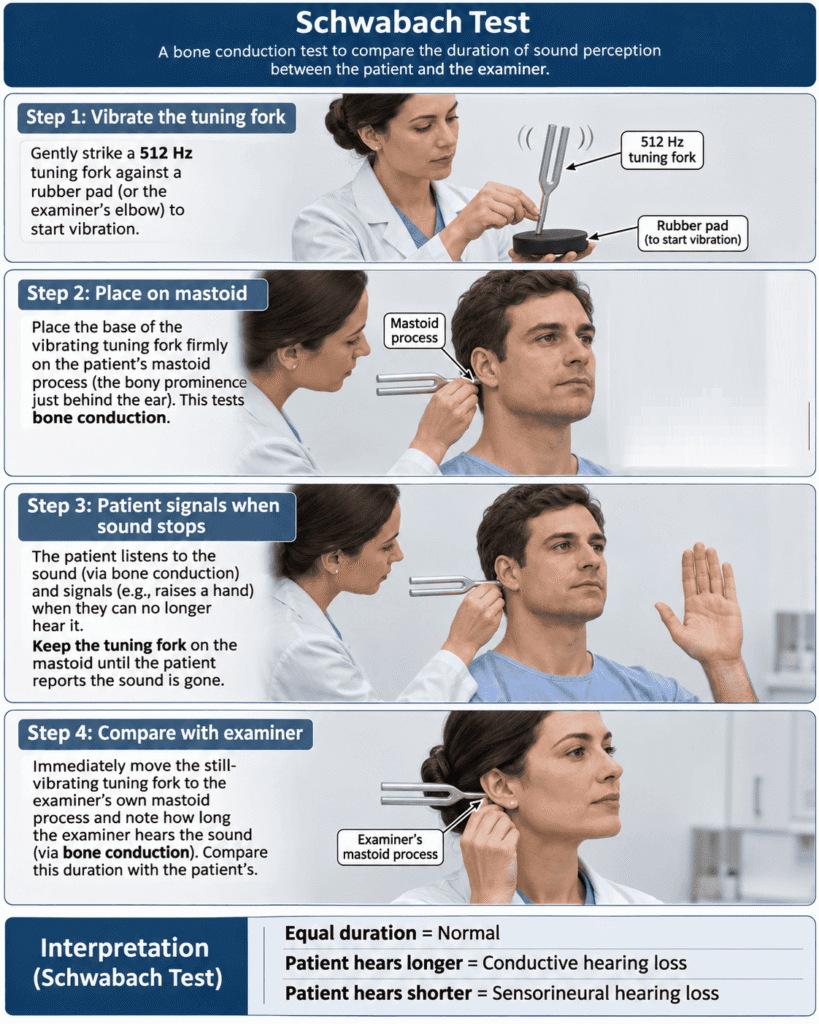
A 512 Hz tuning fork is commonly preferred for bedside hearing assessments because it provides an appropriate balance between audible sound duration and reduced tactile vibration.
Step-by-Step Procedure
- Prepare the patient: Explain the examination and position the patient comfortably in a quiet environment. Ensure that background noise is minimized.
- Activate the tuning fork: Strike the tuning fork gently against a suitable resilient surface to produce a clear vibrating tone.
- Place the tuning fork on the mastoid process: Apply the base of the vibrating tuning fork firmly against the patient’s mastoid process, immediately behind the ear.
- Assess bone conduction duration: Ask the patient to indicate the moment when the sound is no longer audible.
- Compare with the examiner: Immediately transfer the still-vibrating tuning fork to the examiner’s mastoid process to determine whether the examiner can continue hearing the sound.
- Repeat the examination: Repeat the comparison as necessary, including reversing the order of testing, to assess whether the patient perceives the bone-conducted sound for a longer or shorter duration than the examiner.
- Interpret the result: Classify the finding as normal, prolonged, or shortened Schwabach according to the relative duration of sound perception.
The examiner should have normal hearing for the comparison to be meaningful. If the examiner has hearing impairment, the reliability of the findings is reduced.
Schwabach Test Interpretation
The Schwabach test results are traditionally classified into three categories according to the duration of bone conduction.
| Schwabach test result | Bone conduction duration | Clinical interpretation |
|---|---|---|
| Normal Schwabach | Approximately equal to the examiner | Consistent with normal bone conduction |
| Prolonged Schwabach | Longer than the examiner | Suggests conductive hearing loss |
| Shortened Schwabach | Shorter than the examiner | Suggests sensorineural hearing loss |
1. Normal Schwabach Test
A normal Schwabach test occurs when the patient and examiner perceive the tuning fork sound for approximately the same duration.
This indicates that the patient’s bone conduction hearing is comparable to that of the normal-hearing examiner.
However, a normal result does not completely exclude mild hearing impairment or mixed hearing loss.
2. Prolonged Schwabach Test
A prolonged Schwabach test occurs when the patient continues hearing the tuning fork for longer than the examiner.
This finding is classically associated with conductive hearing loss.
Conductive hearing loss develops when sound transmission through the external or middle ear becomes impaired. Bone-conducted sound may be perceived for longer because of changes in sound transmission and the occlusion effect.
Possible causes of conductive hearing loss include:
- Impacted earwax (cerumen).
- Otitis media with middle ear effusion.
- Tympanic membrane perforation.
- Otosclerosis.
- Abnormalities involving the middle ear ossicles.
A prolonged Schwabach result suggests a conductive component but cannot independently determine the underlying cause.
3. Shortened Schwabach Test
A shortened Schwabach test occurs when the patient stops hearing the vibrating tuning fork before the examiner.
This result suggests sensorineural hearing loss, which involves dysfunction of the cochlea, auditory nerve, or associated auditory pathways.
Common causes of sensorineural hearing loss include:
- Age-related hearing loss (presbycusis).
- Noise-induced hearing loss.
- Ototoxic medication exposure.
- Inner ear disorders.
- Auditory nerve abnormalities.
Because sensorineural impairment reduces the ability to perceive bone-conducted sound, the patient may hear the tuning fork for a shorter period than an individual with normal hearing.

Schwabach Test vs. Rinne Test vs. Weber Test
The Schwabach, Rinne, and Weber tests are traditional tuning fork examinations used in the preliminary assessment of hearing loss.
| Hearing test | Main principle | Clinical purpose |
|---|---|---|
| Schwabach test | Compares the patient’s bone conduction duration with a normal-hearing examiner | Suggests conductive or sensorineural impairment |
| Rinne test | Compares air conduction with bone conduction in the same ear | Identifies a conductive component |
| Weber test | Evaluates lateralization of bone-conducted sound | Helps assess asymmetrical hearing loss |
The Rinne test normally demonstrates better air conduction than bone conduction. In conductive hearing loss, bone conduction may be perceived as longer or louder than air conduction.
The Weber test involves placing a vibrating tuning fork on the midline of the head. In unilateral conductive hearing loss, sound generally lateralizes toward the affected ear, whereas in unilateral sensorineural hearing loss, it generally lateralizes toward the better-hearing ear.
Combining these examinations provides more useful clinical information than relying on a single tuning fork test.
Advantages and Limitations
The Schwabach test offers several practical advantages. It is inexpensive, quick, noninvasive, and requires minimal equipment. It can be performed during a routine bedside examination, particularly when formal audiological equipment is unavailable.
However, the test has important limitations.
Its accuracy depends on the examiner having normal hearing and on both individuals providing reliable responses. Background noise, inconsistent tuning fork activation, differences in mastoid contact, and subjective perception may influence the findings.
Furthermore, the Schwabach test cannot accurately quantify hearing thresholds or reliably diagnose mixed hearing loss.
Modern pure-tone audiometry provides more precise measurements of air and bone conduction thresholds and remains essential for confirming the type and severity of hearing impairment.
Research examining tuning fork tests has demonstrated variability in diagnostic accuracy, reinforcing the importance of interpreting bedside findings alongside the clinical history, otoscopic examination, and audiometric investigations.
Frequently Asked Questions (FAQ)
What is a Schwabach test?
The Schwabach test is a bedside hearing examination that compares the duration of bone-conducted sound perception between a patient and an examiner with normal hearing. It helps screen for conductive and sensorineural hearing loss.
What does a positive Schwabach test mean?
The terms prolonged and shortened Schwabach are more informative than simply describing the test as positive or negative. A prolonged result suggests conductive hearing loss, while a shortened result suggests sensorineural hearing loss.
Why is the Schwabach test prolonged in conductive hearing loss?
In conductive hearing loss, reduced transmission of external sound and altered bone-conduction mechanisms can make the vibrating tuning fork audible for longer than in a normal-hearing examiner. This is commonly described as prolonged bone conduction.
Why is the Schwabach test shortened in sensorineural hearing loss?
Sensorineural hearing loss affects the structures responsible for detecting or transmitting auditory signals. Consequently, the patient may perceive bone-conducted vibrations for a shorter duration than someone with normal hearing.
Which tuning fork is used for the Schwabach test?
A 512 Hz tuning fork is a common practical choice for bedside auditory assessment. Other frequencies have historically been used, but the same tuning fork and consistent technique should be used for the comparison.
What is the difference between the Schwabach and Rinne tests?
The Schwabach test compares bone conduction between the patient and a normal-hearing examiner. The Rinne test compares air conduction and bone conduction within the patient’s own ear.
Is the Schwabach test still used today?
The Schwabach test is mainly of historical and educational importance, although its underlying principle remains relevant to bedside hearing assessment. Modern clinical practice relies more heavily on the Rinne and Weber tests and formal audiometry.
Can the Schwabach test confirm hearing loss?
No. The Schwabach test provides a preliminary indication of possible hearing impairment but cannot confirm its diagnosis, cause, or severity. Formal audiometry and appropriate clinical evaluation are necessary for accurate diagnosis.
Conclusion
The Schwabach test is a traditional tuning fork examination used to compare bone conduction hearing between a patient and a normal-hearing examiner.
The interpretation is based on three characteristic findings: normal Schwabach indicates approximately equal bone conduction duration, prolonged Schwabach suggests conductive hearing loss, and shortened Schwabach suggests sensorineural hearing loss.
Although the test is simple and useful for understanding the principles of auditory examination, its diagnostic limitations should be recognized. It is best interpreted alongside the Rinne and Weber tests, otoscopic findings, and formal audiometric assessment.
References
- Orthofixar. Schwabach Test: Procedure, Interpretation, and Clinical Significance for Hearing Loss. Orthofixar.com.
- Brandt J, Winters R. Bone Conduction Evaluation. StatPearls. NCBI Bookshelf. NCBI.
- Kelly EA, Li B, Adams ME. Diagnostic Accuracy of Tuning Fork Tests for Hearing Loss: A Systematic Review. Otolaryngology–Head and Neck Surgery. 2018;159(2):220–230. PubMed PMID: 29661046.
- Miltenburg DM. The Validity of Tuning Fork Tests in Diagnosing Hearing Loss. Journal of Otolaryngology. 1994;23(4):254–259. PubMed PMID: 7996624.
- Huizing EH. The Early Descriptions of the So-Called Tuning-Fork Tests of Weber, Rinne, Schwabach, and Bing. III. The Development of the Schwabach and Bing Tests. ORL. 1975;37(2):92–96. PubMed PMID: 1093082.
- Rinne Test. StatPearls. NCBI Bookshelf. NCBI.
- Weber Test. StatPearls. NCBI Bookshelf. NCBI.