Head Thrust Test: Procedure, Positive Findings, Interpretation & Clinical Significance
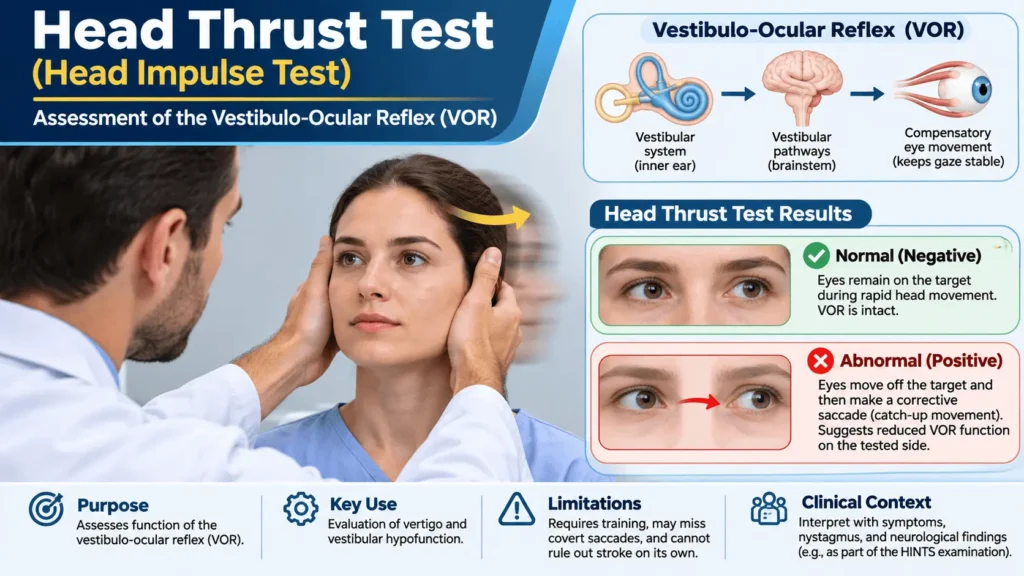
The Head Thrust Test, also known as the Head Impulse Test (HIT) or Halmagyi–Curthoys Test, is a clinical examination used to assess the integrity of the vestibulo-ocular reflex (VOR). This reflex maintains visual stability during rapid head movements and is essential for normal balance and gaze control.
The Head Thrust Test is commonly performed during the evaluation of dizziness, vertigo, vestibular hypofunction, and balance disorders. It is particularly useful for identifying impaired function of the peripheral vestibular system, although its findings must always be interpreted in the appropriate clinical context.
This article explains the Head Thrust Test procedure, normal and abnormal findings, clinical significance, diagnostic accuracy, and limitations, supported by evidence from published medical literature.
What Is the Head Thrust Test?
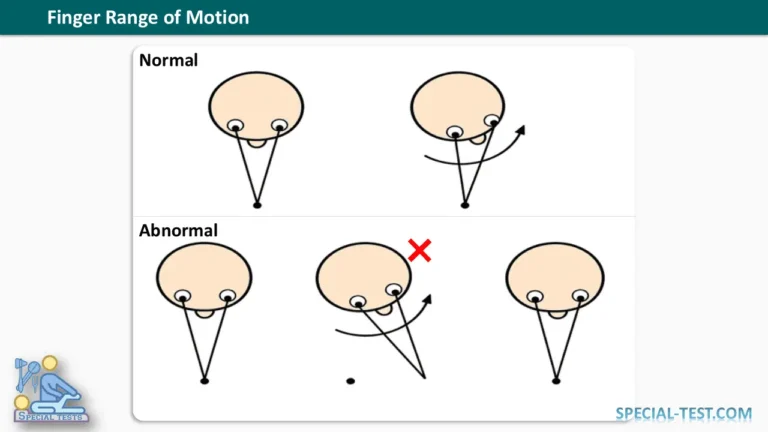
The Head Thrust Test is a bedside vestibular examination designed to evaluate the vestibulo-ocular reflex during rapid, passive head rotations.
When the head moves in one direction, the vestibular system normally produces an equal and opposite eye movement. This compensatory response allows the eyes to remain focused on a stationary object.
In patients with vestibular dysfunction, the eyes may temporarily lose fixation during head rotation. The patient subsequently makes a rapid corrective eye movement, called a refixation or catch-up saccade, to regain visual fixation.
A reproducible corrective saccade suggests impaired vestibulo-ocular reflex function in the direction of the head impulse.
The test is primarily used to assess horizontal semicircular canal function and associated vestibular pathways.
Physiology of the Vestibulo-Ocular Reflex
The vestibulo-ocular reflex is generated through interactions between the inner ear, vestibular nerves, brainstem, and extraocular muscles.
The semicircular canals detect angular acceleration of the head. Vestibular signals travel through the vestibular nerve to central vestibular pathways, which coordinate eye movements in the opposite direction.
For example:
- When the head rotates to the right, the eyes move toward the left.
- When the head rotates to the left, the eyes move toward the right.
- When vestibular function is impaired, compensatory eye movement may be inadequate, resulting in corrective saccades.
Vestibulo-ocular reflex gain represents the relationship between compensatory eye velocity and head velocity. A normal compensatory response generally produces a gain close to 1, although measured normal values depend on the testing method.
Reduced gain can indicate impaired vestibular function and may be measured objectively using video head impulse testing (vHIT).
How to Perform the Head Thrust Test
The Head Thrust Test should be performed by a healthcare professional trained in vestibular examination.
Patient Position
- Position the patient comfortably in a seated position.
- Stand or sit directly in front of the patient.
- Ask the patient to focus continuously on a stationary target, usually the examiner’s nose.
- Explain the procedure and encourage the patient to relax the neck muscles.
- Gently support the patient’s head while ensuring that cervical movements are safe.
Head Thrust Test Procedure
- Position the patient’s head in a neutral or slightly rotated position.
- Ask the patient to maintain visual fixation on the examiner’s nose throughout the examination.
- Apply a small-amplitude, rapid, passive, and unpredictable head rotation toward one side.
- Keep the movement controlled, generally within a small range of approximately 10–20 degrees.
- Observe the patient’s eyes during and immediately after the head movement.
- Return the head gently to the starting position.
- Repeat the examination toward the opposite side.
- Compare the responses to identify asymmetry in vestibulo-ocular reflex function.
The examiner should focus on the presence or absence of corrective saccades rather than provoking dizziness.
Safety precautions: The Head Thrust Test should not be performed when cervical instability, acute neck injury, significant cervical pain, or another condition makes rapid neck movement unsafe. Avoid excessive rotation, forceful thrusts, and cervical manipulation.
Head Thrust Test Results and Interpretation
Negative Head Thrust Test (Normal Response)
A negative Head Thrust Test indicates that the patient maintains fixation on the stationary target during rapid head movement.
Normal findings include:
- Eyes remain directed toward the fixation target.
- Compensatory eye movements occur opposite to head rotation.
- No visible corrective saccades are observed.
- Gaze remains relatively stable during the examination.
A normal bedside response suggests preserved vestibulo-ocular reflex function under the testing conditions. However, subtle abnormalities may remain undetected.
Positive Head Thrust Test (Abnormal Response)
A positive Head Thrust Test occurs when the eyes fail to maintain fixation and a corrective saccade is observed.
Abnormal findings include:
- Temporary loss of visual fixation during head movement.
- A rapid corrective eye movement toward the original target.
- Reproducible abnormalities during impulses toward one side.
- Possible asymmetry between right-sided and left-sided responses.
For example, corrective saccades consistently observed after rightward head impulses may suggest right-sided vestibular hypofunction.
However, a positive result is not specific to one disorder and does not independently confirm vestibular neuritis or exclude central nervous system disease.
Overt and Covert Corrective Saccades
Two types of corrective saccades may occur during Head Thrust Testing.
Overt saccades occur after completion of the head movement. They may be visible to an experienced examiner during bedside testing.
Covert saccades occur during the head movement itself. These rapid corrective eye movements are difficult or impossible to identify reliably through ordinary visual observation.
Patients with vestibular dysfunction may develop covert corrective saccades as an adaptive mechanism for maintaining gaze stability.
Because bedside examination may miss these responses, video head impulse testing can provide additional objective information.
Head Thrust Test vs. Video Head Impulse Test (vHIT)
Although both techniques evaluate vestibulo-ocular reflex function, they differ in their measurement methods.
| Feature | Bedside Head Thrust Test | Video Head Impulse Test |
|---|---|---|
| Equipment | No specialized equipment | High-speed video goggles and motion sensors |
| Main observation | Visible corrective saccades | Eye velocity, head velocity, VOR gain, and saccades |
| Covert saccades | Commonly missed | Can be detected |
| Results | Primarily qualitative | Objective quantitative measurements |
| Clinical setting | Bedside examination | Specialized vestibular assessment |
Video head impulse testing can identify abnormalities that may not be apparent during conventional bedside examination. However, artifacts, technical factors, and interpretation errors may influence results.
Clinical Significance of the Head Thrust Test
The Head Thrust Test is useful in evaluating patients with suspected vestibular disorders, particularly conditions associated with reduced vestibulo-ocular reflex function.
These include:
- Vestibular neuritis: May produce an abnormal head impulse toward the affected side.
- Unilateral vestibular hypofunction: May result in asymmetric corrective saccades.
- Bilateral vestibular hypofunction: May cause abnormal responses during impulses in both directions.
- Acute vestibular syndrome: May require assessment of head impulse responses alongside nystagmus, ocular alignment, hearing, and neurological findings.
The test is not the primary diagnostic maneuver for benign paroxysmal positional vertigo (BPPV). The Dix-Hallpike test is generally used when posterior canal BPPV is suspected.
Head Thrust Test and the HINTS Examination
The Head Thrust Test forms one component of the HINTS examination, a specialized bedside assessment used to distinguish certain peripheral vestibular disorders from central causes of acute vestibular syndrome, including posterior circulation stroke.
HINTS consists of three components:
- Head Impulse: Evaluates vestibulo-ocular reflex function.
- Nystagmus: Assesses the pattern and direction of spontaneous eye movements.
- Test of Skew: Evaluates vertical ocular misalignment.
In appropriately selected patients with continuous acute vestibular symptoms and nystagmus, a normal head impulse response may raise concern for a central cause.
Importantly, some strokes can produce abnormal head impulse findings. Therefore, an abnormal Head Thrust Test does not reliably exclude stroke.
The GRACE-3 clinical practice guideline recommends HINTS assessment only when performed by clinicians with appropriate training and in the correct patient population.
Sudden severe gait instability, double vision, weakness, slurred speech, new neurological abnormalities, or acute hearing loss accompanying vertigo require urgent medical assessment.
Diagnostic Accuracy and Limitations
The diagnostic accuracy of the Head Thrust Test varies according to examiner experience, testing technique, severity of vestibular impairment, and the patient population.
Research indicates that bedside head impulse testing may be less sensitive for mild vestibular dysfunction than for severe vestibular loss.
Important limitations include:
- Difficulty identifying covert corrective saccades.
- Reduced reliability when patients anticipate head movements.
- Incorrect interpretation caused by poor examination technique.
- Limited usefulness when cervical movement is restricted.
- Possible abnormalities associated with central vestibular lesions.
- Inability to exclude stroke when used as an isolated diagnostic test.
A systematic review supporting the GRACE-3 guideline found that the complete HINTS examination can achieve high diagnostic sensitivity for central causes of acute vestibular syndrome when performed by trained clinicians.
These findings should not be interpreted as evidence that the Head Thrust Test alone has equivalent diagnostic accuracy.
Frequently Asked Questions (FAQ)
1. What does a positive Head Thrust Test mean?
A positive Head Thrust Test indicates that the patient makes a corrective eye movement after failing to maintain visual fixation during a rapid head rotation. This may suggest impaired vestibulo-ocular reflex function, commonly associated with vestibular hypofunction.
2. What is the difference between the Head Thrust Test and Head Impulse Test?
The terms are commonly used interchangeably in clinical practice. Both describe rapid, passive head rotations used to evaluate the vestibulo-ocular reflex. Minor procedural distinctions may appear in educational descriptions.
3. What is a normal Head Thrust Test result?
A normal result occurs when the patient maintains visual fixation during rapid head movement without visible corrective saccades. This suggests an adequate vestibulo-ocular reflex response during bedside testing.
4. Can the Head Thrust Test diagnose vestibular neuritis?
The Head Thrust Test can support the diagnosis of vestibular neuritis when interpreted alongside compatible symptoms and other examination findings. It cannot establish the diagnosis independently.
5. Can a normal Head Thrust Test rule out vestibular dysfunction?
No. Mild vestibular impairment and covert corrective saccades may not be identified during bedside examination. Additional vestibular testing may be required.
6. Can a positive Head Thrust Test rule out stroke?
No. Certain central vestibular lesions, including some posterior circulation strokes, can produce abnormal head impulse findings. Stroke assessment requires consideration of the complete clinical presentation.
7. Is the Head Thrust Test safe?
The test is generally well tolerated when performed correctly by a trained clinician in an appropriately selected patient. It should be avoided when rapid cervical rotation is unsafe, and patients should not attempt to reproduce the maneuver themselves.
Conclusion
The Head Thrust Test is an important bedside examination for assessing vestibulo-ocular reflex function and identifying possible unilateral or bilateral vestibular hypofunction.
A normal response involves maintaining gaze fixation during rapid head movement, while an abnormal response is characterized by corrective saccades.
Although the test provides valuable clinical information, its diagnostic accuracy depends on proper technique, examiner experience, and patient selection. The findings should be considered together with other vestibular and neurological examination results.
When additional objective assessment is required, video head impulse testing may help identify reduced vestibulo-ocular reflex gain and covert corrective saccades.
Most importantly, the Head Thrust Test should never be used independently to exclude a central neurological cause of acute vertigo.
References
- Orthofixar. Head Thrust Test for Vestibular Assessment.
https://orthofixar.com/special-test/head-thrust-test/ - Edlow JA, et al. Guidelines for Reasonable and Appropriate Care in the Emergency Department 3 (GRACE-3): Acute Dizziness and Vertigo in the Emergency Department. Academic Emergency Medicine. 2023;30(5):442–486.
https://pubmed.ncbi.nlm.nih.gov/37166022/ - Diagnostic Accuracy of the Physical Examination in Emergency Department Patients With Acute Vertigo or Dizziness: A Systematic Review and Meta-analysis for GRACE-3. Academic Emergency Medicine.
https://pubmed.ncbi.nlm.nih.gov/36453134/ - A Review of the Geometrical Basis and the Principles Underlying the Use and Interpretation of the Video Head Impulse Test (vHIT) in Clinical Vestibular Testing. Frontiers in Neurology. 2023.
https://pmc.ncbi.nlm.nih.gov/articles/PMC10126377/ - Efficient Use of Vestibular Testing. NCBI PubMed Central.
https://pmc.ncbi.nlm.nih.gov/articles/PMC8453116/ - Orthofixar. Head Impulse Test: Procedure, Sensitivity and Specificity for Vestibular Diagnosis.
https://orthofixar.com/special-test/head-impulse-test/