Brudzinski–Kernig Test: How to Perform, Interpret and Their Accuracy
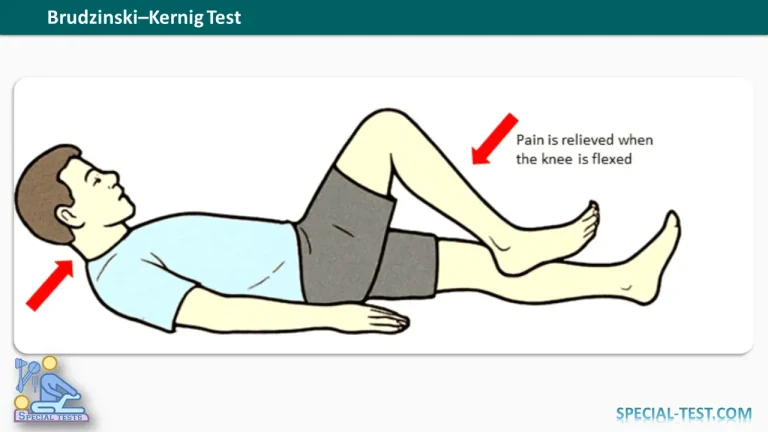
The Brudzinski–Kernig test refers to two classic bedside maneuvers for detecting meningeal irritation. Clinicians often perform them in the same examination, together with a check for neck stiffness (nuchal rigidity). They remain a core part of neurological and emergency assessment, and they are also useful to orthopedic and spine clinicians, because meningeal irritation can mimic radicular or low back pain.
What Is the Brudzinski–Kernig Test Used For?
The test screens for meningeal irritation, which can occur in:
- Bacterial, viral, or tuberculous meningitis
- Subarachnoid hemorrhage
- Meningeal carcinomatosis (cancer spreading to the meninges)
Kernig’s sign was described in 1882, and Brudzinski described several signs in the early 1900s. Brudzinski’s best-known maneuver is the neck sign.
How to Perform Kernig’s Sign
- Position the patient supine.
- Flex one hip to 90° with the knee also flexed.
- Slowly extend the knee while keeping the hip flexed.
- Look for resistance, hamstring spasm, or pain that stops full extension.
The sign is positive when pain or resistance prevents extension, and relaxes when the knee is bent again. The maneuver is described as hip flexion to 90 degrees followed by passive knee extension.
How to Perform Brudzinski’s Neck Sign
- Keep the patient supine.
- Place one hand behind the head and gently flex the neck toward the chest.
- Watch the hips and knees.
The sign is positive when neck flexion triggers involuntary flexion of the hips and knees. This reflex flexion of the hips during forced neck flexion is the most widely used Brudzinski sign.
The Active Variant
Some teaching sources describe an active version. The patient flexes the neck or raises the extended leg until pain appears, and the pain eases when the knee bends. It mirrors the mechanics of the Straight Leg Raise (SLR) test, but the patient performs it instead of the examiner. Because it overlaps with the SLR, interpret it with care: lumbar disc herniation and sciatic nerve root irritation can produce similar leg pain.
Interpreting the Results
- Positive: Pain or reflex flexion during neck flexion or leg elevation that eases with knee flexion suggests meningeal or dural irritation.
- Negative: This does not rule out meningitis.
How Accurate Are These Signs?
The evidence is humbling. In a prospective study of 297 adults with suspected meningitis, Kernig’s and Brudzinski’s signs each had a sensitivity of only 5%, and neither discriminated reliably between patients with and without meningitis. A later emergency department study found specificity of about 97% for Kernig and 98% for Brudzinski, but sensitivity of only 2% for each. A Tabriz study of 120 patients concluded that the accuracy of all these signs ranges from poor to fair, with Kernig and Brudzinski showing the highest specificity.
Clinically, this means:
- A positive sign raises suspicion and should prompt urgent evaluation.
- A negative sign never provides reassurance on its own.
- Brudzinski’s sign and nuchal rigidity are also unreliable in infants under 6 months and in elderly patients.
Red Flags That Need Urgent Care
Fever, severe headache, neck stiffness, photophobia, confusion, vomiting, or a rash require emergency assessment, whatever the result of Kernig’s or Brudzinski’s test. Diagnosis depends on clinical judgment, imaging when indicated, and cerebrospinal fluid analysis.
For related examination techniques, see our guides on [Straight Leg Raise test – insert orthofixar.com link] and [lumbar radiculopathy examination – insert orthofixar.com link].
Frequently Asked Questions (FAQ)
What is the difference between Kernig’s sign and Brudzinski’s sign?
Kernig’s sign tests resistance to passive knee extension with the hip flexed. Brudzinski’s neck sign tests whether passive neck flexion causes reflex hip and knee flexion.
Does a negative Kernig or Brudzinski test rule out meningitis?
No. Sensitivity is very low in published studies, so meningitis can be present with negative signs.
Is a positive test diagnostic of meningitis?
No. Specificity is high, so a positive result raises concern, but confirmation requires further workup, including lumbar puncture when appropriate.
Can these tests be confused with the Straight Leg Raise test?
Yes. The leg-raising mechanics overlap, so lumbar radiculopathy can mimic a positive Kernig’s sign. Neck flexion findings and systemic symptoms help distinguish them.
Are the tests reliable in children and older adults?
Less so. They are unreliable in infants younger than 6 months and in elderly patients, so clinicians should lean on the overall clinical picture.
What conditions besides meningitis cause a positive result?
Subarachnoid hemorrhage and meningeal carcinomatosis can, as can other causes of meningeal irritation.
Should I seek medical care if I suspect meningitis?
Yes, immediately. This article is educational and does not replace professional medical advice.
References
- Thomas KE, Hasbun R, Jekel J, Quagliarello VJ. The diagnostic accuracy of Kernig’s sign, Brudzinski’s sign, and nuchal rigidity in adults with suspected meningitis. Clin Infect Dis. 2002;35(1):46–52. PubMed PMID: 12060874.
- Nakao JH, et al. Jolt accentuation of headache and other clinical signs: poor predictors of meningitis in adults. PubMed PMID: 24139448.
- Accuracy of neck stiffness, Kernig, Brudzinski, and jolt accentuation of headache signs in early detection of meningitis. PubMed Central: PMC5827054.
- Appraisal of Kernig’s and Brudzinski’s sign in meningitis. PubMed Central: PMC3548367.