Brudzinski Sign: Technique, Interpretation, and Accuracy in Meningitis
What Is the Brudzinski Sign?
The Brudzinski sign is a classic bedside neurological test for meningeal irritation. It is named after the Polish pediatrician Józef Brudziński, who described it in the early 20th century. Clinicians still use it as part of the neurological examination whenever meningitis or another disorder of the meninges is suspected.
What Is the Brudzinski Sign Used For?
The test helps identify meningeal irritation, which can occur in several conditions:
- Meningitis, whether bacterial, viral, or fungal
- Subarachnoid hemorrhage, where blood in the subarachnoid space irritates the meninges
- Meningeal carcinomatosis, in which cancer cells infiltrate the meninges
Because these conditions can be life-threatening, recognizing meningeal signs early can speed up urgent investigations such as imaging and lumbar puncture.
How to Perform the Brudzinski Sign Test
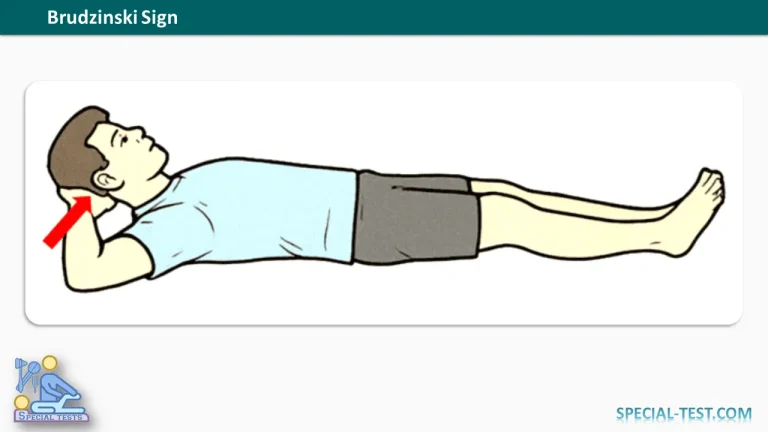
- Position the patient supine (lying flat on their back) on the examination bed.
- Place the patient’s hands cupped behind the head. The examiner can also support the occiput.
- Ask the patient to flex the head actively onto the chest, or gently flex the neck for them if they cannot do it themselves.
- Watch the lower limbs and spine during the movement. Perform the maneuver slowly and gently. In patients with suspected cervical spine injury, do not flex the neck.
Interpreting the Result
Positive Brudzinski sign: neck flexion causes involuntary flexion of the hips and knees, or elicits pain along the spine or posterior thigh.
Negative Brudzinski sign: the hips and knees stay relaxed and no spinal or thigh pain is provoked.
Why Does the Sign Occur?
Flexing the neck stretches the spinal cord, nerve roots, and the meninges that surround them. When these structures are inflamed, the stretch is painful. The body responds with a protective reflex: the hips and knees flex, which reduces tension on the irritated meninges and spinal roots. The same mechanism explains why patients with meningitis often resist neck movement (nuchal rigidity).
How Reliable Is the Brudzinski Sign?
Clinicians should know the limits of this test. A prospective study published in Clinical Infectious Diseases (Thomas et al., 2002) evaluated Kernig’s sign, Brudzinski’s sign, and nuchal rigidity in adults with suspected meningitis. It found that the sensitivity of Brudzinski’s sign was low, about 5%, while its specificity was high, about 95%. The practical meaning is:
- A positive sign raises suspicion and supports further testing.
- A negative sign does not rule out meningitis. Never use it alone to exclude the diagnosis.
Other studies, including work in Clinical Neurology and Neurosurgery and a review in Clinical Microbiology Reviews on acute bacterial meningitis, support the same conclusion. Meningeal signs are useful but unreliable on their own. Fever, headache, altered mental status, neck stiffness, rash, and photophobia should be assessed together, and the diagnosis relies on clinical judgment plus cerebrospinal fluid analysis and imaging when indicated.
Brudzinski Sign vs. Kernig Sign
Both tests look for meningeal irritation. In the Brudzinski sign, neck flexion triggers hip and knee flexion. In the Kernig sign, the hip is flexed to 90° and the examiner tries to extend the knee, which causes pain or resistance. Clinicians often perform both, along with checking for nuchal rigidity, for a more complete assessment.
Clinical Takeaway
The Brudzinski sign is quick, free, and easy to perform, and a positive result is a meaningful warning sign for meningeal irritation. However, its low sensitivity means that any patient with suspected meningitis or subarachnoid hemorrhage needs urgent evaluation whether or not the sign is present.
Frequently Asked Questions (FAQ)
What is a positive Brudzinski sign?
It is a positive result when passive or active neck flexion causes involuntary flexion of the hips and knees, or provokes pain along the spine or posterior thigh.
What does a positive Brudzinski sign indicate?
It indicates meningeal irritation. Possible causes include meningitis, subarachnoid hemorrhage, and meningeal carcinomatosis.
How do you perform the Brudzinski test?
The patient lies supine with hands cupped behind the head. The patient (or the examiner) flexes the head toward the chest while the examiner watches for hip and knee flexion or pain.
Is the Brudzinski sign sensitive for meningitis?
No. Studies show low sensitivity (around 5%) but high specificity (around 95%). A negative result cannot exclude meningitis.
What is the difference between Brudzinski and Kernig signs?
Brudzinski’s sign is triggered by neck flexion, while Kernig’s sign is tested by extending the knee with the hip flexed at 90°. Both reflect meningeal irritation.
Why do the hips and knees flex in a positive Brudzinski sign?
Neck flexion stretches inflamed meninges and spinal roots. The reflex flexion of the lower limbs reduces this tension and pain.
Can the Brudzinski sign be performed on anyone?
Avoid it, or use extreme caution, if a cervical spine injury is suspected. Always follow trauma precautions in those cases.
Should I go to the emergency department if I have meningitis symptoms?
Yes. Fever, severe headache, stiff neck, confusion, vomiting, or a rash need urgent medical care, regardless of any bedside sign.
References
- Thomas KE, et al. The diagnostic accuracy of Kernig’s sign, Brudzinski’s sign, and nuchal rigidity in adults with suspected meningitis. Clin Infect Dis. 2002.
- Waghdhare S, et al. Accuracy of physical signs for detecting meningitis: a hospital-based diagnostic accuracy study. Clin Neurol Neurosurg. 2010.
- Brouwer MC, Tunkel AR, van de Beek D. Epidemiology, diagnosis, and antimicrobial treatment of acute bacterial meningitis. Clin Microbiol Rev. 2010.
- Orthofixar.com: link internally to your related neurological examination and spine pages.