Hoffmann’s Sign: Technique, Interpretation & Accuracy
What Is Hoffmann’s Sign Used For?
Hoffmann’s sign is a quick neurological reflex test. Clinicians use it to look for upper motor neuron (UMN) involvement, meaning dysfunction of the corticospinal pathways that normally keep reflexes in check. It is a common part of the neck and spine examination, especially when degenerative cervical myelopathy (DCM) is suspected. DCM is described as the most common cause of age-related spinal cord dysfunction worldwide (PubMed 37405273).
How to Perform Hoffmann’s Sign Step by Step
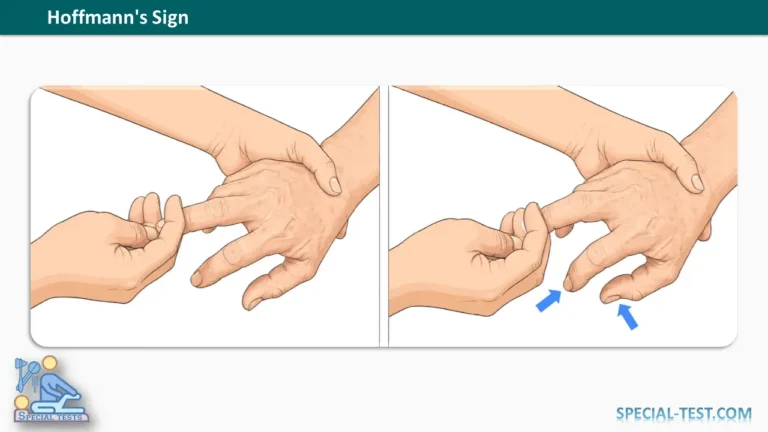
- Position the hand. The patient’s hand should be relaxed, with the wrist slightly extended (dorsiflexed) and the fingers partly flexed.
- Stabilize the finger. Hold the patient’s middle finger between your index and middle fingers, supporting the proximal interphalangeal joint.
- Flick the nail. With your thumb, give a quick, firm flick across the nail of the middle finger.
- Watch the response. Look at the thumb and index finger of the same hand for a reflex movement.
Test both hands and compare them. Keep the patient relaxed, because tension or a poorly supported finger can distort the result.
Interpreting the Result
Positive result: Flexion and adduction of the thumb, often with flexion of the index finger. This pattern reflects hyperreflexia from disrupted UMN control, and it points to a lesion in the corticospinal pathway at or above the cervical cord level.
Negative result: The thumb and index finger stay still.
A positive sign on both sides, especially with symptoms, carries more weight than a single-sided finding.
What a Positive Hoffmann’s Sign Can Mean
Common causes of a positive sign include:
- Degenerative cervical myelopathy: cord compression in the neck from disc disease, spondylosis, or arthritis
- Multiple sclerosis
- Other brain or spinal cord conditions, as well as generalized hyperreflexia
How Accurate Is Hoffmann’s Sign?
Published evidence shows the sign is useful but imperfect, so it should never be read in isolation.
- A 2026 systematic review and meta-analysis found a pooled sensitivity of about 58% and a pooled specificity of about 69% for cervical myelopathy, with high heterogeneity between studies. The authors concluded it should not be used as a standalone diagnostic test (DOI 10.4103/njsoma.njsoma_6_26).
- A Japanese cross-sectional study of cervical cord compression found Hoffmann’s sign was 46% sensitive and 98% specific, with good agreement between examiners. Combining several signs (Hoffmann, Trömner, Wartenberg, finger escape) raised sensitivity to 83% (CORE record).
- A prospective study of 52 patients reported low sensitivity and specificity. It concluded the sign is an unreliable marker for cord compression, and that a negative sign may be more informative (PubMed 37405273).
Studies differ in their populations, examiner experience, and how a positive result is defined, which explains much of the spread.
False Positives and Next Steps
The sign can be positive in people with no cord compression, for example those with naturally brisk reflexes. A small study of asymptomatic people with a positive sign (Sung and Wang, 2001) looked at whether they needed further workup. Because of this, a positive result means “investigate,” not “diagnose.”
If the sign is positive, especially with hand clumsiness, gait imbalance, or neck pain, the usual next step is a full neurological exam and cervical spine MRI. Related reading on Orthofixar.com: [insert internal link, e.g., cervical myelopathy].
Frequently Asked Questions
What does a positive Hoffmann’s sign indicate?
It suggests an upper motor neuron problem, such as cervical cord compression, multiple sclerosis, or other central nervous system disease. It needs correlation with symptoms and imaging.
Is Hoffmann’s sign always abnormal?
No. Some people with brisk reflexes and no neurological disease can show it, which is why it cannot confirm a diagnosis alone.
Can Hoffmann’s sign be negative in cervical myelopathy?
Yes. Pooled sensitivity is only moderate, so a negative test does not rule out myelopathy.
Is Hoffmann’s sign the same as the Babinski sign?
No. Both indicate UMN dysfunction, but Babinski is tested on the foot and Hoffmann on the hand.
Is Hoffmann’s sign the same as the Hoffmann-Tinel sign?
No. The Hoffmann-Tinel sign is a nerve-tapping test for peripheral nerve compression or regeneration, such as in carpal tunnel syndrome.
Do I need an MRI if my Hoffmann’s sign is positive?
Often yes, particularly if you have symptoms. MRI is the standard way to confirm cervical cord compression.
Can it be done at home?
Self-testing is unreliable. Technique and interpretation matter, so see a clinician if you have concerning symptoms.