Barré Test (Pronator Drift): How to Perform, Interpret and Understand Its Accuracy
What Is the Barré Test?
The Barré test is a bedside neurological and cervical spine examination maneuver named after the French neurologist Jean-Alexandre Barré. It is also called the Barré sign, the upper limb drift test, or the pronator drift test. It is quick, needs no equipment, and can be repeated at the bedside or in the clinic.
Traditionally, the test has been used to check for reduced blood flow to the brain stem. In current neurological practice, it is best known as a screening sign for subtle arm weakness caused by corticospinal tract (upper motor neuron) dysfunction.[1,2]
How to Perform the Barré Test
- Ask the patient to stand.
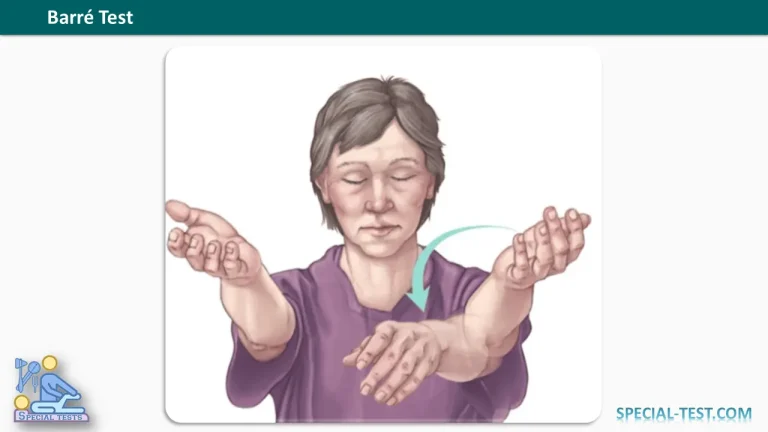
- Have the patient flex both shoulders forward to 90° with the elbows fully extended.
- Position the forearms in supination, with the palms facing up.
- Ask the patient to close their eyes and hold this position for 10 to 20 seconds.
- Watch both arms for slow downward movement or rotation.
Closing the eyes removes visual feedback, so subtle weakness or position-sense problems show up more easily. Record the result in detail, for example “left arm drifts downward with pronation at 8 seconds”, rather than writing only “positive”.
Interpreting the Result
Positive test: one arm slowly falls while the forearm pronates (the palm turns toward the floor).
Negative test: both arms hold the starting position steadily for the full period.
Why does the arm pronate?
In upper motor neuron weakness, the supinators weaken more than the pronators. The affected arm therefore turns inward and drifts down. Pronator drift points to abnormal function of the corticospinal tract on the opposite side of the brain.[2]
The brain stem blood flow explanation
Many cervical spine references describe a positive Barré test as a possible sign of reduced blood flow to the brain stem, that is, vertebrobasilar insufficiency. The evidence for this is limited. Positional tests for vertebrobasilar insufficiency have shown low sensitivity (0–57%) in a systematic review of four studies of questionable quality, with specificity ranging from 67% to 100%.[3] Later PubMed-indexed reviews argue that these positional tests do not reliably measure arterial blood flow or predict the risk of cervical arterial dissection.[4,5] A positive Barré test with new neurological symptoms should therefore prompt a full neurological assessment and urgent imaging if indicated, not a presumed vascular diagnosis.
How Accurate Is the Barré Test?
In a study of 170 patients with and without CT-confirmed lesions of the motor areas of the brain, the Barré and pronator drift tests together had a sensitivity of 92.2% and a specificity of 90.0%. The best screening combination was pronator drift plus finger tapping and reflex testing. An abnormality in any of the three had a sensitivity of 97%, and when all three were positive, specificity was 97%.[1]
A related finding is “drift without pronation”: a downward drift without forearm rotation. In one prospective study, it distinguished functional from organic arm weakness with 100% sensitivity and 93% specificity.[6]
Clinical Uses
- Screening for mild or subtle arm weakness when manual muscle testing appears normal
- Detecting corticospinal tract involvement in stroke, tumour, or other cerebral lesions
- Complementing other upper motor neuron signs such as hyperreflexia and an abnormal Babinski response
- Helping distinguish functional from organic arm weakness (see above)
- Forming part of a cervical spine examination alongside other dizziness and vertebral artery assessments (see our related tests on orthofixar.com)
Limitations
- It is a sign, not a diagnosis. Findings must be combined with history, reflexes, tone, strength, and imaging.
- The patient must be able to understand instructions and keep their eyes closed and arms raised.
- Shoulder pain, limited shoulder range of motion, or fatigue can mimic or mask a drift.
- It should not be used alone to rule out vertebrobasilar or cervical artery pathology.
Frequently Asked Questions (FAQ)
What is the Barré test used for?
It is used to detect subtle upper limb weakness, mainly from upper motor neuron (corticospinal tract) dysfunction. It has also been described in cervical spine examination as a test for brain stem blood flow.
How long should the patient hold the position?
Usually 10 to 20 seconds, with the eyes closed.
What is a positive Barré test?
One arm slowly falls with simultaneous forearm pronation.
Is the Barré test the same as the pronator drift test?
Yes. Barré sign, pronator drift, and upper limb drift test are used for the same maneuver.
Does a positive Barré test mean a stroke?
Not by itself. It indicates possible corticospinal tract dysfunction and needs further neurological evaluation. New sudden weakness requires emergency assessment.
How accurate is the test?
In one CT-confirmed study, Barré and pronator testing together reached 92.2% sensitivity and 90.0% specificity.[1] Accuracy is higher when combined with finger tapping and reflex testing.
Can the Barré test diagnose vertebrobasilar insufficiency?
Current evidence does not support that use. Positional tests for vertebrobasilar insufficiency have low sensitivity and should not be used alone to judge arterial safety.[3–5]
Research Limitations
The main accuracy data come from a single-centre study of patients with CT-confirmed cerebral lesions, and its findings may not apply to every population. Evidence linking the Barré test specifically to brain stem blood flow is limited, so results should always be interpreted alongside the full clinical picture.
References
- Tests of motor function in patients suspected of having mild unilateral cerebral lesions. Can J Neurol Sci. (170 patients; Barré and pronator sensitivity 92.2%, specificity 90.0%.)
- Pronator drift (pyramidal drift) as a sign of corticospinal tract dysfunction; see also: Rotator drift: a sign of upper motor neuron leg weakness. Clin Neurol Neurosurg. 2020. PMID: 32683196.
- Diagnostic accuracy of premanipulative vertebrobasilar insufficiency tests: a systematic review. Man Ther. 2013;18(3):177–182.
- Should we abandon positional testing for vertebrobasilar insufficiency? Musculoskelet Sci Pract. PMID: 31767531.
- Evidence in practice: diagnostic accuracy of the vertebral artery test and teaching of the test. Phys Ther. 2005;85(6):589–599. PMID: 15921479.
- Validity of the “Drift without pronation” sign in conversion disorder. BMC Neurol. PMC3617996.