Chair Test for Lateral Epicondylitis (Tennis Elbow)
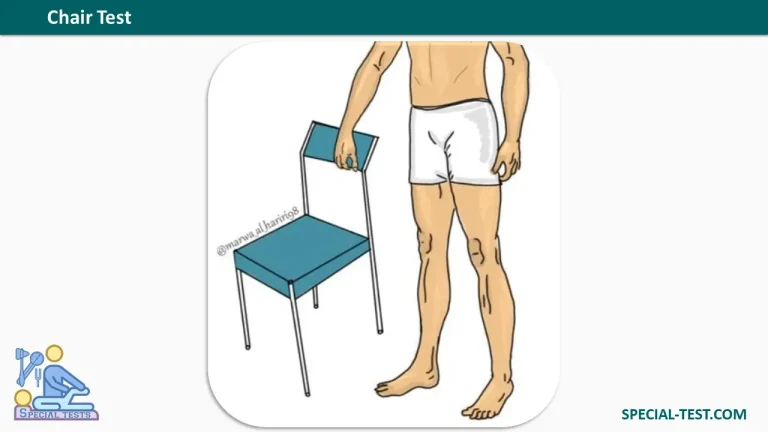
The Chair Test (also known as the Chair Lift Test or Tennis Elbow Chair Test) is a provocative physical examination test used to assess for lateral epicondylitis (commonly known as Tennis Elbow). It specifically stresses the extensor carpi radialis brevis (ECRB) and common extensor muscle origin at the lateral epicondyle of the humerus.
How to Perform the Chair Test
- Patient Position: The patient stands or sits upright next to a lightweight, back-backed chair.
- Arm Position: Instruct the patient to extend the elbow fully with the forearm completely pronated (palms facing downward/toward the chair back).
- Action: Ask the patient to lift the chair off the floor using three fingers (thumb, index, and middle finger) or a pinch grip on the top or backrest of the chair.
Positive Chair Test Interpretation
- Positive Finding: Sudden onset of pain localized over the lateral epicondyle or radiating into the proximal wrist extensor mass in the forearm during the lifting motion.
- Clinical Significance: Indicates lateral epicondylitis, where repetitive mechanical strain causes tendinopathy at the common extensor origin.
Differential Diagnosis & Clinical Correlations
When evaluating lateral elbow pain, clinicians often combine the Chair Test with other physical exam maneuvers:
- Cozen’s Test: Resisted wrist extension with the elbow extended and forearm pronated.
- Mill’s Test: Passive wrist flexion with forearm prononation and elbow extension.
- Maudsley’s Test: Resisted extension of the middle finger (3rd digit).
Reference
- Dutton, M. Dutton’s Orthopaedic Examination, Evaluation, and Intervention. 3rd ed. McGraw-Hill Education; 2012.