Cozen’s Test for Tennis Elbow (Lateral Epicondylalgia): How to Perform It and Interpret Results
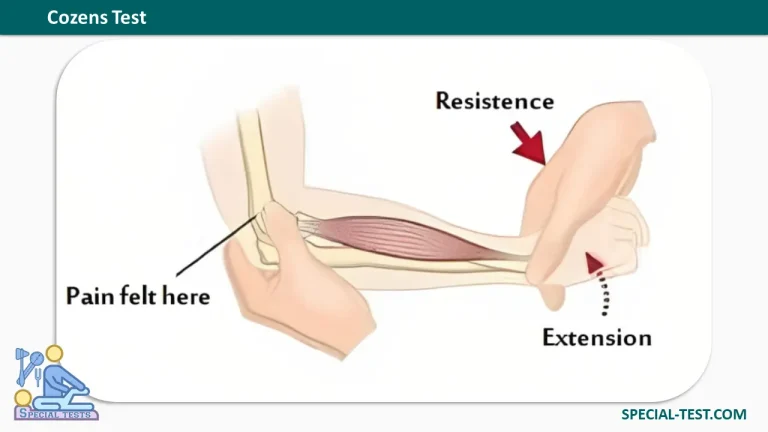
What Is Cozen’s Test?
Cozen’s test, also called the resisted wrist extension test or resisted tennis elbow test, is a clinical maneuver that checks for lateral epicondylalgia, also known as lateral epicondylitis or “tennis elbow.” It is one of the most widely used orthopedic special tests for lateral elbow pain. A systematic review overview found it was among the most frequently reported diagnostic tests for lateral elbow pain.
Lateral epicondylalgia describes pain from tendinopathic changes in the extensor carpi radialis brevis (ECRB) muscle. These changes usually come from repetitive loading, typically from manual work or racket sports such as tennis. Despite the name, the condition also affects office workers, tradespeople, musicians, and anyone who grips or lifts repetitively.
Why Clinicians Use Cozen’s Test
The test is quick, needs no equipment, and can be done in any clinic or sports setting. It reproduces the patient’s familiar lateral elbow pain through resisted wrist extension. The diagnosis of lateral elbow tendinopathy rests on an accurate medical history and specific tests that provoke the patient’s symptoms. Cozen’s test is therefore one part of a wider assessment, not a stand-alone diagnosis.
How to Perform Cozen’s Test: Step by Step
- Position the patient. The patient sits with the elbow extended, the forearm fully pronated, and the wrist radially deviated. Testing in extension matters because with the elbow flexed, the extensor carpi radialis longus is shortened, so repeating the test in full extension helps isolate the ECRB.
- Make a fist. The patient closes the hand into a fist.
- Stabilize and palpate. Support the elbow with one hand while palpating the lateral epicondyle. Place your other hand over the back of the patient’s hand and wrist.
- Apply resistance. Ask the patient to extend the wrist upward (dorsiflexion) while you resist the movement.
- Compare sides. Repeat on the unaffected arm. Comparing both sides is good practice.
What Is a Positive Result?
The test is positive if it reproduces the patient’s pain at the lateral epicondyle. A positive result is the return of the patient’s familiar, sudden pain at the lateral elbow. Weakness during the movement may also be noted, but pain over the lateral epicondyle is the key finding.
How Accurate Is Cozen’s Test?
Research on the test’s accuracy is still limited. A recent paper in PubMed Central notes that Cozen’s, Mill’s, and Maudsley’s are the most widely accepted tests, and that a systematic review found Cozen’s test had the highest sensitivity at 91%, followed by Mill’s at 76% and Maudsley’s at 70%, while specificity is generally low. A high sensitivity means a negative result makes tennis elbow less likely. The low specificity means a positive result should not be treated as proof. nih
The evidence base is also thin. One overview reported that only one small primary study had looked at the diagnostic accuracy of the Cozen and Maudsley tests. A separate study found good reliability for Cozen’s test across physical activity levels.
Tips for Clinical Use
- Combine Cozen’s test with palpation of the lateral epicondyle, grip strength testing, and the patient’s history.
- Pair it with Mill’s or Maudsley’s test when the picture is unclear.
- Consider imaging or referral if symptoms are atypical, severe, or do not improve with conservative care.
- Treat a positive result as a strong screening signal rather than a stand-alone diagnosis.
Frequently Asked Questions
Is Cozen’s test the same as the resisted wrist extension test?
Yes, the names are used interchangeably.
Does a negative test rule out tennis elbow?
Not entirely, but because the test is highly sensitive, a negative result argues against the diagnosis.
Can I perform Cozen’s test on myself?
It is best done by a trained clinician, since correct stabilization and resistance matter.
Final Thoughts
Cozen’s test remains a simple, practical way to screen for lateral epicondylalgia. Used alongside history, palpation, and other provocation tests, it helps clinicians decide on rehabilitation and follow-up. Anyone with persistent lateral elbow pain should see a qualified healthcare professional.
References
- Clinical Tests for the Musculoskeletal System, 3rd Edition.
- Dutton’s Orthopaedic Examination, Evaluation, and Intervention, 3rd Edition.
- Treatment, Diagnostic Criteria and Variability of Terminology for Lateral Elbow Pain: Findings from an Overview of Systematic Reviews. Healthcare 2022 (PubMed-indexed).
- “The Selfie Test”: A Novel Test for the Diagnosis of Lateral Epicondylitis (PubMed Central), which cites the Karanasios et al. 2021 systematic review in the Journal of Hand Therapy.