Tabletop Relocation Test for Elbow Instability: Purpose, Procedure, and Results
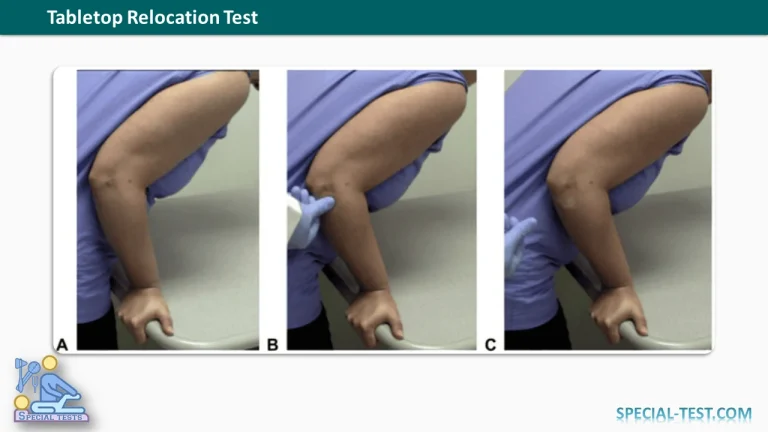
What is the Tabletop Relocation Test?
The Tabletop Relocation Test is a specialized orthopedic physical examination maneuver used to assess posterolateral rotary instability (PLRI) of the elbow. This clinical test helps clinicians identify ligamentous laxity and joint instability by replicating and subsequently relieving a patient’s symptoms under controlled conditions.
How to Perform the Tabletop Relocation Test
The test is performed in a standing position using a stable surface such as a table:
- Initial Setup: The patient stands facing a table, placing the symptomatic arm over the lateral edge with the elbow fully extended and the forearm in supination.
- Initial Movement: The patient performs a modified push-up (lowering or “down” phase) while keeping the elbow pointed laterally and maintaining forearm supination as the elbow flexes.
- Symptom Provocation: If the patient suffers from posterolateral rotary instability, pain and apprehension typically manifest near $40^\circ$ of elbow flexion.
- The Relocation Maneuver: The movement is repeated. This time, the examiner places a firm thumb directly over the radial head, applying a stabilizing force. If the pain and apprehension disappear during the “down” phase, and return immediately once the examiner lifts their thumb, the test is clinically significant.
What Constitutes a Positive Result?
A positive Tabletop Relocation Test points directly to posterolateral rotary instability of the elbow. Clinical implications include:
- Lateral Ulnar Collateral Ligament (LUCL) Insufficiency: The primary stabilizer against posterolateral rotation is compromised.
- Capsular Laxity: Potential associated laxity within the joint capsule.
- Lateral Epicondyle Pathology: Possible secondary or related structural stress.
- Recurrent Subluxation Risk: Heightened susceptibility to recurrent elbow subluxation episodes during functional movements.