Mill’s Test for Tennis Elbow: Purpose, Procedure & Accuracy
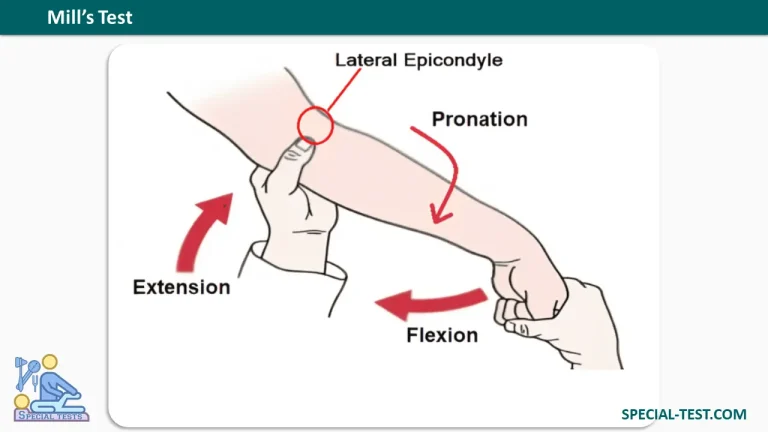
If you are experiencing outer elbow pain, your physical therapist or doctor may perform Mill’s test during an examination. This orthopedic physical therapy test is a standard diagnostic tool used to help identify Lateral Epicondylitis, commonly known as Tennis Elbow.
Here is everything you need to know about how Mill’s test works, how it is performed, and what the results mean.
What is Mill’s Test?
Mill’s test is a clinical orthopedic maneuver designed to stress the extensor carpi radialis brevis and other forearm extensor muscles. It is specifically used to assess for Lateral Epicondylitis (Tennis Elbow), a painful condition caused by overuse of the forearm muscles that attach to the outside of the elbow.
How to Perform Mill’s Test
Clinicians follow a specific sequence of movements to isolate and stress the targeted tendon:
- Patient Position: The patient sits comfortably in a chair facing the clinician.
- Palpation: The clinician places one hand over the patient’s lateral epicondyle (the bony bump on the outer side of the elbow).
- Arm Positioning: The clinician passively moves the patient’s arm through the following steps:
- Fully extends the elbow.
- Pronates the forearm (turns the palm downward).
- Fully flexes the wrist (bends the hand downward toward the palm).
What is a Positive Mill’s Test Result?
A test is considered positive if the patient experiences a familiar reproduction of pain or discomfort directly over the lateral epicondyle and the tendon insertion site. This pain indicates irritation or tendinopathy of the wrist extensors.
Test Accuracy & Diagnostic Value
Understanding the statistical accuracy of clinical tests helps medical professionals interpret results more effectively:
- Sensitivity (53%): A moderate sensitivity means that while a positive result is a strong indicator, a negative result does not completely rule out tennis elbow.
- Specificity (100%): A high specificity means that if the test is positive, it is extremely reliable in confirming the presence of lateral epicondylitis (very few false positives).