Maudsley’s Test for Tennis Elbow (Lateral Epicondylitis)
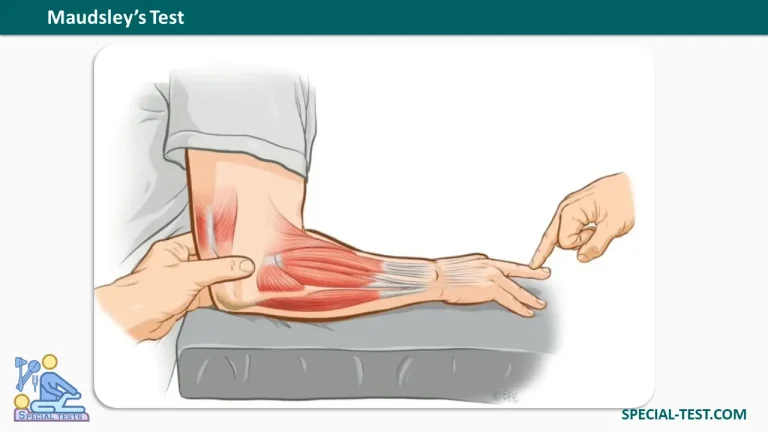
Maudsley’s Test (also known as the Middle Finger Extension Test) is an orthopedic examination used to evaluate patients presenting with lateral elbow pain.
What is Maudsley’s Test Used For?
Maudsley’s Test helps identify Lateral Epicondylitis (commonly referred to as Tennis Elbow). It specifically stresses and isolates the extensor digitorum communis muscle and its tendon attachment at the lateral epicondyle of the humerus.
How to Perform Maudsley’s Test
- Positioning: The patient sits comfortably with the affected forearm pronated and resting on a flat surface.
- Palpation: The examiner places a finger directly over the patient’s lateral epicondyle to feel for localized tenderness.
- Resisted Extension: The examiner applies downward resistance against the distal phalanx of the patient’s 3rd digit (middle finger) while instructing the patient to actively extend it.
Test Results
- Positive Result: Reproduction of sharp or localized pain over the lateral epicondyle of the humerus during resisted extension.
- Negative Result: Absence of pain at the lateral epicondyle.
Diagnostic Accuracy
| Metric | Accuracy Rate | Clinical Significance |
| Sensitivity | 88% | High sensitivity makes it a reliable screening tool to help rule out lateral epicondylitis when negative. |
| Specificity | 0% | Low isolated specificity means false positives can occur (e.g., in cases of Radial Tunnel Syndrome or posterior interosseous nerve entrapment). |
Note: Due to low isolated specificity, Maudsley’s Test should always be combined with other clinical evaluations such as Cozen’s Test, Mill’s Test, and direct palpation for a comprehensive diagnosis.
References
- Research Gate
- Image taken from YouTube video
- Maudsley Test | Orthofixar