Star Excursion Balance Test (SEBT): Procedure & Scoring
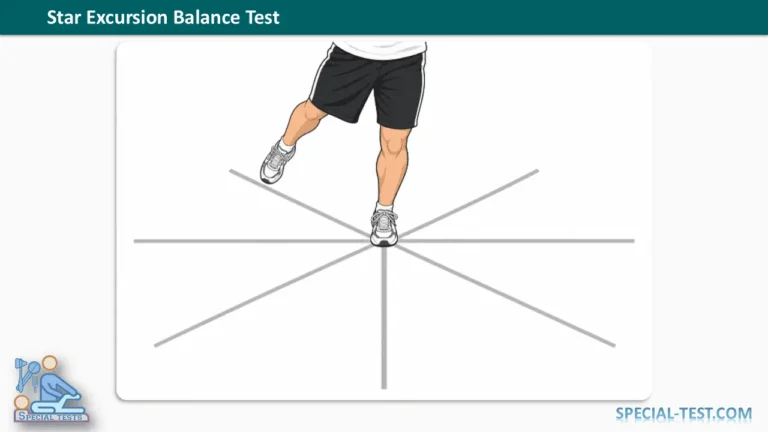
The Star Excursion Balance Test (SEBT) is a widely used clinical assessment designed to evaluate dynamic balance, postural stability, proprioception, and neuromuscular control of the lower extremities. It is commonly performed in sports medicine, orthopedic rehabilitation, and physical therapy to identify functional limitations, assess lower limb stability, and monitor recovery following musculoskeletal injuries.
The test requires an individual to maintain a single-leg stance while reaching as far as possible with the opposite leg in multiple directions. By challenging balance and movement control, the SEBT provides valuable information about lower extremity function during demanding physical activities.
Research supports the SEBT as a reliable clinical tool for detecting dynamic postural control deficits and monitoring functional improvements during rehabilitation.
What Is the Star Excursion Balance Test Used For?
The Star Excursion Balance Test assesses an individual’s ability to maintain postural control while performing dynamic reaching movements on one leg.
Successful performance requires coordinated activity of the ankle, knee, hip, and trunk muscles, together with adequate joint mobility and proprioceptive feedback.
The primary clinical applications of the SEBT include:
- Dynamic balance assessment: Evaluating single-leg stability during multidirectional movements.
- Ankle instability evaluation: Identifying functional balance deficits associated with chronic ankle instability and previous ankle sprains.
- Lower extremity injury rehabilitation: Monitoring recovery following ankle, knee, and other lower limb injuries.
- Neuromuscular control assessment: Examining the ability to maintain stability during challenging functional tasks.
- Sports injury risk assessment: Identifying movement deficits that may be associated with an increased risk of lower extremity injuries in certain athletic populations.
- Return-to-sport evaluation: Providing an objective measure of dynamic postural control as part of a comprehensive rehabilitation assessment.
The SEBT is especially useful because it requires minimal equipment and can be performed in most clinical or sports rehabilitation settings.
Eight Directions of the Star Excursion Balance Test
The traditional SEBT consists of eight reaching directions, arranged in a star-shaped pattern with 45-degree angles between adjacent directions.
These directions are:
- Anterior (ANT): Directly forward.
- Anteromedial (AM): Forward and toward the body’s midline.
- Medial (M): Directly toward the midline.
- Posteromedial (PM): Backward and toward the midline.
- Posterior (P): Directly backward.
- Posterolateral (PL): Backward and away from the midline.
- Lateral (L): Directly away from the midline.
- Anterolateral (AL): Forward and away from the midline.
All directions are defined relative to the stance leg.
Although the original SEBT evaluates eight directions, research has demonstrated considerable redundancy among certain reaching tasks. Consequently, a modified version frequently uses only three directions: anterior, posteromedial, and posterolateral.
These three directions provide an efficient assessment of dynamic postural control and are commonly used in clinical research and rehabilitation.
How to Perform the Star Excursion Balance Test
Equipment Required
The SEBT requires:
- Four strips of adhesive tape, approximately 6–8 feet long.
- A measuring tape or ruler marked in centimeters.
- A flat, firm, non-slip testing surface.
- A recording sheet for documenting reach distances.
Patient Position and Test Preparation
The examiner places four strips of tape on the floor so that they intersect at a central point, creating eight lines separated by 45-degree angles.
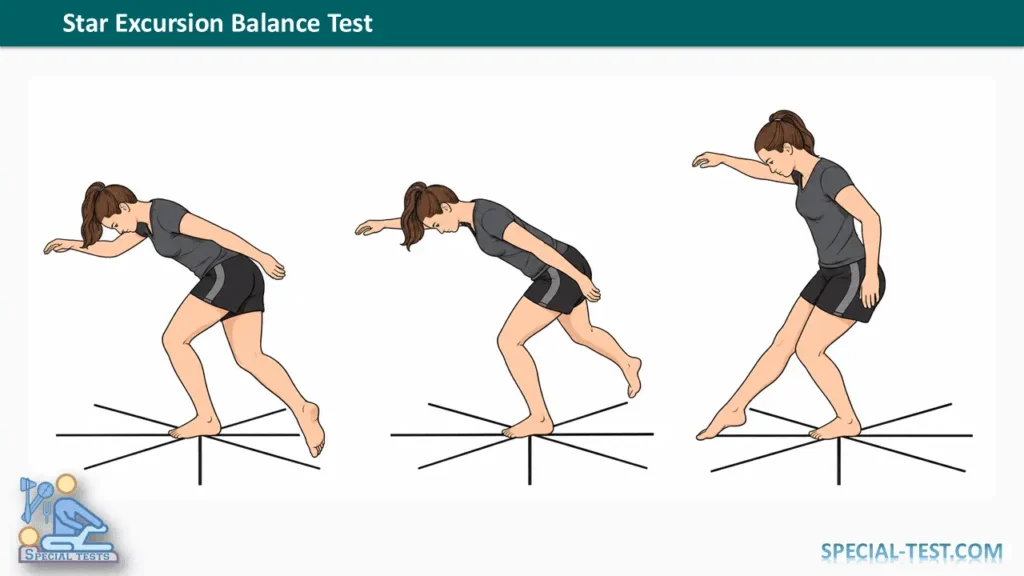
The patient stands at the center of the star on one leg while maintaining balance. The opposite leg remains free to perform the reaching movements.
Footwear, stance-foot position, and testing instructions should be standardized to ensure consistent results.
Step-by-Step SEBT Procedure
Step 1: Position the patient
Ask the patient to stand on one leg at the center of the star-shaped grid. The supporting foot should remain positioned according to the selected testing protocol.
Step 2: Explain the movement
Instruct the patient to extend the non-weight-bearing leg as far as possible along the designated direction while maintaining balance on the stance leg.
Step 3: Perform the reaching movement
The patient reaches toward the maximum achievable distance without transferring body weight onto the reaching foot.
Depending on the standardized protocol, the reaching foot may lightly touch the surface or remain just above it.
Step 4: Return to the starting position
After reaching the maximum distance, the patient returns the reaching leg to the starting position while maintaining balance.
Step 5: Record the reaching distance
The examiner measures the maximum successful reach distance in centimeters from the center of the grid to the farthest point reached.
Step 6: Repeat for all directions
The same procedure is performed for the remaining directions, using a consistent testing sequence.
Step 7: Test the opposite leg
The examination is repeated with the other leg as the stance limb. The examiner then compares the results between both lower extremities.
Research protocols commonly include approximately four to six practice trials to minimize learning effects, followed by three recorded trials in each direction.
When Is a Trial Considered Invalid?
A trial is generally considered unsuccessful when the patient:
- Loses balance during the reaching movement.
- Moves the stance foot from its designated position.
- Transfers substantial weight onto the reaching foot.
- Cannot return to the starting position in a controlled manner.
- Violates other movement restrictions specified by the selected protocol.
Invalid trials should be repeated to obtain accurate measurements.
Star Excursion Balance Test Scoring and Interpretation
The SEBT score is based on the maximum reaching distance achieved in each direction.
Greater reaching distances generally indicate better dynamic postural control, provided the movement is performed correctly.
However, absolute reaching distances are influenced by factors such as leg length, joint mobility, muscular strength, and testing technique.
Therefore, normalization to leg length is recommended when comparing results between individuals or between limbs.
Normalized Reach Distance
The normalized reach distance is calculated using the following formula:
Normalized Reach Distance (%) = (Reach Distance ÷ Leg Length) × 100
Leg length is commonly measured from the anterior superior iliac spine (ASIS) to the medial malleolus.
For the three-direction modified SEBT, a composite score can be calculated:
Composite Score (%) = [(Anterior Reach + Posteromedial Reach + Posterolateral Reach) ÷ (3 × Leg Length)] × 100
The composite score represents overall reaching performance relative to the individual’s leg length.
Clinical Interpretation
Clinicians should evaluate:
- Differences in reaching distance between the right and left legs.
- Reduced performance in specific directions.
- Changes in scores during rehabilitation.
- Movement quality, including knee alignment, trunk control, and balance strategies.
- Consistency between repeated testing sessions.
An important prospective study involving high school basketball players found that an anterior reach asymmetry greater than 4 cm was associated with an increased risk of lower extremity injury.
However, this finding should not be considered a universal diagnostic cutoff for all athletes or patient populations.
SEBT results must be interpreted alongside the patient’s clinical history, physical examination, symptoms, and other functional assessments.
Star Excursion Balance Test and Concussion Assessment
Dynamic balance testing may contribute to the broader assessment of individuals recovering from sports-related concussion.
Historically, reduced bilateral reaching performance has been suggested as a possible finding following concussion, while unilateral deficits may raise concern about a localized lower extremity injury.
However, this distinction is not sufficiently reliable to diagnose or differentiate these conditions.
A prospective study of athletes recovering from sports-related concussion found no significant differences between concussed and control participants in anterior SEBT reach distance at the evaluated time points.
Therefore, the SEBT should not be used as a standalone diagnostic test for concussion, and bilateral or unilateral reach deficits cannot independently establish the underlying cause.
Concussion assessment requires a comprehensive clinical examination using appropriate neurological, vestibular, cognitive, and balance assessments.
Modified Star Excursion Balance Test vs. Y-Balance Test
The Modified Star Excursion Balance Test (mSEBT) and the Y-Balance Test (YBT) are closely related functional balance assessments.
Both evaluate dynamic postural control using three principal reaching directions:
- Anterior.
- Posteromedial.
- Posterolateral.
The modified SEBT typically uses floor markings and a measuring tape, while the Y-Balance Test commonly uses a standardized apparatus with movable reach indicators.
The Y-Balance Test was developed to improve standardization and address certain limitations of traditional SEBT procedures.
Although these assessments evaluate similar aspects of lower extremity function, their results are not necessarily interchangeable because equipment and procedural differences may influence reaching distances.
Reliability and Clinical Significance
Scientific investigations have demonstrated good to excellent reliability for the Star Excursion Balance Test when standardized procedures are followed.
A systematic review published in 2019 reported strong evidence supporting the intra-rater and inter-rater reliability of the SEBT and Y-Balance Test in healthy adults.
Factors influencing test reliability include:
- Adequate practice before formal testing.
- Consistent foot positioning.
- Standardized instructions.
- Accurate measurement of reach distances.
- Consistent footwear and testing conditions.
- Proper examiner training.
The SEBT is a valuable outcome measure for monitoring lower extremity rehabilitation, particularly when clinicians compare repeated assessments using the same protocol.
Nevertheless, the test should be considered one component of a comprehensive functional evaluation rather than an independent measure of injury risk or readiness to return to sport.
Frequently Asked Questions (FAQ)
1. What does the Star Excursion Balance Test measure?
The Star Excursion Balance Test measures dynamic postural control during single-leg stance. It challenges balance, proprioception, lower extremity strength, coordination, and joint mobility while the opposite leg reaches in multiple directions.
2. What are the eight directions of the SEBT?
The eight directions are anterior, anteromedial, medial, posteromedial, posterior, posterolateral, lateral, and anterolateral. Each direction is separated by a 45-degree angle.
3. What are the three most commonly used SEBT directions?
The anterior, posteromedial, and posterolateral directions are commonly used in the modified Star Excursion Balance Test. This shortened assessment provides useful information about dynamic postural control while reducing testing time.
4. What is considered a normal SEBT score?
There is no single universally accepted normal score for every population. Results depend on age, sex, sport, leg length, testing procedure, and physical condition. Clinicians commonly evaluate normalized scores, side-to-side differences, and changes over time.
5. Can the SEBT predict sports injuries?
Research has identified associations between certain SEBT reach deficits and subsequent lower extremity injuries in specific athletic populations. However, injury risk is multifactorial, and the SEBT alone cannot reliably predict whether an individual will sustain an injury.
6. What is the difference between SEBT and Y-Balance Test?
The traditional SEBT assesses reaching performance in eight directions, whereas the Y-Balance Test evaluates three directions using specialized equipment. The modified SEBT also uses three directions but generally relies on floor markings rather than a dedicated testing apparatus.
7. Is the Star Excursion Balance Test reliable?
Yes. Research supports good to excellent reliability when examiners use standardized instructions, provide adequate practice, and measure reaching distances consistently. Reliability may vary according to patient population and testing protocol.
8. Can the SEBT be used after an ankle sprain?
Yes. The test is frequently used during rehabilitation following ankle sprains and in individuals with chronic ankle instability. It helps clinicians evaluate dynamic balance deficits and monitor improvements in functional performance.
Conclusion
The Star Excursion Balance Test (SEBT) is a practical, inexpensive, and evidence-supported assessment of dynamic balance and lower extremity neuromuscular control.
By measuring maximal reaching distances during single-leg stance, clinicians can identify functional asymmetries, evaluate postural stability, and monitor rehabilitation progress.
The traditional eight-direction test provides a comprehensive assessment, while the modified three-direction version offers an efficient alternative.
For meaningful results, clinicians should use standardized testing procedures, normalize reach distances to leg length, and interpret findings in conjunction with other clinical assessments.
References
- Gribble PA, Hertel J, Plisky P. (2012). Using the Star Excursion Balance Test to Assess Dynamic Postural-Control Deficits and Outcomes in Lower Extremity Injury: A Literature and Systematic Review. Journal of Athletic Training, 47(3), 339–357.
PubMed – PMID: 22892416 - Orthofixar. Star Excursion Balance Test: How to Perform, Scores & Clinical Use.
Orthofixar – Star Excursion Balance Test - Plisky PJ, Rauh MJ, Kaminski TW, Underwood FB. (2006). Star Excursion Balance Test as a Predictor of Lower Extremity Injury in High School Basketball Players. Journal of Orthopaedic & Sports Physical Therapy, 36(12), 911–919.
PubMed – PMID: 17193868 - Interrater Reliability of the Star Excursion Balance Test. (2013). Journal of Athletic Training.
PubMed – PMID: 24067151 - The Reliability of the Star Excursion Balance Test and Lower Quarter Y-Balance Test in Healthy Adults: A Systematic Review. (2019).
PubMed – PMID: 31598406 - Using Functional Movement Tests to Investigate the Presence of Sensorimotor Impairment in Amateur Athletes Following Sport-Related Concussion: A Prospective, Longitudinal Study. (2020).
PubMed – PMID: 33242699 - Reproducibility of the Modified Star Excursion Balance Test Composite and Specific Reach Direction Scores. (2016).
NCBI – PubMed Central