Chvostek Sign: What is it? How to Perform & Test Results
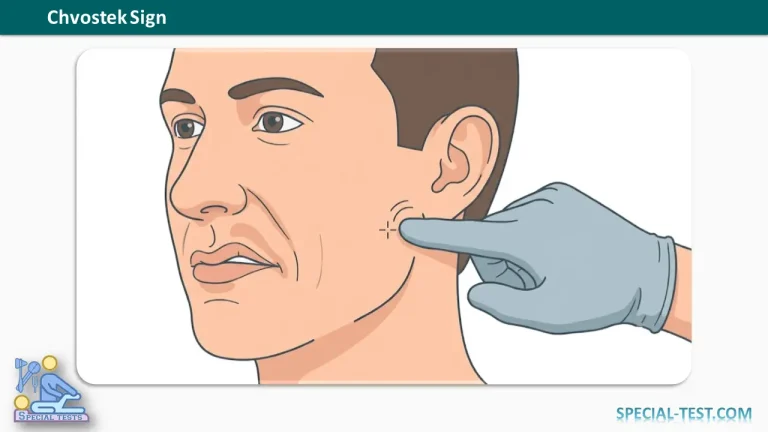
What Is the Chvostek Sign?
The Chvostek sign is a bedside clinical test that checks for neuromuscular irritability. The examiner taps over the facial nerve (the seventh cranial nerve) and watches for a brief twitch of the facial muscles on the same side. It is named after the Austrian physician František Chvostek, who described it in the nineteenth century in patients with tetany.
Clinicians most often use it when they suspect hypocalcemia, a low blood calcium level. It can also come up when assessing facial nerve (cranial nerve VII) pathology. The test is quick, needs no equipment beyond your fingertip or a reflex hammer, and can be done in seconds.
What Is the Chvostek Sign Used For?
- Screening for hypocalcemia: Low calcium makes nerves more excitable, so a light tap can trigger a muscle response.
- Assessing facial nerve excitability: It gives a simple look at how the seventh cranial nerve responds to mechanical stimulation.
- Supporting a clinical suspicion: It is most useful alongside symptoms such as perioral numbness, tingling, muscle cramps, or tetany, and alongside risk factors. These include recent thyroid or parathyroid surgery, hypoparathyroidism, vitamin D deficiency, and magnesium depletion.
How to Perform the Chvostek Sign Test
- Position the patient. Have the patient sit comfortably, facing you, with the face relaxed.
- Locate the facial nerve. Find the area just in front of the ear, below the zygomatic arch, where the nerve runs close to the surface over the cheek.
- Tap gently. Use a reflex hammer or your finger to tap over the nerve. A light tap is enough; a hard one adds nothing.
- Observe the response. Watch the muscles around the mouth, nose, and eye on the tapped side for a brief twitch.
- Compare both sides. Test each side and note any asymmetry.
Interpreting the Result
A positive Chvostek sign is a twitch of the facial muscles, particularly around the mouth, nose, or eye, after the tap. The reaction is usually described by how far it spreads:
- Twitching at the corner of the mouth only
- Twitching of the mouth and nose
- Twitching that also involves the eyelid or most of the face on that side
A stronger, more widespread response suggests greater nerve irritability. However, the pattern of the twitch does not reliably tell you how low the calcium is.
Why the Chvostek Sign Must Be Interpreted Carefully
The Chvostek sign is easy to perform but has real limits.
- It appears in people with normal calcium. Published literature indicates that roughly one in four healthy people can show a positive sign. A paper titled “Chvostek sign, frequently found in healthy subjects, is not a useful clinical sign” (PubMed ID 23479466) discusses this directly.
- It can be absent in true hypocalcemia. StatPearls reports that about 29% of patients with hypocalcemia do not show the sign.
- Evidence for the link is weaker than tradition suggests. A population-based study (PubMed ID 29443134) found no meaningful correlation between serum calcium and the sign.
The test cannot rule hypocalcemia in or out. Confirm with serum calcium (corrected for albumin or ionized), magnesium, phosphate, PTH, and vitamin D levels, plus an ECG when hypocalcemia is significant.
Chvostek Sign vs. Trousseau Sign
The Trousseau sign (carpopedal spasm after inflating a blood pressure cuff above systolic pressure for up to three minutes) is generally considered more reliable for latent tetany. Many clinicians use the Chvostek sign as a quick first look and rely on the Trousseau sign and laboratory results for confirmation.
Clinical Pearls
- Always correlate with symptoms, history, and lab results.
- Hyperventilation can cause respiratory alkalosis, which lowers ionized calcium and may produce a positive sign even when total calcium is normal.
- Check magnesium. Low magnesium can cause refractory hypocalcemia.
- A new positive sign after neck surgery warrants prompt calcium measurement.
- Treat the patient and the lab values, not the sign.
Frequently Asked Questions (FAQ)
What does a positive Chvostek sign mean?
It means the facial nerve is hyperexcitable. This is classically linked to hypocalcemia, but it is not specific to it. Confirm with blood tests.
Is the Chvostek sign reliable for diagnosing hypocalcemia?
No. It can appear in healthy people and can be missing in patients with low calcium. Use it as supporting evidence only.
Where exactly do you tap to elicit the Chvostek sign?
Tap just in front of the ear, below the zygomatic arch, over the course of the facial nerve on the cheek.
What is the difference between the Chvostek and Trousseau signs?
Chvostek is a facial twitch after tapping the facial nerve. Trousseau is a hand and wrist spasm after cuff inflation. Trousseau is generally regarded as the more dependable of the two.
Can a healthy person have a positive Chvostek sign?
Yes. A meaningful minority of people with normal calcium show a mild positive response.
What conditions can cause a positive Chvostek sign?
Hypoparathyroidism (including after thyroid surgery), vitamin D deficiency, hypomagnesemia, chronic kidney disease, and hyperventilation-related alkalosis.
What should I do after a positive result?
Check serum calcium, magnesium, and other relevant labs. Seek urgent care if there is muscle spasm, seizures, difficulty breathing, or palpitations.
References
- Chvostek Sign. StatPearls, NCBI Bookshelf: https://www.ncbi.nlm.nih.gov/books/NBK542326/
- Hujoel IA. The association between serum calcium levels and Chvostek sign: a population-based study. PubMed ID 29443134: https://pubmed.ncbi.nlm.nih.gov/29443134
- Chvostek sign, frequently found in healthy subjects, is not a useful clinical sign. PubMed ID 23479466: https://pubmed.ncbi.nlm.nih.gov/23479466
- The Chvostek sign: a clinical study. PubMed ID 13545482: https://pubmed.ncbi.nlm.nih.gov/13545482
- The value of Chvostek’s sign in tetany. PubMed ID 5680230: https://pubmed.ncbi.nlm.nih.gov/5680230