Single-Leg Balance Stance Test: Procedure, Scoring, and Interpretation
The Single-Leg Balance Stance Test, also known as the Single-Leg Stance Test (SLST) or Unipedal Stance Test, is a simple clinical assessment used to evaluate static balance, postural stability, and the ability to maintain an upright position while standing on one leg.
This test is commonly used in physical therapy, orthopedic rehabilitation, neurological examinations, and vestibular assessments. It helps healthcare professionals identify balance impairments, evaluate lower-extremity stability, and monitor changes in postural control during rehabilitation.
The Single-Leg Balance Stance Test requires minimal equipment and can be performed in most clinical settings. Research suggests that single-leg stance performance can help distinguish older adults with a history of falls from those without, although it should not be used alone to predict future falls. [1,2]
Purpose of the Single-Leg Balance Stance Test
The primary purpose of the Single-Leg Balance Stance Test is to evaluate an individual’s ability to maintain static balance while supporting their body weight on one lower extremity.
Maintaining a single-leg stance requires coordinated contributions from the visual, vestibular, and somatosensory systems, together with adequate muscle strength and neuromuscular control.
Clinical Uses
The test can be used to:
- Assess static balance: Evaluate the ability to maintain postural stability while standing on one leg.
- Screen for balance impairments: Identify difficulties associated with vestibular, neurological, or musculoskeletal dysfunction.
- Evaluate lower-extremity stability: Assess functional control of the hip, knee, ankle, and surrounding musculature.
- Assess fall-related balance deficits: Identify reduced balance performance, particularly in older adults.
- Monitor rehabilitation progress: Compare balance performance over time following injury or during physical therapy.
- Identify side-to-side differences: Compare the ability to maintain balance on the right and left lower extremities.
Clinical balance assessments, including single-leg stance testing, may contribute to a comprehensive evaluation of patients with suspected vestibular disorders. [3]
How to Perform the Single-Leg Balance Stance Test
The Single-Leg Balance Stance Test procedure should be performed under standardized conditions to improve consistency and reliability.
Patient Position
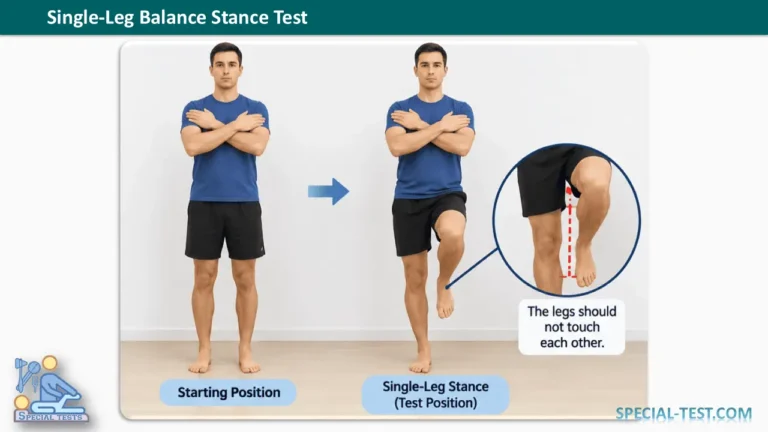
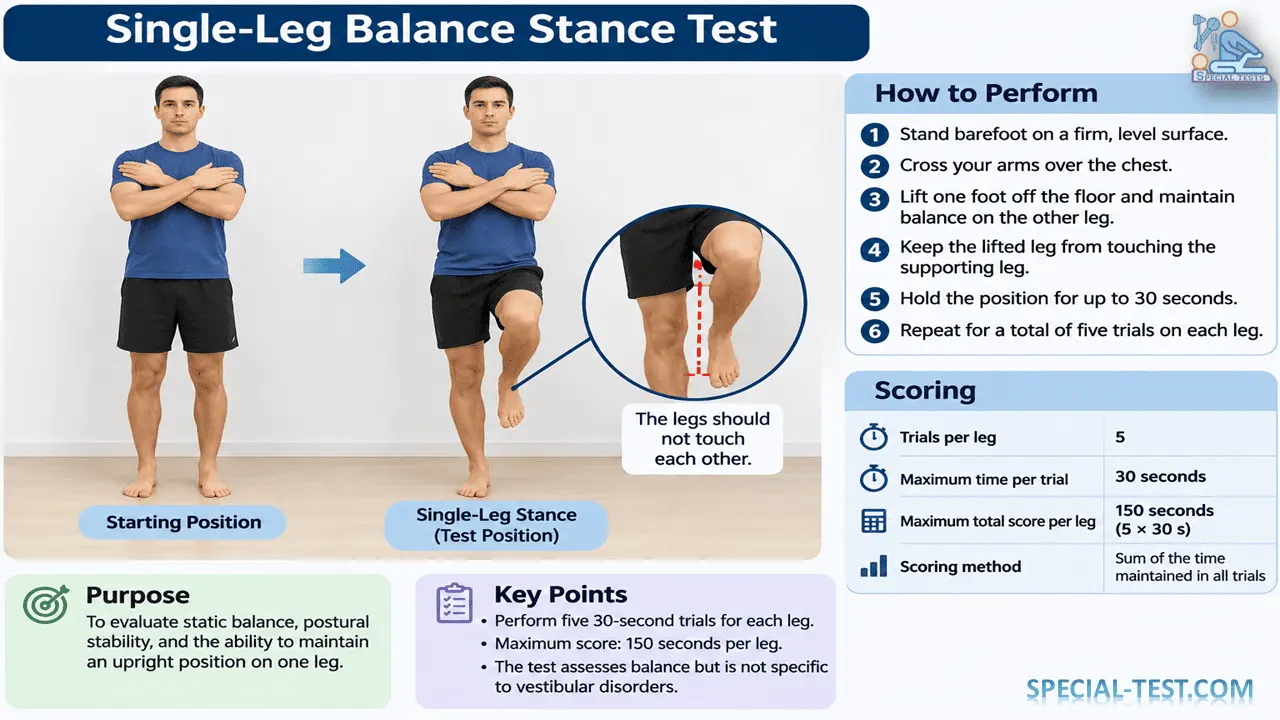
The patient stands upright on a firm, level surface without shoes. Both feet are initially positioned on the floor, and the arms are crossed over the chest.
The examiner should remain close enough to prevent a fall without providing physical assistance during the timed assessment.
Step-by-Step Procedure
- Ask the patient to stand barefoot on a firm, stable surface.
- Instruct the patient to cross both arms over the chest.
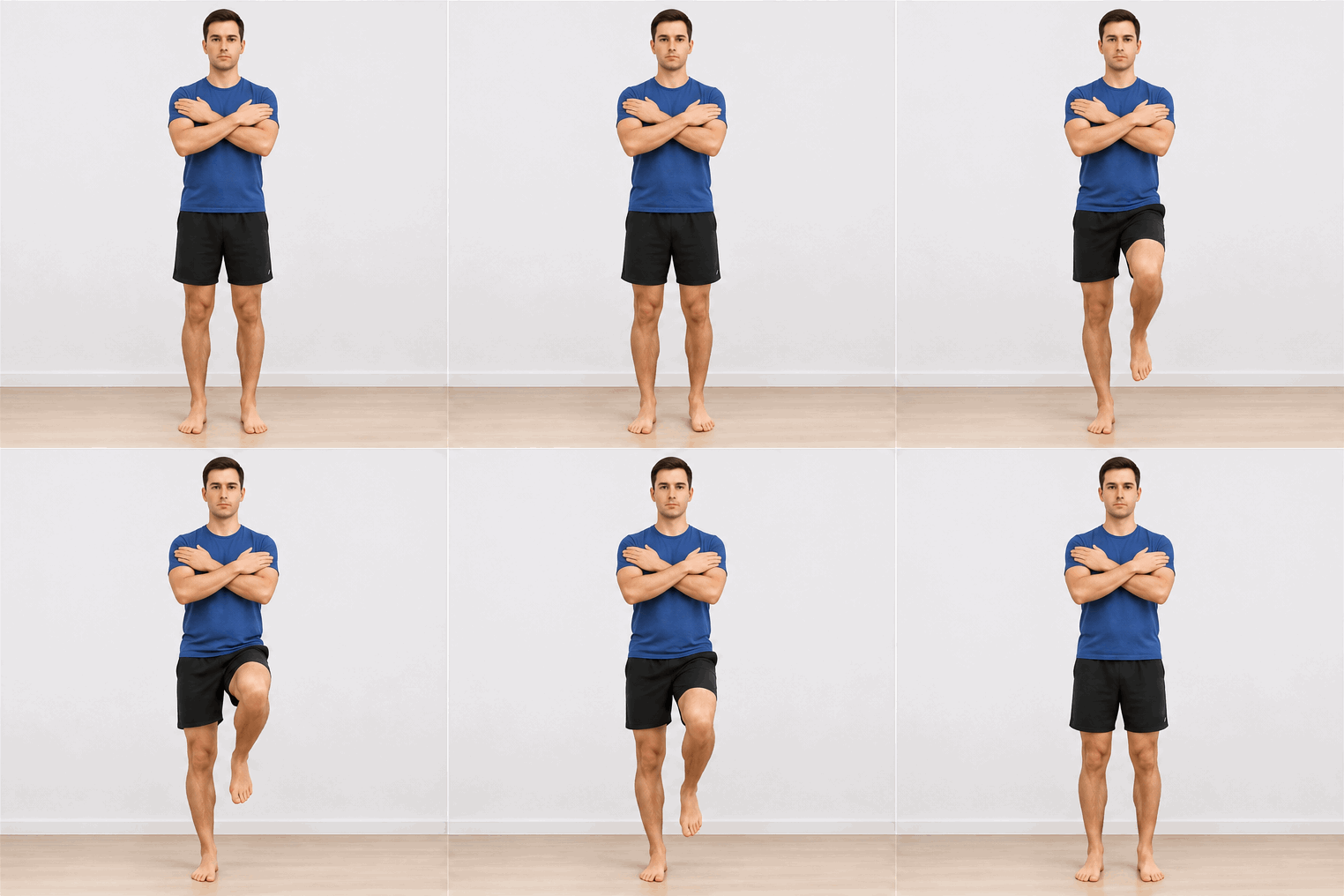
- Ask the patient to lift one foot off the floor while maintaining balance on the opposite leg.
- Ensure that the elevated leg does not touch the supporting leg.
- Begin timing once the patient has established the required single-leg standing position.
- Instruct the patient to maintain the position for as long as possible, up to 30 seconds per trial.
- Stop timing if the patient loses balance, places the elevated foot on the ground, touches the supporting leg, or requires external support. Other deviations should be handled according to the selected standardized protocol.
- Repeat the procedure for five trials on each leg, allowing appropriate rest between attempts.
- Record the duration of each trial and calculate the total time for each leg.
The five-trial protocol described by Orthofixar allows a maximum cumulative score of 150 seconds for each lower extremity. [1]
For consistent interpretation, the examiner should document the testing conditions, including whether the eyes remained open or closed, the stance surface, and any modifications to the arm or leg position.
Single-Leg Balance Stance Test Scoring
The test is scored according to the time the patient can maintain a stable single-leg standing position.
Under the five-trial protocol, each attempt has a maximum duration of 30 seconds.
| Scoring Parameter | Measurement |
|---|---|
| Number of trials | 5 per leg |
| Maximum duration per trial | 30 seconds |
| Maximum total score per leg | 150 seconds |
| Scoring method | Sum of successful balance times |
| Interpretation | Longer duration generally indicates better static balance |
For example, if a patient maintains balance for 20, 25, 30, 18, and 27 seconds across five trials, the total score is 120 out of 150 seconds for that leg.
A higher score generally reflects better performance under the tested conditions. However, the score should not be considered a universal measure of normal balance.
Different published protocols use different numbers of trials and scoring methods. For example, Springer and colleagues evaluated the mean and best performance across three trials when establishing age-related normative values. Therefore, scores obtained using different protocols should not be compared directly without considering these methodological differences. [4]
Interpretation of Single-Leg Balance Stance Test Results
Single-Leg Balance Stance Test results provide useful information about static postural control but must be interpreted alongside the patient’s age, medical history, symptoms, and other examination findings.
Normal or Good Balance Performance
A patient who maintains the required single-leg standing position without substantial postural instability demonstrates relatively good static balance under the tested conditions.
However, normal performance does not exclude vestibular dysfunction or other balance disorders.
Impaired Balance Performance
Difficulty maintaining the single-leg stance may indicate reduced postural control associated with:
- Vestibular dysfunction.
- Lower-extremity muscle weakness.
- Impaired proprioception.
- Neurological disorders affecting coordination.
- Musculoskeletal pain or joint instability.
- Age-related changes in balance performance.
Shorter standing times may indicate an increased need for further assessment, but they do not establish a specific diagnosis.
Vestibular Dysfunction
The Single-Leg Balance Stance Test may be particularly challenging for patients experiencing acute vestibular dysfunction.
Patients with significant uncompensated vestibular loss may demonstrate pronounced instability or difficulty maintaining the required position.
In contrast, individuals who have developed vestibular compensation may perform normally despite persistent underlying vestibular impairment.
Importantly, the Single-Leg Balance Stance Test is not specific for vestibular disorders. Research supports combining clinical balance tests and considering the patient’s history and overall examination when screening for vestibular dysfunction. [3]
Age-Related Changes
Single-leg stance duration generally decreases with advancing age.
In a study involving 549 healthy adults, Springer and colleagues found significant age-related reductions in unipedal stance performance under both eyes-open and eyes-closed conditions. [4]
Consequently, clinicians should use age-appropriate reference values obtained from a comparable testing protocol rather than applying a single cutoff to all patients.
Clinical Significance
The Single-Leg Balance Stance Test is a practical component of a comprehensive balance examination.
Its simplicity, low cost, and minimal equipment requirements make it useful in outpatient rehabilitation, geriatric assessment, and other clinical environments.
A systematic review and meta-analysis found that the eyes-open single-leg stance test was among the more promising non-instrumented balance assessments for distinguishing older adults with and without a fall history. However, an umbrella review reported inconsistent evidence regarding its ability to predict future falls. [2,5]
Therefore, clinicians should consider combining the Single-Leg Balance Stance Test with additional assessments, such as the Romberg Test, Timed Up and Go Test, or other appropriate functional balance measures.
Precautions and Limitations
Although the Single-Leg Balance Stance Test is straightforward, several precautions should be considered.
- Patients with substantial balance impairments should be closely supervised to prevent falls.
- Testing should be stopped if the patient experiences significant dizziness, pain, or instability.
- Patients who cannot safely attempt unsupported single-leg standing should undergo an alternative or modified balance assessment.
- Results may be influenced by age, fatigue, visual conditions, surface stability, pain, and lower-extremity strength.
- Test scores cannot independently identify the underlying cause of impaired balance.
The test is a screening and assessment tool, not a standalone diagnostic examination for vestibular disease or fall risk.
Frequently Asked Questions (FAQ)
What is the Single-Leg Balance Stance Test?
The Single-Leg Balance Stance Test is a clinical assessment that measures how long an individual can maintain balance while standing on one leg without external support. It evaluates static postural stability and lower-extremity control.
How is the Single-Leg Balance Stance Test performed?
The patient stands barefoot with the arms crossed over the chest, lifts one foot from the floor, and maintains the single-leg position without allowing the legs to touch. In the described protocol, five trials of up to 30 seconds are completed for each leg.
What is the maximum score for the Single-Leg Balance Stance Test?
Using the five-trial, 30-second protocol, the maximum cumulative score is 150 seconds per leg. Other published versions may use different trial numbers and scoring methods.
What does a positive Single-Leg Balance Stance Test indicate?
The test does not have a universally accepted positive or negative result. Poor performance may suggest impaired static balance, but additional clinical assessment is required to determine the cause.
Can the Single-Leg Balance Stance Test detect vestibular dysfunction?
The test may reveal balance difficulties in individuals with vestibular dysfunction, particularly during periods of poor vestibular compensation. However, it is not specific enough to confirm or exclude vestibular disease independently.
Is the Single-Leg Stance Test useful for assessing fall risk?
Yes. Reduced single-leg standing time may help identify balance impairments associated with falls, especially in older adults. Nevertheless, evidence for predicting future falls is inconsistent, and the test should be combined with other clinical risk assessments.
Does age affect Single-Leg Balance Stance Test results?
Yes. Research indicates that single-leg stance performance generally declines with age. Age-specific reference values and consistent testing conditions are important for accurate interpretation.
Conclusion
The Single-Leg Balance Stance Test is a quick, inexpensive, and clinically useful method for evaluating static balance and postural stability.
In the five-trial protocol, patients attempt to maintain single-leg standing for up to 30 seconds per trial, producing a maximum total score of 150 seconds for each leg.
Although impaired performance may indicate vestibular, neurological, or musculoskeletal dysfunction, the test is not disease-specific. Its greatest clinical value comes from interpreting the results alongside age-appropriate reference values, patient history, and other balance assessments.
References
- Orthofixar. Balance Tests & Assessment. Single-Leg Balance Stance protocol. Orthofixar
- Diagnostic Balance Tests for Assessing Risk of Falls and Distinguishing Older Adult Fallers and Non-Fallers: A Systematic Review with Meta-Analysis. 2020. NCBI PubMed Central
- Salah M, et al. Clinical Balance Testing to Screen for Patients With Vestibular Disorders: A Retrospective Case-control Study. Otology & Neurotology. 2020;41(9):1258–1265. PubMed — PMID: 32925853
- Springer BA, Marin R, Cyhan T, Roberts H, Gill NW. Normative Values for the Unipedal Stance Test with Eyes Open and Closed. Journal of Geriatric Physical Therapy. 2007;30(1):8–15. PubMed — PMID: 19839175
- Predicting Falls in Older Adults: An Umbrella Review of Instruments Assessing Gait, Balance, and Functional Mobility. 2022. NCBI PubMed Central