Romberg Test: How to Perform, Positive Sign, Interpretation & Clinical Significance
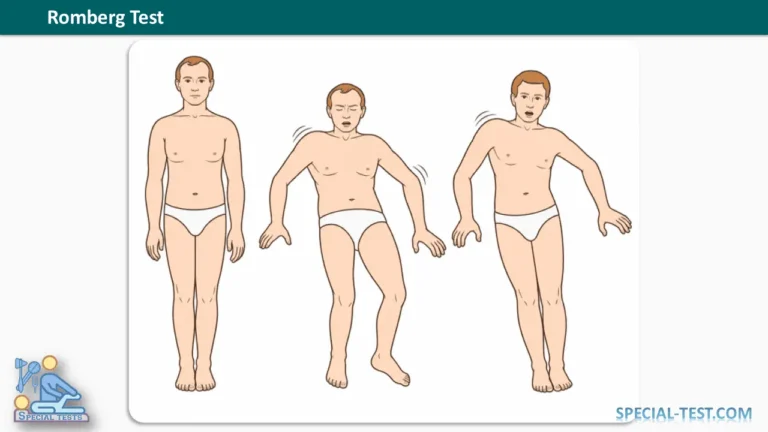
The Romberg test, also known as the Romberg sign, is a commonly used neurological examination for evaluating balance, postural stability, and proprioceptive function. It helps clinicians identify sensory ataxia and investigate neurological conditions affecting the dorsal columns of the spinal cord, peripheral sensory nerves, and vestibular system.
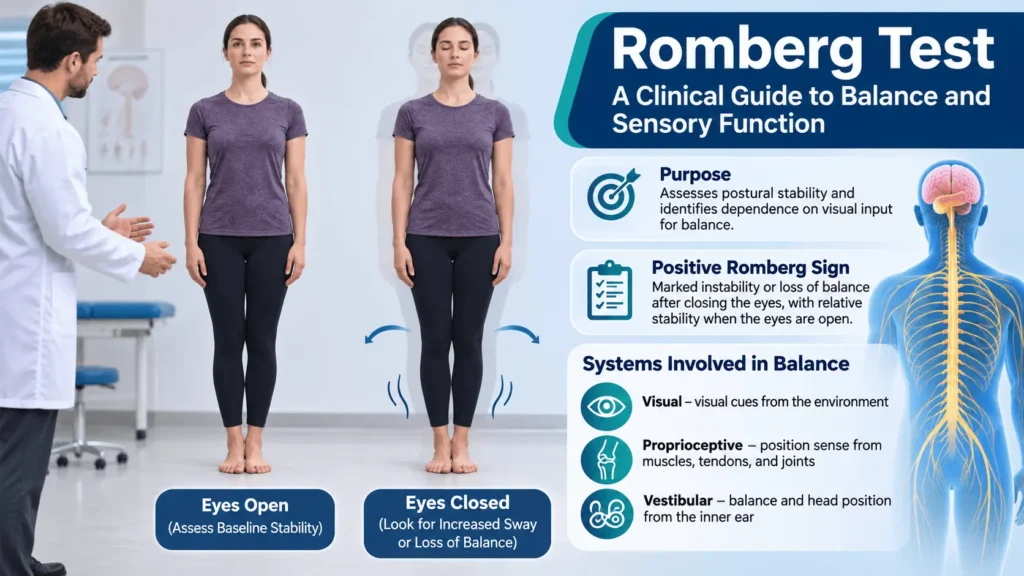
The test involves assessing a patient’s ability to maintain an upright standing position with their feet together, first with their eyes open and then with their eyes closed. A significant deterioration in balance after closing the eyes is considered a positive Romberg sign.
Although the Romberg test is simple, requires no specialized equipment, and can be performed during a routine neurological examination, its findings must be interpreted alongside other neurological assessments.
What Is the Romberg Test?
The Romberg test is a bedside clinical examination used to assess the sensory contributions to standing balance, particularly proprioception, which is the body’s ability to recognize the position and movement of its joints and limbs without relying on vision.
The test is named after the German neurologist Moritz Heinrich Romberg, who described postural instability associated with sensory impairment during the 19th century.
Normal postural stability depends on three essential sensory systems:
- Visual system: Provides information about body position relative to the surrounding environment.
- Proprioceptive system: Transmits information from muscles, tendons, and joints regarding body position and movement.
- Vestibular system: Located in the inner ear, detects head movement and orientation relative to gravity.
During the Romberg test, closing the eyes removes visual input, requiring the nervous system to maintain balance using proprioceptive and vestibular information.
When proprioceptive function is impaired, patients may compensate by using vision. Once their eyes are closed, this compensation disappears, potentially resulting in excessive postural sway or loss of balance.
The Romberg test is particularly valuable for assessing sensory ataxia, but it is not a definitive diagnostic test for any single neurological disorder.
How to Perform the Romberg Test
The Romberg test should be performed by a trained healthcare professional in a safe clinical environment with appropriate fall precautions.
Patient Position
- Ask the patient to remove their shoes if appropriate.
- Position the patient on a firm, level, non-slip surface.
- Instruct the patient to stand upright with both feet together.
- The arms should remain comfortably at the sides or crossed in front of the body.
- The examiner should stand close enough to support the patient immediately if balance is lost.
Step-by-Step Romberg Test Procedure
Step 1: Assess Balance With Eyes Open
Ask the patient to stand with their feet together and eyes open.
Observe whether the patient can maintain an upright posture without excessive swaying, stepping, or requiring assistance.
If the patient cannot stand safely with their eyes open, the conventional Romberg comparison cannot be reliably completed.
Step 2: Assess Balance With Eyes Closed
If the patient maintains a stable position with eyes open, instruct them to close their eyes while keeping their feet in the same position.
Observe their postural stability for approximately 20–30 seconds, depending on the clinical protocol. Some standardized descriptions use an observation period of up to 60 seconds.
Step 3: Observe Postural Sway
Assess whether closing the eyes produces:
- A marked increase in body swaying.
- Significant side-to-side or forward-backward instability.
- Stepping to prevent a fall.
- A need for external support.
- Complete loss of balance.
Step 4: Record the Findings
Document the difference between the eyes-open and eyes-closed conditions, including the duration maintained, degree of sway, corrective steps, and any examiner assistance.
Important: Stop the examination immediately if the patient begins to fall. The test should never be performed without appropriate supervision and fall protection.
Positive Romberg Test: What Does It Mean?
A positive Romberg test occurs when a patient can maintain a relatively stable standing position with their eyes open but develops marked instability after closing their eyes.
A positive Romberg sign may indicate impaired proprioceptive input or vestibular dysfunction.
Common findings include excessive postural sway, inability to maintain the feet-together stance, taking corrective steps, or requiring assistance to prevent falling.
Causes of a Positive Romberg Sign
Several neurological conditions may produce an abnormal Romberg test, including:
- Peripheral neuropathy: Damage to sensory nerves may impair proprioceptive information from the lower limbs.
- Posterior column dysfunction: Lesions involving the dorsal columns of the spinal cord can disrupt vibration and joint-position sensation.
- Vitamin B12 deficiency: Severe deficiency may produce subacute combined degeneration of the spinal cord with sensory ataxia.
- Tabes dorsalis: A late neurological manifestation of syphilis that can damage dorsal root and posterior column pathways.
- Sensory ataxia: Impaired proprioceptive feedback can cause patients to rely heavily on vision for balance.
- Vestibular disorders: Uncompensated vestibular deficits may also cause increased instability when visual information is removed.
A positive Romberg test should prompt further neurological assessment rather than being interpreted as confirmation of a specific diagnosis.
Negative Romberg Test
A negative Romberg test indicates that the patient maintains standing balance without a substantial deterioration when the eyes are closed.
A small amount of postural sway may occur in healthy individuals and does not necessarily indicate an abnormal result.
However, a negative Romberg sign does not exclude peripheral neuropathy, vestibular dysfunction, cerebellar disease, or other neurological disorders.
The test’s diagnostic value depends on the clinical presentation and accompanying examination findings.
Romberg Test: Sensory Ataxia vs. Cerebellar Ataxia
One of the most important clinical applications of the Romberg test is helping distinguish sensory-dependent imbalance from some forms of cerebellar ataxia.
| Clinical Feature | Sensory Ataxia | Cerebellar Ataxia |
|---|---|---|
| Balance with eyes open | Often relatively preserved | Frequently impaired |
| Balance with eyes closed | Markedly worsens | Often remains impaired |
| Romberg sign | Classically positive | Not typically positive in the classical sense |
| Proprioception | May be reduced | Often preserved in isolated cerebellar disease |
| Associated findings | Impaired vibration or joint-position sense | Dysmetria, intention tremor, abnormal coordination |
Patients with significant cerebellar dysfunction may demonstrate postural instability even while their eyes are open. Therefore, the classic eyes-open versus eyes-closed contrast may not be present.
However, the Romberg test alone cannot reliably distinguish all causes of ataxia.
Additional examinations, including finger-to-nose testing, heel-to-shin testing, gait assessment, and sensory evaluation, are needed for accurate clinical interpretation.
Modified Romberg Test and Sharpened Romberg Test
Several variations of the traditional Romberg examination are used in clinical practice.
Sharpened Romberg Test
The sharpened Romberg test, also called the tandem Romberg test, requires the patient to stand with one foot directly in front of the other in a heel-to-toe position.
This narrower base of support increases the difficulty of maintaining balance and may help reveal subtle postural instability.
Modified Romberg Test
The modified Romberg test may involve standing on a compliant foam surface with the eyes open or closed.
The foam surface reduces the reliability of proprioceptive information from the feet and ankles. When combined with eye closure, this places greater demands on vestibular function.
However, modified Romberg testing is not sufficiently accurate by itself to diagnose or exclude vestibular disease. Its results must be interpreted alongside other clinical and vestibular assessments.
Clinical Significance of the Romberg Test
The Romberg test is useful during neurological examinations of patients presenting with:
- Unexplained balance difficulties.
- Sensory ataxia or an unsteady gait.
- Frequent falls.
- Difficulty walking in darkness.
- Suspected peripheral neuropathy.
- Loss of joint-position or vibration sensation.
- Possible spinal cord posterior column dysfunction.
- Dizziness or suspected vestibular disorders.
For example, a patient with peripheral neuropathy may appear relatively stable when standing with their eyes open but become significantly unstable after eye closure because visual compensation is removed.
When the Romberg test is positive, clinicians may perform additional investigations based on the patient’s history and examination. These can include vibration and joint-position testing, deep tendon reflex assessment, nerve conduction studies, vitamin B12 testing, vestibular examination, or neuroimaging when indicated.
Limitations and Precautions
Despite its usefulness, the Romberg test has several limitations.
First, its findings are not specific to one neurological condition. A positive result may occur with proprioceptive impairment or certain vestibular disorders.
Second, performance can be influenced by muscle weakness, joint pain, fatigue, medications, age-related balance changes, poor understanding of instructions, and fear of falling.
Third, the traditional test does not provide a complete assessment of dynamic balance, gait, coordination, or fall risk.
Finally, changes in foot positioning, testing duration, and examination technique may influence results, making standardized documentation important.
Sudden-onset severe imbalance, especially when accompanied by weakness, speech disturbance, double vision, or other acute neurological symptoms, requires emergency medical assessment rather than reliance on the Romberg test alone.
Frequently Asked Questions About the Romberg Test
1. What does a positive Romberg test indicate?
A positive Romberg test indicates that postural stability becomes significantly worse when visual input is removed. It classically suggests proprioceptive impairment associated with sensory ataxia, although vestibular disorders can also produce abnormal findings.
2. How do you perform the Romberg test?
Ask the patient to stand with their feet together and arms at their sides. First, assess balance with the eyes open. Then ask the patient to close their eyes while the examiner observes for marked instability or loss of balance. Appropriate fall precautions are essential.
3. Is the Romberg test used for cerebellar lesions?
The traditional Romberg test primarily evaluates the effect of removing vision on postural stability rather than directly testing cerebellar function. Patients with significant cerebellar ataxia may be unstable even with their eyes open.
4. What is the difference between a positive and negative Romberg sign?
A positive Romberg sign indicates substantial instability after closing the eyes despite relatively stable balance with eyes open. A negative Romberg sign indicates no clinically significant worsening after eye closure.
5. How long should the Romberg test be performed?
Many clinical examinations use approximately 20–30 seconds of observation with eyes closed. Some protocols use up to 60 seconds. The observation period should be documented, and testing must stop immediately if the patient loses balance.
6. Can peripheral neuropathy cause a positive Romberg test?
Yes. Peripheral neuropathy affecting large sensory fibers may interfere with proprioception. Patients may rely on visual information to maintain their balance and become unstable when their eyes are closed.
7. Can vestibular disorders cause a positive Romberg test?
Yes. Vestibular dysfunction can reduce postural stability, particularly when visual information is unavailable. However, the Romberg test alone cannot identify the precise cause or location of vestibular dysfunction.
8. What is the difference between the Romberg test and the tandem Romberg test?
The traditional Romberg test is performed with both feet together. The tandem or sharpened Romberg test uses a heel-to-toe stance, creating a narrower base of support and increasing the difficulty of the balance task.
9. Is a positive Romberg test always abnormal?
Mild swaying after closing the eyes may be normal. A clinically positive result requires a substantial deterioration in balance, such as pronounced sway, corrective stepping, or loss of postural stability.
10. Can patients perform the Romberg test at home?
Self-testing is not recommended because sudden loss of balance can cause falls or injury. The examination should be performed under the supervision of a trained healthcare professional.
Conclusion
The Romberg test is a valuable neurological examination for assessing sensory contributions to balance, particularly proprioceptive function. A positive Romberg sign occurs when a patient demonstrates significant postural instability after closing their eyes despite maintaining relatively stable balance with their eyes open.
Although the test is particularly associated with sensory ataxia and posterior column dysfunction, vestibular abnormalities can also affect its results.
Accurate interpretation requires assessment of the patient’s medical history, neurological findings, sensory function, gait, and coordination. The Romberg test should therefore be considered a component of the comprehensive neurological examination rather than a standalone diagnostic procedure.
References
- Kaprive JF, Munakomi S, Cronovich HA. Romberg Test. StatPearls. NCBI Bookshelf.
https://www.ncbi.nlm.nih.gov/books/NBK563187/ - Ataullah AHM, Singla R, Naqvi IA. Cerebellar Dysfunction. StatPearls. NCBI Bookshelf.
https://www.ncbi.nlm.nih.gov/books/NBK562317/ - Orthofixar. Romberg Sign: Test, Procedure, Positive Meaning & Causes.
https://orthofixar.com/special-test/romberg-test/ - Vestibular Contributions to the Romberg Test: Testing Semicircular Canal and Otolith Function. PubMed.
https://pubmed.ncbi.nlm.nih.gov/34160115/ - Insensitivity of the Romberg Test of Standing Balance on Firm and Compliant Support Surfaces to the Results of Caloric and VEMP Tests. PubMed.
https://pubmed.ncbi.nlm.nih.gov/21775891/ - Clinical Balance Testing to Screen for Patients With Vestibular Disorders: A Retrospective Case-control Study. PubMed.
https://pubmed.ncbi.nlm.nih.gov/32925853/ - Neurologic Exam. StatPearls. NCBI Bookshelf.
https://www.ncbi.nlm.nih.gov/books/NBK557589/