Finger Thumb Test: How to Perform, Interpret and Document Hand Coordination
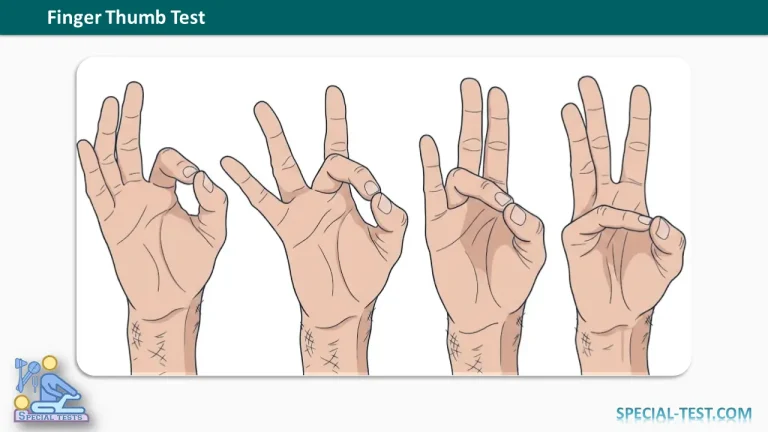
The finger thumb test is a quick, equipment-free coordination test used during the neurological and musculoskeletal examination of the hand. The patient touches the thumb to each finger of the same hand in turn. The examiner watches the speed, accuracy and smoothness of the movement and compares the two hands.
Finger-to-thumb opposition underlies many daily activities, including writing, buttoning clothes and gripping small objects (1). A fast, repeatable screen for this movement is therefore useful in both orthopedic and neurological practice.
What the Finger Thumb Test Is Used For
The test is used as a coordination test. It assesses how well the patient can plan, time and sequence fine movements of the hand. Standard neurology references list tapping the index finger against the thumb, or alternately against each finger, among the additional bedside tests of coordination (3). It is usually done alongside other coordination tests, such as finger-to-nose and heel-to-shin.
How to Perform the Finger Thumb Test
- Position the patient. The patient sits or stands comfortably with the arms free and the hands visible.
- Demonstrate the task. Show the patient how to touch the tip of the thumb to the tip of each finger in sequence, from index to little finger and back.
- Test the normal side first. Starting with the uninjured hand gives a personal baseline for that patient.
- Test the injured side. The patient repeats the same sequence with the affected hand.
- Observe closely. Note the speed, rhythm, accuracy of fingertip contact and any hesitation, tremor or missed touches.
Interpreting the Results
Normal Result
The examiner compares the two sides for coordination and timing. In a normal test, both sides should be equal, with smooth, accurate and evenly timed movements.
Positive Test
A positive test shows slower movement on the affected side. The movement may also be clumsy, irregular or inaccurate, with fingertip contacts that miss or are uneven in timing.
Why Comparing Both Sides Matters
Performance varies with age. In a normative study of 255 healthy volunteers, increasing age was associated with reduced movement speed, less correct sequences and poorer bimanual coordination (1). Because there is no single cut-off value at the bedside, the patient’s own uninjured hand is the most practical reference. The examiner is looking for a meaningful asymmetry, not a specific number.
In the same study, sex differences were small, limited to the duration of finger touch and the interval between successive touches (1). Sex therefore matters little when the two hands of one patient are compared.
Clinical Value and Limitations
Instrumented versions of the test can detect subtle impairment. For example, a sensor-based finger sequencing test recorded greater timing variability in children with motor coordination difficulties than in typically developing children (2). The bedside version, however, depends on the examiner’s visual judgment and has not been standardized, so it is a screening tool and not a diagnostic test. An abnormal result should prompt a fuller examination, including strength, sensation, reflexes, and other coordination tests, and should be interpreted in the clinical context. Pain, swelling, stiffness or joint injury in the hand can also slow movement, so slowness alone does not identify the cause.
Practical Tips for Examiners
- Always test the uninjured side first and use the same instructions for both hands.
- Ask the patient to touch the fingertips, not the finger pads, so that accuracy is easy to judge.
- Time the sequence over the same interval on both sides if you want a rough objective comparison.
- Document the result as a side-to-side comparison, noting speed, rhythm and accuracy.
Frequently Asked Questions (FAQ)
What is the finger thumb test used for?
It is a bedside coordination test that assesses the timing and accuracy of fine finger movements by comparing the two hands.
How is the finger thumb test performed?
The patient touches the thumb of the same hand to each finger in turn. The normal side is tested first, followed by the injured side.
What is a positive finger thumb test?
A positive test is slower movement on the affected side compared with the normal side.
Should both hands always be tested?
Yes. Performance changes with age (1), so the patient’s uninjured hand is the best reference for comparison.
Can the finger thumb test diagnose a specific condition?
No. It is a screening test of coordination, and an abnormal result calls for a fuller neurological and musculoskeletal examination.
Is the finger thumb test the same as the finger drumming test?
Both are bedside tests of coordination and rapid finger movement, but the finger thumb test uses sequential thumb-to-finger touching.
Research Limitations
The published literature on instrumented finger-to-thumb tasks is limited. Only one of the studies cited here is a normative study of adults (1). The other involved children and used a sensor-based test rather than the bedside examination (2). No standardized cut-off values or diagnostic accuracy data (sensitivity and specificity) exist for the manual bedside version, so its interpretation depends on the examiner.
References
- Signori A, Sormani MP, Schiavetti I, et al. Quantitative assessment of finger motor performance: Normative data. PLoS One. 2017;12(10):e0186524. doi:10.1371/journal.pone.0186524. PMC5646860.
- Keinan A, Bar-Shalita T, Portnoy S. An instrumented assessment of a rhythmic finger task among children with motor coordination difficulties. Sensors (Basel). 2020;20(16):4554. doi:10.3390/s20164554.
- Harrison’s Principles of Internal Medicine, Neurology section, bedside tests of coordination.