Bulbocavernosus Reflex: How to Test It, Interpret It and Use It in Spinal Shock
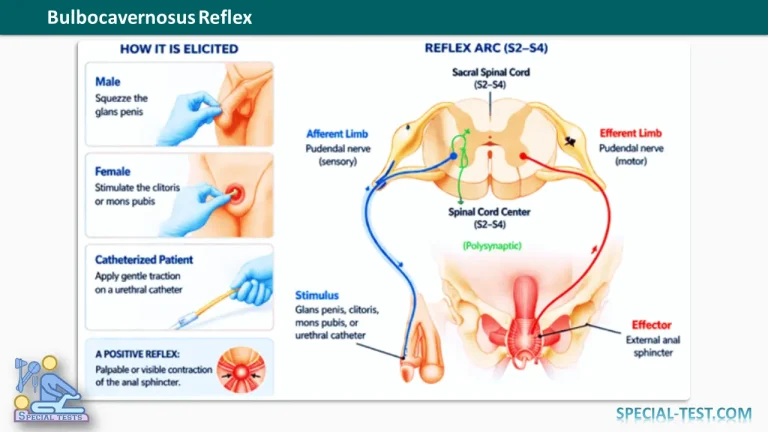
The bulbocavernosus reflex (BCR), also called the bulbospongiosus reflex, is a sacral reflex that tests the integrity of the S2–S4 spinal cord segments and the pudendal nerve pathway. It is a core part of the neurological examination after spinal trauma. It helps clinicians decide whether a patient with flaccid paralysis is still in spinal shock or has a structural spinal cord lesion.
Clinicians have long used the BCR in the initial evaluation of spinal cord injury (SCI) to judge the presence of spinal shock and to estimate prognosis [1]. Its prognostic role is now debated (see below).
Anatomy and Physiology of the Reflex Arc
The reflex is a short sacral arc. A sensory stimulus to the genitalia travels through the pudendal nerve to the S2–S4 cord segments, and a motor response returns to the pelvic floor and anal sphincter. Electrophysiological studies show that the anal reflex can be reliably recorded in healthy subjects. Its latency can be prolonged when the reflex arc is damaged [2]. Because the arc sits in the sacral cord, a normal BCR means that segment and its nerve roots are working.
How to Perform the Bulbocavernosus Reflex
Preparation
- Position the patient, usually supine.
- Explain the procedure and ensure privacy.
- Wear gloves and, if you will palpate the sphincter, lubricate your examining finger.
Applying the stimulus
Use one of the following:
- Squeeze the glans penis (male) or clitoris (female).
- Gently tug on the urinary catheter in a catheterized patient.
Observing the response
- Watch for visible contraction of the anal sphincter.
- Or palpate for a contraction with a gloved finger in the anal canal.
Interpreting the Results
Positive (present) reflex
A palpable or visible anal sphincter contraction means the S2–S4 reflex arc is intact.
Absent reflex
- After acute trauma: absence is a hallmark of spinal shock.
- Without spinal shock: persistent absence points to a lesion of the sacral cord, conus medullaris or sacral nerve roots.
Return of the reflex
The BCR is one of the earliest reflexes to return as spinal shock resolves. This typically happens within 24–48 hours of injury.
Complete spinal cord injury
Once spinal shock has resolved, three findings together suggest a complete injury:
- absent motor function below the lesion
- absent sensory function below the lesion
- a present BCR
Limits of the Test: What Recent Evidence Shows
The BCR is traditionally taught as a prognostic sign, but the evidence is mixed. A review of the North American Clinical Trials Network (NACTN) spinal cord injury registry (J Neurotrauma) found that the BCR provided no prognostic utility in the acute evaluation of SCI patients [1]. The authors also note that the reflex has been used less in the last decade [1].
Practical takeaways:
- Use the BCR to document sacral reflex integrity and spinal shock status.
- Do not use it alone to predict neurological recovery.
- Combine it with a full ASIA/ISNCSCI examination, perianal sensation, voluntary anal contraction and imaging.
- Repeat the examination serially, because the findings change as spinal shock resolves.
Common Pitfalls
- Declaring a complete injury too early. Absent function with an absent BCR can simply mean ongoing spinal shock.
- Missing a lower lesion. Absence of the BCR with preserved upper-segment findings can point to conus medullaris or cauda equina involvement rather than spinal shock.
- Technique errors. Weak stimulation, a poorly relaxed patient or a missed sphincter response can all give a false absent result.
- Single-test reasoning. One reflex should never define the injury level or the prognosis.
Key Takeaways
- The BCR tests S2–S4 integrity through anal sphincter contraction.
- Absence after acute injury suggests spinal shock.
- Return within about 24–48 hours signals the end of spinal shock.
- Absent motor and sensory function with a present BCR suggests complete SCI.
- Prognostic value is limited, so interpret it alongside the full neurological exam [1].
Frequently Asked Questions (FAQ)
What does the bulbocavernosus reflex test?
It tests the integrity of the sacral spinal cord segments S2–S4 and the associated pudendal nerve reflex arc.
What is a positive bulbocavernosus reflex?
A positive reflex is a visible or palpable contraction of the anal sphincter after squeezing the glans penis or clitoris, or tugging on a urinary catheter.
What does an absent bulbocavernosus reflex mean?
After acute spinal trauma, it is a hallmark of spinal shock. If spinal shock is not suspected, it may indicate injury to the sacral cord, conus medullaris or sacral nerve roots.
When does the reflex return after spinal shock?
It is typically one of the earliest reflexes to return, usually within 24–48 hours of injury.
Does a present bulbocavernosus reflex mean the spinal cord injury is complete?
Only when it appears together with absent motor and sensory function below the lesion after spinal shock has resolved. A present reflex alone does not make the injury complete.
Can the bulbocavernosus reflex predict recovery?
Not reliably. A registry-based review found no prognostic utility for the BCR in the acute evaluation of SCI [1]. Use it together with the full neurological examination.
Is the bulbocavernosus reflex the same as the anal wink?
No. The anal wink is a cutaneous reflex elicited by stroking the perianal skin. The BCR is elicited by genital or catheter stimulation. Both depend on the sacral segments.
Can the BCR be tested in catheterized patients?
Yes. A gentle tug on the urinary catheter can substitute for direct genital stimulation.
References
- Mansoor Ali D, Sivaganesan A. Bulbocavernosus Reflex Has No Prognostic Features During the Acute Evaluation of Spinal Cord Injuries. J Neurotrauma. 2023;40. doi:10.1089/neu.2022.0412. (PubMed-indexed)
- Anal reflex by perianal electrical stimulation with EMG recording from the external anal sphincter. J Neurol Neurosurg Psychiatry. 1978;41(9):813–818. PMID 690652.