TILT Sign: How to Test for a Partial Distal Biceps Tendon Tear
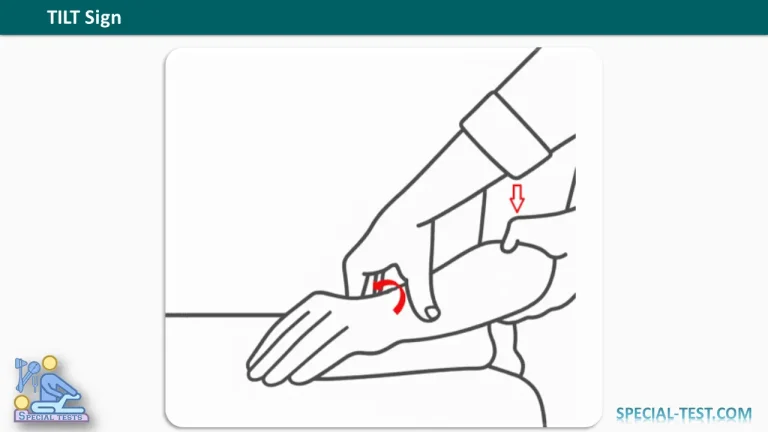
Partial distal biceps tendon tears are easy to miss. Pain near the front of the elbow can come from many conditions, and a partial tear lacks the dramatic signs of a complete rupture, such as the “reverse Popeye” deformity. The TILT sign is a simple bedside palpation test that helps clinicians identify these subtle injuries.
What Is the TILT Sign?
TILT stands for Tenderness over the Lateral aspect of the Tuberosity. It is a physical examination test for a partial tear of the distal biceps tendon, the part of the tendon that attaches to the radial tuberosity just below the elbow. Partial tears of the distal tendon are more subtle in their presentation, which is why Shim et al. proposed the TILT sign. Most other distal biceps tests are designed to detect complete ruptures.
Why Partial Tears Matter
Partial distal biceps tendon tears cover a spectrum of disease, and the tear usually begins in the lateral (radial-sided) fibres. Patients often report aching or pain in the front of the elbow, especially when lifting, bending, or twisting the forearm. Because the tendon is not fully torn, strength may seem nearly normal, which is why a targeted palpation test is useful.
How to Perform the TILT Sign
- Position the patient. The patient sits (or stands) with the elbow flexed to 90°.
- Locate the radial head. Alternate between supination and pronation to feel the head of the radius.
- Move distally. Slide about 2.5 cm (1 inch) distal to the radial head, toward the radial tuberosity where the biceps inserts.
- Fully pronate the forearm. This step is essential. Full pronation rotates the radius so that the radial tuberosity lies directly under the palpating finger. In practice, the tuberosity can only be reliably felt in full pronation.
- Palpate firmly over the tuberosity, comparing with the opposite arm if needed.
What Is a Positive TILT Sign?
A positive result is tenderness over the lateral (radial) aspect of the radial tuberosity in full pronation. This suggests a partial tear of the distal biceps tendon. The pain is thought to come from the inflammation that typically accompanies a partial tear.
How Reliable Is the Test?
The TILT sign is promising but not definitive. In their case reports, Shim et al. found it 100% specific for partial distal biceps tears compared with MRI. However, it is a novel test that has not been studied in diagnostic accuracy studies, so its clinical value remains uncertain for now. Because the evidence is limited, a positive result should be treated as a reason for further evaluation, not a final diagnosis. A recent review of partial distal biceps tears also notes that suspected partial tearing should be confirmed with advanced imaging.
Next Steps After a Positive Test
- Imaging: MRI (often with the elbow in a flexed, abducted, supinated position) or ultrasound can confirm the tear and show its extent.
- Conservative care: For small tears or lower-demand patients, treatment may include activity modification, physical therapy, and gradual strengthening.
- Surgical options: In small tears or low-demand patients, a simple debridement of the bursa, tuberosity and tendon may be indicated. Larger or persistent tears may need tendon repair or reattachment.
A clinician should always make the final decision based on the full history, examination, and imaging.
Frequently Asked Questions (FAQ)
What is the TILT sign used for?
It helps detect a partial tear of the distal biceps tendon at its attachment on the radial tuberosity.
What does TILT stand for?
Tenderness over the Lateral aspect of the Tuberosity.
Why must the forearm be fully pronated?
Full pronation turns the radial tuberosity toward the examiner’s fingers. In other positions, the tuberosity is hidden and cannot be palpated accurately.
Where exactly do I palpate?
About 2.5 cm (1 inch) distal to the radial head, over the radial tuberosity.
What does a positive TILT sign mean?
Tenderness over the lateral aspect of the tuberosity in full pronation suggests a partial distal biceps tendon tear.
Can the TILT sign diagnose a complete rupture?
No. It is aimed at partial tears. Complete ruptures are assessed with other tests, such as the hook test, and often show a visible deformity.
Is the TILT sign proven to be accurate?
Early reports found high specificity against MRI, but it has not been validated in larger diagnostic accuracy studies. Imaging is recommended for confirmation.
Does a positive test mean I need surgery?
Not necessarily. Many partial tears are managed without surgery, especially smaller ones. Treatment depends on tear size, symptoms, and activity level.
Who should perform this test?
A trained physician, orthopedic specialist, or physiotherapist. If you have persistent pain in the front of your elbow, see a healthcare professional.