Hook Test for Distal Biceps Tendon Avulsion: Procedure, Accuracy & Interpretation
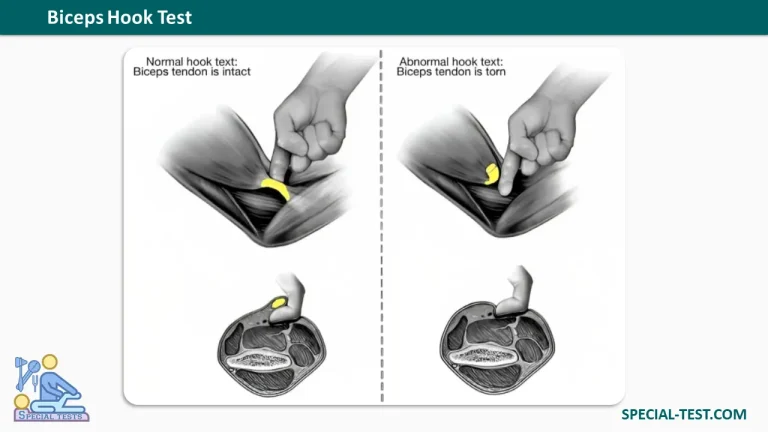
Are you looking for a reliable clinical assessment to diagnose a distal biceps avulsion? The Hook Test is a highly accurate, quick, and non-invasive physical examination maneuver used by orthopedic specialists, physical therapists, and sports medicine physicians to evaluate complete or partial tears of the distal biceps tendon.
What is the Hook Test Used For?
The Hook Test is specifically designed to detect distal biceps tendon ruptures and avulsions. First described by orthopedic surgeon Dr. Lanier Osgood, it helps clinicians differentiate between an intact tendon and a complete tear without requiring immediate advanced imaging like an MRI.
How to Perform the Hook Test
The physical examination is straightforward and can be completed in a few seconds:
- Patient Positioning: Ask the patient to actively flex their elbow to 90 degrees and fully supinate (palm facing upward) the forearm.
- The Maneuver: The examiner attempts to hook their index finger under the lateral (outer) edge of the biceps tendon from the lateral side.
Interpreting the Results
- Normal / Intact Tendon: The examiner’s finger easily hooks around a cord-like, firm, distinct tendon structure.
- Positive Test (Avulsion): The normal cord-like tendon is absent, meaning the finger cannot hook under the structure, indicating a distal biceps tendon rupture.
Potential False Positives
While highly reliable, certain anatomical structures can sometimes mimic an intact tendon, leading to a false positive result in cases of partial tears:
- Partial Tears: Part of the tendon fibers remain attached, preserving some hooking sensation.
- Intact Lacertus Fibrosis: The bicipital aponeurosis can remain taut and create a false sense of an intact tendon.
- Underlying Brachialis Tendon: Palpating the deeper brachialis muscle or tendon can occasionally be mistaken for the biceps tendon.
Hook Test Accuracy: Sensitivity and Specificity
One of the primary reasons clinicians rely on this diagnostic tool is its exceptional statistical validity:
- Sensitivity: 100% (Excellent at correctly identifying patients who actually have a tear).
- Specificity: 100% (Excellent at correctly identifying patients who do not have a tear).
Note: While physical tests like the Hook Test, Biceps Crepitus Test, and Thompson-like squeeze tests offer incredible clinical insight, confirmation via MRI or referral to an orthopedic specialist is recommended for complete treatment planning.