Supination Pronation Test: Distal Biceps Tendon Tear Assessment
What Is the Supination Pronation Test Used For?
The Supination Pronation Test is a clinical orthopedic exam used to detect a distal biceps tendon tear (rupture). It is a quick, non-invasive way to check whether the biceps tendon is still attached at the elbow.
How to Perform the Supination Pronation Test
Patient position
- The patient stands with both shoulders abducted to 90°.
- Both elbows are flexed to 60°-70°.
Examiner technique
- Stand in front of the patient so both arms are clearly visible.
- Ask the patient to actively supinate (palm up) and pronate (palm down) the forearm.
- Watch the contour of the biceps muscle on both sides and compare them.
What to look for in a healthy arm?
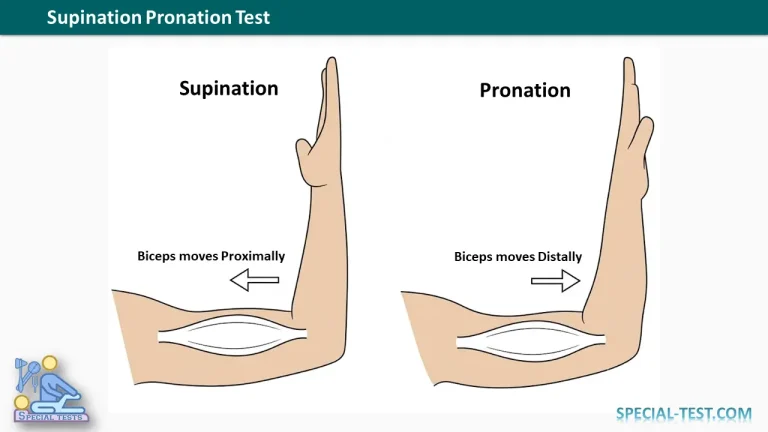
If the distal biceps tendon is intact, the biceps visibly changes shape during forearm rotation:
- Supination: the biceps moves proximally (rises).
- Pronation: the biceps moves distally (falls).
What Is a Positive Result?
The test is positive when the biceps muscle fails to migrate during supination and pronation. This lack of movement suggests the tendon is no longer attached at the elbow, which points to a distal biceps tendon tear.
References & More
- Metzman L, Tivener K, et al. The Supination-Pronation Test for Distal Biceps Tendon Rupture. American Journal of Orthopedics. 2015
- Physiotutors. Supination Pronation Test | Distal Biceps Tendon Rupture Assessment. https://www.physiotutors.com/wiki/supination-pronation-test/
- Ruland RT, Dunbar RP, Bowen JD. The biceps squeeze test for diagnosis of distal biceps tendon ruptures. Clin Orthop Relat Res. 2005.