The Squeeze Test (Fibular Compression Test)
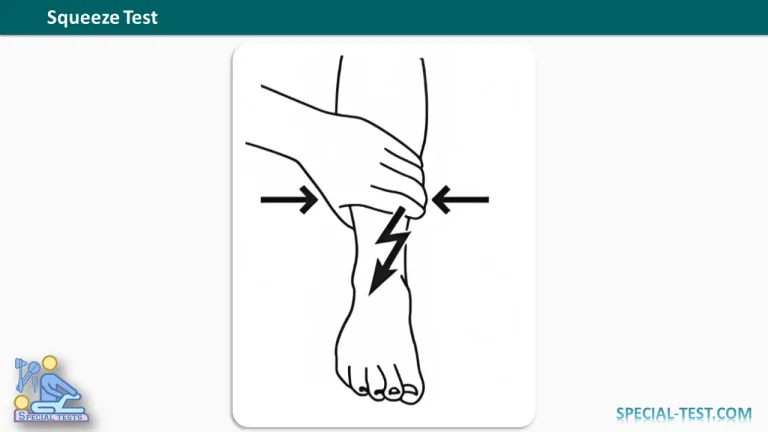
Purpose & Clinical Utility
The squeeze test is a specialized physical examination maneuver used primarily to diagnose syndesmotic ankle sprains (often referred to as a “high ankle sprain”).
- Companion Test: It is typically performed alongside the ankle external rotation test to increase diagnostic confidence.
- Target Structures: The test assesses the structural integrity of the lower leg bones, the interosseous membrane, and the distal tibiofibular syndesmotic ligaments.
How to Perform the Test
- Patient Position: The patient is typically seated or lying down with the leg relaxed.
- Examiner Action: The examiner places both hands around the proximal/mid-calf (compressing the fibula against the tibia), or uses the heel of one hand/fist to compress the fibula toward the tibia.
- Force Application: A gentle, inward compressive force is applied, gradually increasing pressure.
Interpretation & Accuracy
- Positive Result: The test is considered positive if the patient experiences pain at the syndesmosis or along the interosseous membrane (rather than strictly at the site of compression), which may indicate a syndesmotic sprain, fracture, or diastasis.
- Diagnostic Accuracy:
- Sensitivity: 30% (A negative test does not entirely rule out injury).
- Specificity: 93% (A positive test is a strong indicator of syndesmotic pathology).
References
- Orthofixar | Squeeze Test
- Polzer, Hans & Kanz, Karl-Georg & Prall, Wolf & Haasters, Florian & Ockert, Ben & Mutschler, W. & Grote, Stefan. (2012). Diagnosis and treatment of acute ankle injuries: Development of an evidence-based algorithm. Orthopedic reviews. 4. e5. 10.4081/or.2012.e5. Link