Rinne Test: Procedure, Positive and Negative Results
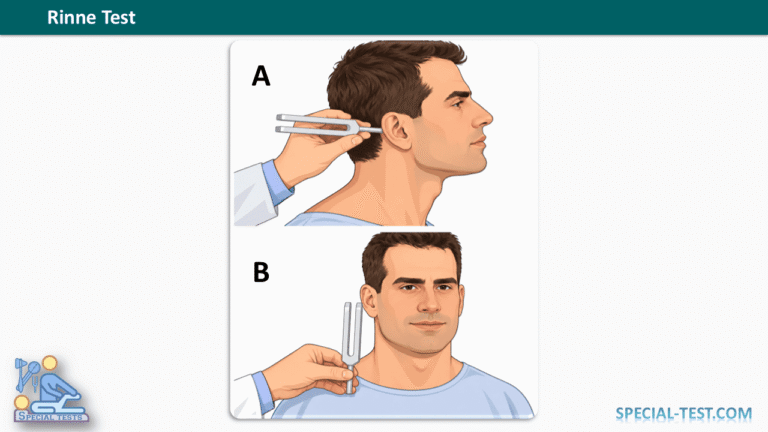
The Rinne test is a clinical hearing examination used to compare air conduction (AC) with bone conduction (BC) and identify patients with suspected conductive hearing loss. It is performed using a vibrating tuning fork, typically with a frequency of 512 Hz.
The Rinne test is commonly performed alongside the Weber test during an ear examination or an assessment of the vestibulocochlear nerve (cranial nerve VIII). Although it provides valuable diagnostic information, it should not replace formal audiometric testing.
What Is the Rinne Test?
The Rinne test is a simple, noninvasive bedside examination that evaluates the transmission of sound through the external ear, middle ear, and bones of the skull.
It was named after Heinrich Adolf Rinne, a German otologist who developed the examination in the nineteenth century.
The primary purpose of the Rinne test is to help differentiate between conductive and sensorineural hearing loss. Its simplicity and minimal equipment requirements make it useful in primary care, otolaryngology (ENT), neurology, and emergency medicine.
Air Conduction vs. Bone Conduction
Understanding the physiological mechanisms of hearing is essential for interpreting the Rinne test results.
Air Conduction (AC)
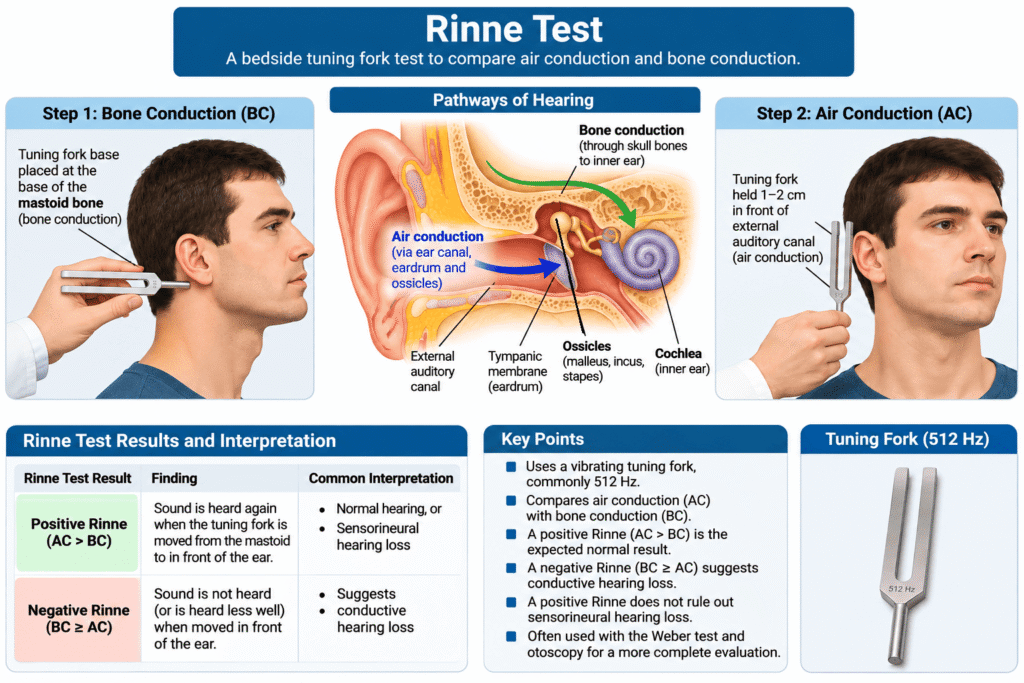
Air conduction is the natural pathway through which sound reaches the inner ear. Sound waves enter the external auditory canal and cause the tympanic membrane (eardrum) to vibrate.
These vibrations are transmitted through the three auditory ossicles:
- Malleus
- Incus
- Stapes
The vibrations subsequently reach the cochlea, where sensory hair cells participate in converting mechanical energy into electrical signals that are transmitted to the brain.
Bone Conduction (BC)
Bone conduction involves the transmission of sound vibrations through the bones of the skull to the inner ear, largely bypassing the external and middle ear structures.
Under normal conditions, air conduction is more efficient than bone conduction. However, abnormalities affecting the external or middle ear may alter this relationship, resulting in a negative Rinne test.
Indications for the Rinne Test
The Rinne tuning fork test is useful in the clinical evaluation of patients presenting with:
- Unilateral or bilateral hearing loss.
- Suspected conductive hearing loss.
- Sudden changes in hearing.
- Otosclerosis.
- Tympanic membrane perforation.
- Middle ear infections or effusion.
- Cerumen impaction.
- Suspected auditory nerve dysfunction.
The examination provides preliminary information that helps clinicians determine whether additional audiological investigations are required.
How to Perform the Rinne Test
The Rinne test is preferably performed using a 512-Hz tuning fork in a quiet examination room.
The patient should be seated comfortably and instructed to report when the sound becomes inaudible.
Rinne Test Procedure
- Ask the patient to remove any hearing aids and explain the examination.
- Activate the tuning fork by gently striking it against a rubber pad or another suitable surface.
- Place the base of the vibrating tuning fork against the mastoid process behind the patient’s ear.
- Ask the patient to indicate when they can no longer hear the sound.
- Immediately reposition the vibrating tuning fork approximately 1–2 cm in front of the external auditory canal.
- Ask the patient whether the sound is audible again.
- Repeat the same procedure on the opposite ear.
- Document the findings separately for each ear.
The examiner should ensure that the patient distinguishes between hearing the sound and physically feeling the vibrations of the tuning fork.
Rinne Test Results and Interpretation
The Rinne test can produce positive, negative, or false-negative results depending on the underlying auditory condition.
Positive Rinne Test
A positive Rinne test occurs when air conduction is greater than bone conduction (AC > BC).
The patient can hear the vibrating tuning fork again when it is moved from the mastoid process to the external auditory canal.
A positive result is typically associated with normal hearing or sensorineural hearing loss.
In sensorineural hearing loss, both air and bone conduction may be impaired, while their normal relationship remains preserved.
Therefore, a positive Rinne test does not necessarily indicate that the patient has normal hearing.
Negative Rinne Test
A negative Rinne test occurs when bone conduction is equal to or greater than air conduction (BC ≥ AC).
This finding suggests the presence of a conductive component to the patient’s hearing impairment.
Common causes of conductive hearing loss include:
- Impacted earwax (cerumen).
- Otitis media with effusion.
- Tympanic membrane perforation.
- Otosclerosis.
- External auditory canal obstruction.
- Auditory ossicular chain abnormalities.
- Cholesteatoma.
Further examination is necessary to determine the underlying cause.
False-Negative Rinne Test
A false-negative Rinne test may occur in patients with profound unilateral sensorineural hearing loss.
When the vibrating tuning fork is placed over the mastoid process of the affected ear, vibrations can travel across the skull and stimulate the functioning cochlea of the opposite ear.
The patient may mistakenly attribute this sound to the affected ear. When the tuning fork is moved in front of the affected external auditory canal, the sound is no longer perceived.
This phenomenon can incorrectly suggest conductive hearing loss. Performing the Weber test and formal audiometry helps clarify the diagnosis.
Rinne and Weber Tests: Clinical Interpretation
The Rinne and Weber tests are complementary bedside examinations used to evaluate hearing impairment.
While the Rinne test compares air and bone conduction in each ear, the Weber test assesses the lateralization of sound when a vibrating tuning fork is placed along the midline of the skull.
| Hearing condition | Rinne test | Weber test |
|---|---|---|
| Normal hearing | AC > BC in both ears | No lateralization |
| Unilateral conductive hearing loss | BC ≥ AC in the affected ear | Lateralizes to the affected ear |
| Unilateral sensorineural hearing loss | Usually AC > BC in both ears | Lateralizes to the better-hearing ear |
| Symmetrical conductive hearing loss | Usually negative in both ears | No lateralization |
| Symmetrical sensorineural hearing loss | Usually positive in both ears | No lateralization |
| Profound unilateral sensorineural hearing loss | Possible false-negative result | Lateralizes to the better-hearing ear |
These findings represent typical clinical patterns. Mixed hearing loss and asymmetrical bilateral hearing impairment can produce more complex results.
Sensitivity and Specificity of the Rinne Test
The diagnostic accuracy of the Rinne test varies depending on the tuning fork frequency, severity of hearing impairment, examination technique, and characteristics of the patient population.
A systematic review published by Kelly et al. in 2018 analyzed 17 studies involving 3,158 participants.
For a 512-Hz tuning fork, the review reported:
- Sensitivity: 16–87%.
- Specificity: 55–100%.
For a 256-Hz tuning fork, the reported values were:
- Sensitivity: 43–91%.
- Specificity: 50–100%.
These findings demonstrate considerable variability between studies and highlight the limitations of relying exclusively on tuning fork examinations to diagnose hearing loss.
Limitations of the Rinne Test
Although the Rinne test is a valuable clinical examination, it has several limitations:
- It cannot accurately quantify the severity of hearing loss.
- Mild conductive hearing loss may remain undetected.
- Profound unilateral sensorineural hearing loss can produce misleading results.
- Results depend on patient cooperation and examiner technique.
- Background noise may interfere with sound perception.
- Mixed hearing loss may be difficult to interpret.
- It cannot establish the specific cause of hearing impairment.
Pure-tone audiometry, otoscopy, and tympanometry may be required to establish a more accurate diagnosis.
Patients experiencing sudden hearing loss should receive urgent medical assessment because sudden sensorineural hearing loss is a time-sensitive condition.
Frequently Asked Questions (FAQs)
What does the Rinne test measure?
The Rinne test compares hearing through air conduction and bone conduction to identify a possible conductive component of hearing loss.
What is a normal Rinne test result?
A normal Rinne test is positive, meaning that air conduction is greater than bone conduction (AC > BC).
What does a negative Rinne test indicate?
A negative Rinne test generally suggests conductive hearing loss resulting from abnormalities involving the external or middle ear. However, profound unilateral sensorineural hearing loss may also produce a false-negative result.
Why is the Rinne test positive in sensorineural hearing loss?
Sensorineural hearing loss can impair both sound transmission pathways while preserving the relative advantage of air conduction over bone conduction.
Why is a 512-Hz tuning fork used for the Rinne test?
A 512-Hz tuning fork provides a suitable balance between vibration duration and sound perception while minimizing the tactile sensations associated with lower-frequency tuning forks.
What is the difference between the Rinne and Weber tests?
The Rinne test compares air and bone conduction in individual ears, whereas the Weber test evaluates the lateralization of sound between both ears.
Is the Rinne test painful?
No. The Rinne test is a noninvasive examination that is generally painless and does not require special patient preparation.
Can the Rinne test detect all types of hearing loss?
No. The examination is primarily useful for identifying conductive hearing impairment. Formal audiometry is necessary to accurately classify and quantify hearing loss.
References
- Belardo K, Kong EL, Sutton AE. Rinne Test. StatPearls Publishing. NCBI Bookshelf.
- Weber Test. StatPearls Publishing. NCBI Bookshelf.
- Kelly EA, Li B, Adams ME. Diagnostic Accuracy of Tuning Fork Tests for Hearing Loss: A Systematic Review. Otolaryngol Head Neck Surg. 2018;159(2):220–230. PubMed.
- Bayoumy AB, de Ru JA. Sudden Deafness and Tuning Fork Tests: Towards Optimal Utilisation. Pract Neurol. 2020;20(1):66–68. PubMed.
- Bone Conduction Evaluation. StatPearls Publishing. NCBI Bookshelf.
- Chandrasekhar SS, et al. Clinical Practice Guideline: Sudden Hearing Loss (Update). Otolaryngol Head Neck Surg. 2019;161(1_suppl)–S45. PubMed.
- Audiogram Interpretation. StatPearls Publishing. NCBI Bookshelf.