Schmidt-Rimpler Test: Purpose, Procedure, Results & Clinical Significance
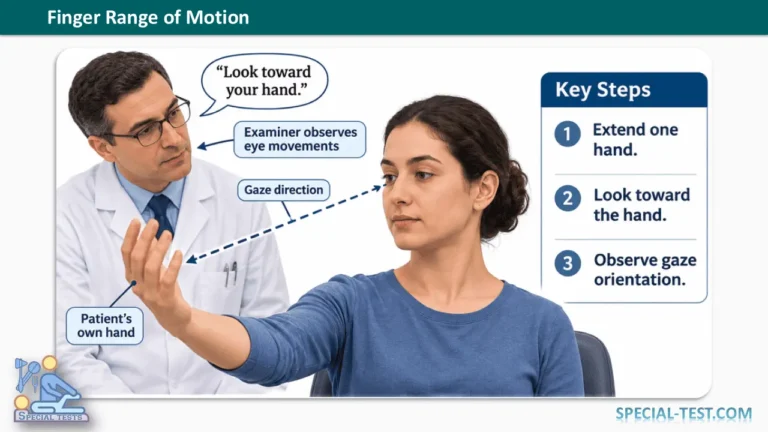
The Schmidt-Rimpler Test, also known as the Look at the Hand Test, is a historical bedside examination maneuver described in the assessment of suspected simulated blindness and unexplained visual loss. The test involves asking a patient to look toward their own hand while the examiner observes eye movements and gaze direction.
Historically, the Schmidt-Rimpler Test was intended to help distinguish organic blindness from simulated visual impairment. However, modern ophthalmology recognizes that this simple maneuver cannot reliably differentiate functional visual loss, neurological blindness, and deliberate simulation.
Although the test is of historical and educational interest, it should not replace a comprehensive ophthalmological or neuro-ophthalmological examination. [1,2]
What Is the Schmidt-Rimpler Test?
The Schmidt-Rimpler Test is a clinical observation technique based on the relationship between eye movements, body awareness, and proprioception.
Proprioception is the body’s ability to recognize the position and movement of its limbs without relying on vision. A person with profound visual impairment may therefore know where their hand is located and direct their eyes toward it, even when unable to see it.
Older descriptions proposed that individuals with genuine blindness could orient their gaze toward their hands, while those intentionally simulating blindness might avoid doing so.
However, this traditional interpretation has important limitations. Looking toward one’s hand does not necessarily demonstrate preserved vision, and failing to look toward it does not establish deliberate deception. [1]
Purpose of the Schmidt-Rimpler Test
The historical purpose of the Schmidt-Rimpler Test was to provide an additional bedside observation when examining patients who reported severe visual impairment.
Its proposed applications included:
- Observing gaze orientation in patients reporting blindness.
- Assessing the relationship between proprioception and eye movements.
- Identifying behavioral responses that might require further neurological examination.
- Contributing to the historical evaluation of suspected simulated visual loss.
- Supporting educational discussions about the limitations of bedside visual assessment.
The Schmidt-Rimpler Test is not a validated standalone diagnostic test for functional blindness or malingering. Its findings must be interpreted in combination with the patient’s history, examination, and appropriate investigations.
How to Perform the Schmidt-Rimpler Test
The following steps describe the historical maneuver for educational purposes.
Step 1: Patient Position
The patient is seated comfortably in a well-lit examination room. The examiner explains that the assessment involves observing eye movements and awareness of hand position.
Step 2: Hand Positioning
The patient is asked to extend one hand in front of the body or position it within the expected visual field.
Step 3: Verbal Instruction
The examiner asks the patient to direct their eyes toward their own hand.
The instruction should be straightforward and understandable, without attempting to mislead or embarrass the patient.
Step 4: Observation
The examiner observes whether the patient’s eyes turn toward the approximate position of the hand.
Relevant observations may include:
- Direction of gaze.
- Ability to maintain eye orientation.
- Consistency of responses.
- Presence of abnormal eye movements.
- Difficulty understanding or following instructions.
Step 5: Clinical Documentation
The response is documented objectively, including any factors that might influence the result, such as impaired proprioception, neurological deficits, reduced attention, or abnormal ocular motility.
The maneuver does not have established standardized scoring criteria or diagnostic accuracy measures suitable for independent clinical decision-making.
Schmidt-Rimpler Test Results and Interpretation
Historically, the test was interpreted according to whether the patient directed their gaze toward the hand.
| Observation | Clinical Interpretation |
|---|---|
| Patient looks toward the hand | May reflect proprioceptive awareness; does not prove intact vision |
| Patient does not look toward the hand | Nonspecific finding; cannot establish simulation |
| Inconsistent gaze responses | May warrant further assessment of attention, ocular motility, comprehension, and visual function |
| Difficulty locating the hand | May be associated with impaired body awareness, proprioceptive dysfunction, or neurological disease |
Importantly, there is no clinically established positive or negative result that reliably determines whether the reported blindness is organic, functional, or intentionally simulated.
The historical interpretation should not be applied as a modern diagnostic rule.
Clinical Significance of the Schmidt-Rimpler Test
The main educational value of the Schmidt-Rimpler Test is its demonstration that gaze direction and conscious visual perception are not equivalent.
A person can orient toward a body part using proprioceptive information without seeing it.
Conversely, impaired attention, neurological dysfunction, or disturbances of body representation may affect the ability to perform the maneuver despite preserved visual pathways.
This distinction is particularly important when assessing patients with suspected functional visual loss (FVL).
Functional visual loss, also called functional vision disorder, is a recognized presentation of functional neurological disorder. Patients experience genuine visual symptoms that are inconsistent with the degree or pattern of structural disease identified during examination.
Modern diagnostic approaches emphasize positive clinical findings demonstrating preserved or variable visual function rather than assuming that unexplained symptoms represent deception. [2–4]
Limitations of the Schmidt-Rimpler Test
Several important limitations restrict the clinical usefulness of this maneuver.
1. Lack of established diagnostic accuracy
The Schmidt-Rimpler Test does not have established sensitivity, specificity, or validated thresholds for distinguishing different causes of visual loss.
2. Influence of proprioception
Individuals with profound visual impairment may accurately orient their eyes toward their hands without using visual information.
3. Neurological confounding factors
Conditions affecting spatial attention, body awareness, motor planning, or eye movements may interfere with the response.
4. Cognitive and communication factors
Reduced attention, difficulties understanding instructions, or impaired cooperation can alter performance.
5. Risk of incorrect diagnosis
Relying on a single behavioral observation may result in inappropriate accusations of malingering or delayed recognition of serious ocular and neurological disorders.
Therefore, contemporary clinical practice favors structured assessment rather than relying on historical bedside maneuvers alone.
Modern Evaluation of Functional Visual Loss
Patients presenting with unexplained visual loss require a systematic assessment to identify ocular, neurological, and functional causes.
A modern evaluation may include:
1. Visual Acuity Testing
Standardized visual acuity assessment helps determine the degree of reported visual impairment. Alternative testing methods may be used when conventional responses are inconsistent.
2. Pupillary Examination
Pupillary light responses and assessment for a relative afferent pupillary defect can provide information about the anterior visual pathways.
However, normal pupillary responses do not exclude all causes of severe visual loss, including certain cortical disorders.
3. Visual Field Examination
Confrontation testing and automated perimetry can identify patterns of visual field loss.
Certain inconsistent field patterns may support a functional diagnosis when considered with other findings, but they are not independently conclusive.
4. Fundus Examination and Optical Coherence Tomography
Fundoscopy and optical coherence tomography (OCT) help identify structural abnormalities involving the retina, macula, and optic nerve.
5. Positive Tests of Preserved Visual Function
Depending on the clinical presentation, specialists may assess stereopsis, optokinetic responses, ocular movements, or visual performance using techniques such as fogging and structured visual tasks.
6. Additional Neurological Investigations
Magnetic resonance imaging, electrophysiological testing, and other investigations may be appropriate when the history or examination suggests optic nerve, retinal, or intracranial disease.
A normal structural examination alone does not establish functional visual loss. A positive diagnosis requires findings that demonstrate visual function inconsistent with the reported impairment while appropriately assessing possible coexisting disease. [2–5]
Clinical Precautions
The Schmidt-Rimpler Test should never be used to accuse a patient of pretending to be blind.
Functional visual symptoms can be involuntary and significantly disabling. Furthermore, functional and structural visual disorders may coexist.
Patients with sudden visual loss, painful visual impairment, new visual field defects, or associated neurological symptoms require urgent medical evaluation.
The most appropriate approach combines careful examination, respectful communication, evidence-based investigations, and referral to ophthalmology or neuro-ophthalmology when indicated.
Frequently Asked Questions (FAQs)
1. What is the Schmidt-Rimpler Test used for?
The Schmidt-Rimpler Test is a historical maneuver used in the assessment of reported blindness. It involves observing whether a patient directs their gaze toward their own hand. It is not considered a reliable standalone diagnostic test.
2. How is the Schmidt-Rimpler Test performed?
The patient is asked to extend a hand and look toward it. The examiner observes gaze direction and eye movements while considering neurological and proprioceptive factors that could influence the response.
3. What is a positive Schmidt-Rimpler Test?
There is no universally accepted or validated modern definition of a positive Schmidt-Rimpler Test. Historically, gaze behavior was interpreted as a possible indicator of simulated blindness, but this interpretation is not diagnostically reliable.
4. Can the Schmidt-Rimpler Test detect malingering?
No. The test cannot reliably establish intentional simulation or malingering. Such conclusions require a much broader clinical assessment and cannot be inferred from a single bedside observation.
5. What is the difference between functional and organic visual loss?
Organic visual loss results from identifiable abnormalities involving structures such as the retina, optic nerve, or visual pathways. Functional visual loss involves altered visual function that is inconsistent with recognized structural disease. Both types of visual impairment can occur in the same patient.
6. Is functional visual loss the same as fake blindness?
No. Functional visual loss is a recognized clinical condition in which symptoms are generally experienced involuntarily. It should not be equated with deliberate deception.
7. Is the Schmidt-Rimpler Test still used today?
The maneuver may be discussed in historical ophthalmology literature or clinical education. Modern evaluations rely on more informative examination techniques and investigations rather than treating the Schmidt-Rimpler Test as definitive evidence.
8. Which tests are more useful for evaluating unexplained visual loss?
Visual acuity testing, pupillary examination, visual field assessment, fundus examination, OCT, and selected neuro-ophthalmological tests are more informative. The appropriate combination depends on the patient’s symptoms and clinical findings.
9. Can a blind person look toward their own hand?
Yes. A person with severe blindness may orient their eyes toward their hand using proprioceptive information rather than vision. This is one reason the Schmidt-Rimpler Test cannot reliably determine whether a patient can see.
10. When should someone with unexplained visual loss seek medical attention?
New, sudden, painful, or progressive visual loss requires prompt medical assessment. Sudden visual loss or visual symptoms accompanied by neurological deficits may represent a medical emergency.
Conclusion
The Schmidt-Rimpler Test (Look at the Hand Test) is a historical examination maneuver based on the relationship between proprioception, gaze direction, and body awareness.
Although originally described as a method for evaluating suspected simulated blindness, its diagnostic limitations prevent it from reliably distinguishing organic visual loss, functional visual loss, and malingering.
Contemporary ophthalmology emphasizes positive clinical findings, comprehensive visual assessment, identification of coexisting diseases, and respectful patient communication.
The Schmidt-Rimpler Test is therefore best understood as a historical clinical observation rather than a definitive diagnostic procedure.
References
- Incesu AI, Sobacı G. Malingering or simulation in ophthalmology—visual acuity. International Journal of Ophthalmology. 2011;4(5):558–566.
PubMed – PMID: 22553721 - Zeppieri M, et al. Nonorganic Vision Loss. StatPearls. NCBI Bookshelf. Updated 2026.
NCBI Bookshelf – NBK599519 - Ramsay N, McKee J, Al-Ani G, Stone J. How do I manage functional visual loss? Eye. 2024;38:2257–2266.
PubMed – PMID: 38778139
NCBI Full Text - Raviskanthan S, et al. Functional Vision Disorders in Adults: A Paradigm and Nomenclature Shift for Ophthalmology. Survey of Ophthalmology. 2022;67(1):8–18.
PubMed – PMID: 33737039
NCBI Full Text - Functional vision disorder: a review of diagnosis, management and costs. British Journal of Ophthalmology.
PubMed – PMID: 38307720 - Ramsay N, et al. Functional visual loss: a systematic review and meta-analysis of epidemiology, prognosis and treatment. Eye. 2026;40:1784–1793.
PubMed – PMID: 42362994