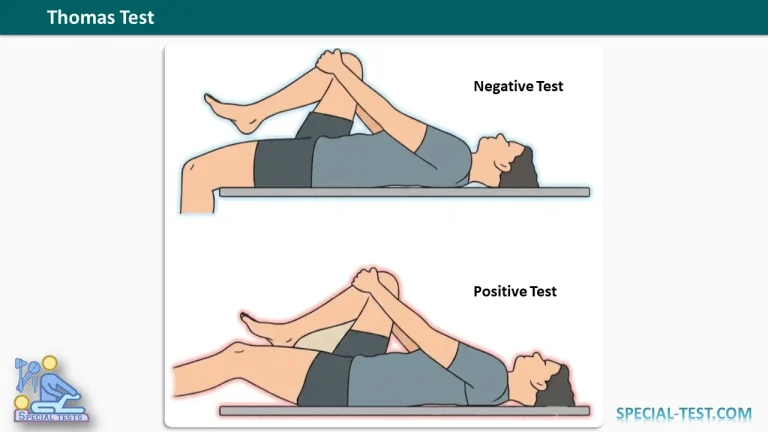
Thomas Test
What is the “Thomas Test” used for?
- Thomas Test is used to measure the flexibility of the hip flexors, which includes:
- Iliopsoas muscle group
- Rectus femoris
- Pectineus
- Gracilis
- Tensor Fascia Latae
- Sartorius.
How to perform the “Thomas Test”?
- The patient should be supine on the examination table, maximally flex both knees, using both arms to ensure that the lumbar spine is flexed and flat on the table and avoids a posterior tilt of the pelvis.
- The patient then lowers the tested limb toward the table, whilst the contralateral hip and knee is still held in maximal flexion to stabilize the pelvis and flatten out the lumbar lordosis.
What is the positive result?
- The Thomas test is negative when the subject’s lower back and the sacrum is able to remain on the table.
- The hip can make a 10° posterior tilt or a 10° hip extension. The knee must be able to make a 90° flexion.
- The test is positive when:
- Patient is unable to maintain his lower back and sacrum against the table
- Hip has a large posterior tilt or hip extension greater than 15°
- Knee unable to meet more than 80° flexion
Test Accuracy
- Sensitivity: 31 %
- Specificity: 57 %
References