Tabletop Relocation Test
What is the "Tabletop Relocation Test" used for?
- Posterolateral rotary instability of the elbow
How to perform the "Tabletop Relocation Test"?
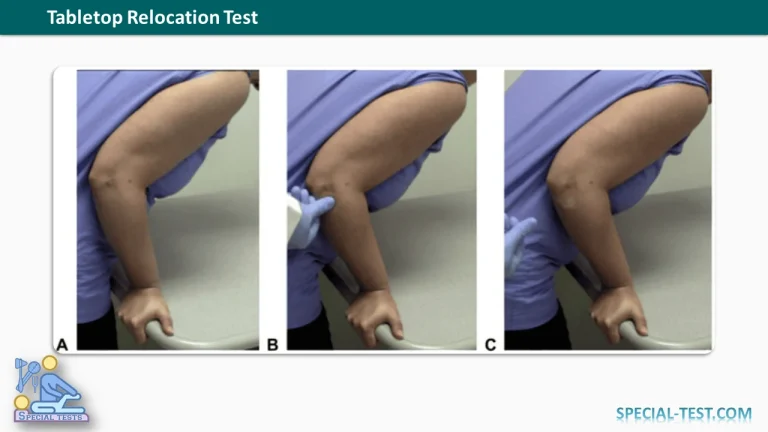
The patient is asked to stand in front of a table with the symptomatic arm placed over the table’s lateral edge and elbow extended. First, the patient is asked to do a push-up (down phase) with the elbow pointed laterally maintaining the arm in supination by flexing the elbow. If the patient has posterolateral rotary instability, pain and apprehension will occur near 40° of flexion.
Secondly, the movement is repeated while the examiner places a thumb over the radial head, pushing against the head to stabilize it, and when the patient does the “down” movement, the pain and apprehension are relieved. If the examiner removes the thumb, the pain and apprehension will return
What is the positive result?
A positive Tabletop Relocation Test indicates posterolateral rotary instability of the elbow, suggesting:
- Lateral ulnar collateral ligament insufficiency
- Possible associated capsular laxity
- Potential lateral epicondyle pathology
- Risk for recurrent subluxation episodes