Subacromial Injection Test
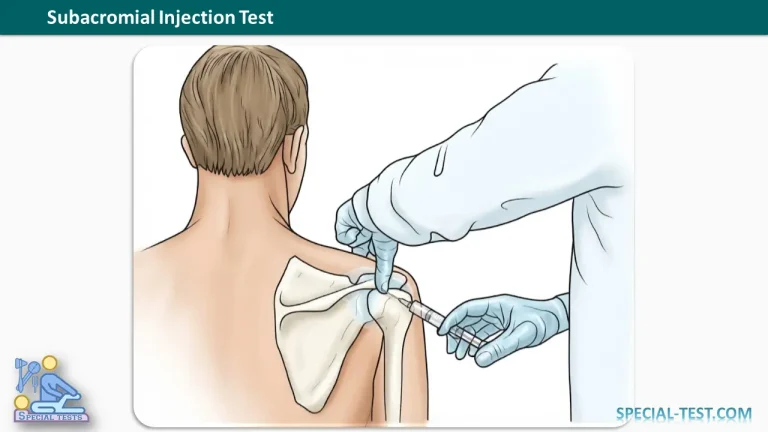
What is the "Subacromial Injection Test" used for?
- Subacromial Impingement Syndrome
How to perform the "Subacromial Injection Test"?
Subacromial injection of 10 mL of 1% lidocaine (Xylocaine).
Posterior Approach
- Patient is placed in the seated position with their affected upper extremity resting comfortably at their side on the chair’s arm rest with the shoulder in an internally rotated position.
- Examine the posterolateral aspect of the shoulder looking for evidence of overlying cellulitis (avoid placing the needle through any area of potential infection).
- Palpate the posterior and lateral borders of the acromion process localizing its most posterolateral aspect and palpate the coracoid process anteriorly.
- Localize the posterolateral soft spot between the humeral head and the glenoid approximately two finger breadths distal and one finger breadth medial to the posterolateral corner of the acromion (The location of the humeral head relative to the glenoid can be appreciated with rotation of the upper arm).
- Mark this site as the starting point for the injection.
- Prep the skin in this region using alcohol and povidone-iodine, Put on sterile gloves.
- If available, an assistant can spray the area with ethyl chloride spray to provide superficial analgesia just prior to needle insertion.
- The needle should be directed anteriorly toward the coracoid process advancing slowly aiming slightly medial.
- The needle aimed superiorly at a 10 to 15° angle to end up just distal to the undersurface of the acromion process.
- Once in the subacromial space, aspirate first to ensure that the tip of the needle is not intravascular followed by injection of the prepared lidocaine-corticosteroid mixture.
Anterior Approach
- Patient is placed in the seated position with their affected upper extremity resting comfortably at their side on the chair’s arm rest with the shoulder in a neutral or slightly externally rotated (approximately 15 to 20°) position.
- Examine the anterior aspect of the shoulder looking for evidence of overlying cellulitis (avoid placing the needle through any area of potential infection).
- Palpate the coracoid process and the humeral head (rotation of the upper extremity can help localize the humeral head relative to the glenoid).
- Mark the starting point for the injection just medial to the humeral head, 5 to 10 mm lateral to the tip of the coracoid process.
- The needle aimed superiorly at a 10 to 15° angle to end up just distal to the undersurface of the acromion process.
What is the positive result?
- Pain caused by impingement usually is significantly reduced or eliminated, but pain caused by other conditions (with the exception perhaps of calcific tendinitis) is not relieved.
Test Accuracy
- Sensitivity: 79 %
- Specificity: 53 %
References
- Campbel’s Operative Orthopaedics Book
- Huu MN, Dung TT, Ngoc TM, Tran Q, Le Khanh T, et al. (2017) Corticoid Injection for Subacromial Impingement Syndrome Treatment. Glob J Medical Clin Case Rep 4(4): 080-082. DOI: 10.17352/2455-5282.000055