Published July 17, 2026Read time 1 min readReaders 49
What is the "Stinchfield Test" used for?
Stinchfield test (or resisted hip flexion test) is designed to help distinguish between intra-articular and extra-articular hip pathology causing groin, thigh, buttock, and even pretibial leg pain.
How to perform the "Stinchfield Test"?
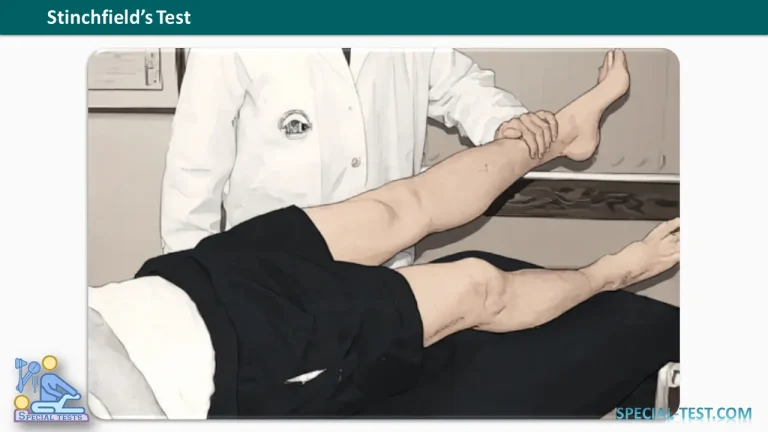
The patient is positioned in supine and asked to lift their leg, without bending the knee, to about 30 degrees.
If this maneuver does not reproduce any pain, the clinician applies pressure downward on the patient’s raised leg, in an attempt to extend the flexed hip, while the patient resists the force.
Pain produced either with or without resistance is assessed for location.
What is the positive result?
If the pain is felt in the groin or anterior thigh, it is considered to arise from the hip;
While if the pain is felt in the buttock or lumbar spine, the sacroiliac joint or lumbar spine is the likely source.
References
Dutton’s Orthopaedic Examination, Evaluation, And Intervention 3rd Edition.
The Diagnostic Validity of Hip Provocation Maneuvers to Detect Intra-Articular Hip Pathology” from PM&R, March 2010 Link