Silfverskiold Test
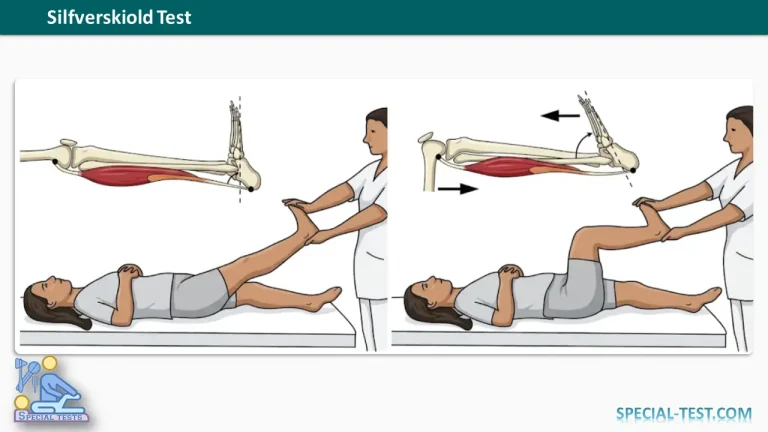
What is the "Silfverskiold Test" used for?
- Silfverskiold Test is used to evaluate the contracture of the ankle joint whether it's caused by gastrocnemius muscle contracture or by the Achilles tendon contracture.
- It measures the dorsiflexion of the foot at the ankle joint with knee extended and flexed to 90 degrees.
How to perform the "Silfverskiold Test"?
- With the patient supine or seated, the examiner dorsiflexes the foot while the knee in full extension and measures the ankle dorsiflexion range.
- Then the test is repeated with knee flexed at 90 degrees and the ankle dorsiflexion range is measured.
What is the positive result?
Ankle movements are influenced by the position of the knee because gastrocnemius crosses both joints.
- In gastrocnemius contracture, dorsiflexion of the ankle is limited with knee extension and more dorsiflexion of ankle is possible on knee flexion.
- In Achilles tendon contracture the dorsiflexion of the ankle remains the same irrespective of the position of the knee joint (flexion or extension).
Because the gastrocnemius originates from above the knee, it tightens when the knee is extended and relaxes when the knee is flexed. If the loss of dorsiflexion is because of gastrocnemius tightness alone, then there will be reduced dorsiflexion with the knee extended. If there is no change of ankle dorsiflexion with knee flexion or extension, then the contracture is in both gastrocnemius and soleus.
Test Accuracy
- The Silfverskiöld test had poor inter- and intrarater reliability.
References
- Symeonidis P. The Silfverskiöld Test. Foot Ankle Int. 2014 Aug;35(8):838. doi: 10.1177/1071100714535202. Epub 2014 Jul 30. PMID: 25080357.
- Clinical Assessment and Examination in Orthopedics, 2nd Edition Book.
- Orthofixar – Silfverskiold Test