Seated Flexion Test
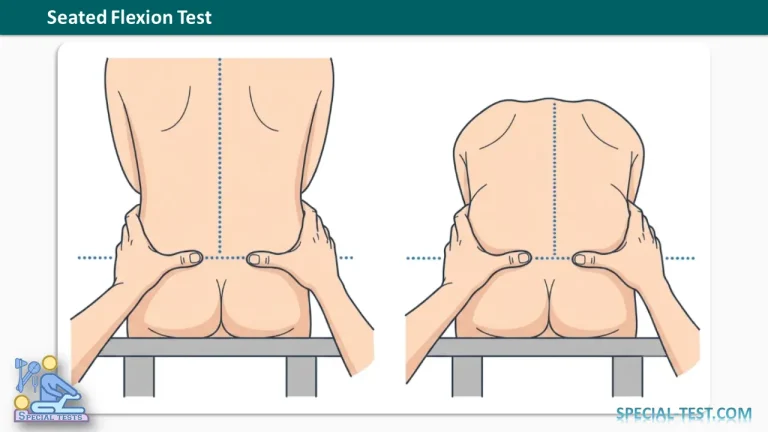
What is the "Seated Flexion Test" used for?
- Dysfunction of the sacroiliac joint
How to perform the "Seated Flexion Test"?
- The patient sits on a firm examination table, Legs hang over the edge with the feet supported, the examiner stands behind the patient.
- Each posterior superior iliac spine (PSIS) is palpated with the thumbs placed inferiorly (caudally).
- This position reduces innominate motion and is believed to isolate SI joint movement.
- Examiner palpates both PSIS landmarks simultaneously.
- The patient bends forward at the waist.
- The examiner observes and compares PSIS motion.
What is the positive result?
Normal Finding
- Both PSIS move superiorly and symmetrically as the patient flexes forward.
Positive Test
- One PSIS moves more superiorly than the other.
- The side that moves first or furthest is considered the restricted side.
- This asymmetry suggests possible SI joint dysfunction or pelvic fixation.
Test Accuracy
- Sensitivity: 9%
- Specificity: 93%