Roos Test
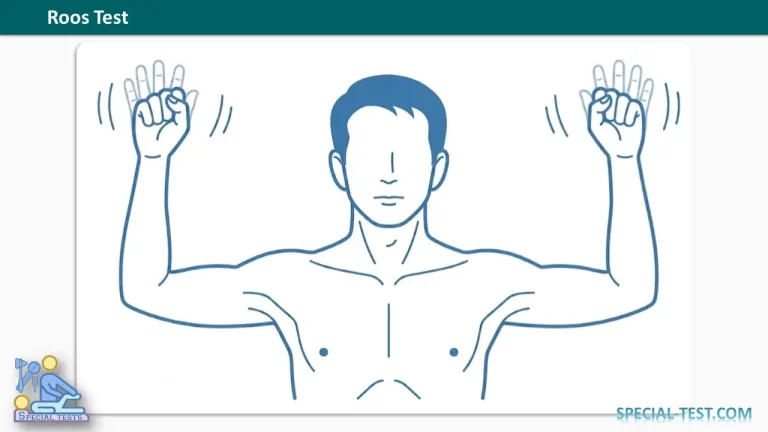
What is the "Roos Test" used for?
It is also referred to as the hands-up test, or the elevated arm stress test, it's used for:
- Thoracic Outlet Syndrome
How to perform the "Roos Test"?
- The patient is positioned sitting.
- The arm is positioned in 90 degrees of shoulder abduction, and 90 degrees of elbow flexion.
- The patient is asked to perform slow finger clenching for 3 minutes.
- The radial pulse may be reduced or obliterated during this maneuver, and an infraclavicular bruit may be heard.
- The patient is encouraged to describe any sensation felt during this process.
What is the positive result?
- If the patient is unable to maintain the arms in the start position for 3 minutes, diminished motor function of the hands, or reports pain, heaviness, or numbness and tingling, the test is considered positive for Thoracic Outlet Syndrome TOS on the involved side.
Test Accuracy
- Sensitivity: 0.52-0.84
- Specificity: 0.30-1.00
References
- Roos Test – Orthofixar
- Roos OB. Historical perspectives and anatomic considerations. Thoracic outlet syndrome. Semin Thorac Cardiovasc Surg. l 996;8(2) : 183-189.
- Dutton’s Orthopaedic Examination, Evaluation, And Intervention 3rd Edition.