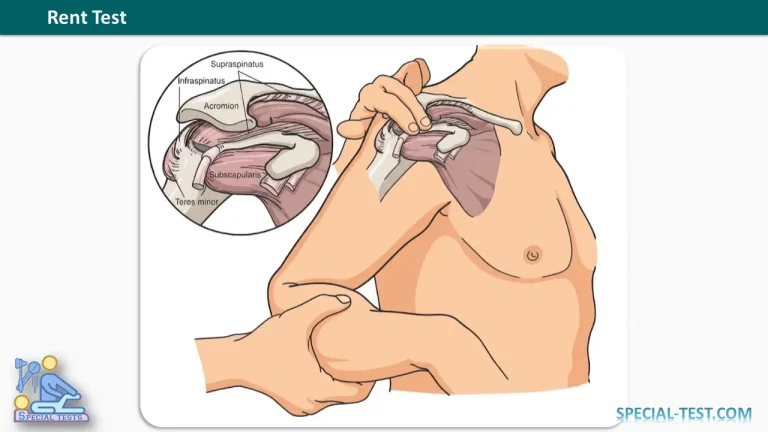
Rent Test
What is the "Rent Test" used for?
- The Rent Test (or Transdeltoid Palpation test) is used to diagnosis the full thickness tear of the shoulder rotator cuff.
How to perform the "Rent Test"?
- The patient sits or stands with the involved arm relaxed and hanging on the side.
- The clinician stands behind the patient and holds the patient’s distal arm with the patient’s elbow flexed to 90 degrees.
- The clinician then passively moves the patient’s glenohumaeral joint into full extension, which allows greater palpation of the humeral head and tendons inserting into the greater tuberosity.
- Palpation is performed at the anterior margin of the acromion. While palpating this area with the shoulder in the fully relaxed and extended position, the clinician moves the patient’s arm into internal and external shoulder rotation to allow further palpation of the rotator cuff tendons.
What is the positive result?
- In the presence of a complete rotator cuff tear, the eminence of the greater tuberosity appears quite prominent to palpation, and the torn area feels like a sulcus “rent”, or soft-tissue defect (depression of approximately 1 finger-width) that has avulsed from the tuberosity.
- Palpating the anterior and posterior margins of the cuff tear may elicit an avulsed edge.
- It is recommended that this test be used to determine the absence or presence of a rotator cuff tear rather than the size of the tear.
Test Accuracy
- Sensitivity: 95.7%
- Specificity: 96.8%
References