Protzman Test
What is the “Protzman Test” used for?
- Shoulder Anterior Instability
How to perform the “Protzman Test”?
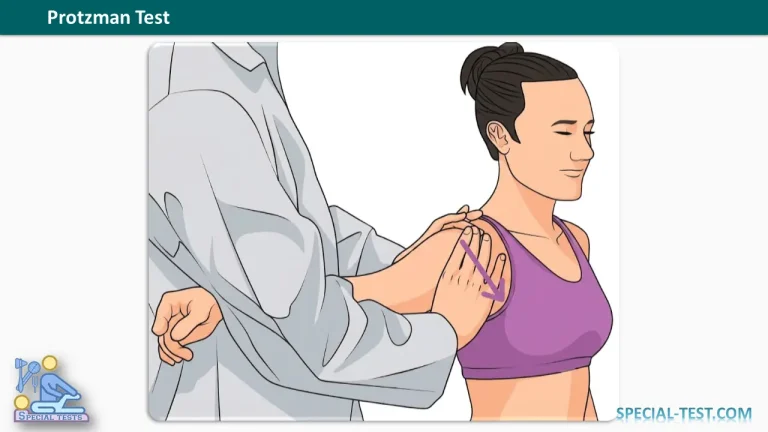
- The patient is sitting. The examiner abducts the patient’s arm to 90° and supports the arm against the examiner’s hip so that the patient’s shoulder muscles are relaxed.
- The examiner palpates the anterior aspect of the head of the humerus with the fingers of one hand deep in the patient’s axilla while the fingers of the other hand are placed over the posterior aspect of the humeral head.
- The examiner then pushes the humeral head anteriorly and inferiorly
- The test can also be done with the patient in the supine-lying position with the elbow supported on a pillow
What is the positive result?
- If this movement causes pain and if palpation indicates abnormal anteroinferior movement, the test is positive for anterior instability
- Anterior translation should normally be no more than 25% of the diameter of the humeral head.
- A click may sometimes be palpated as the humeral head slides over the glenoid rim.
References
- Valencia Mora M, Ibán MÁR, Heredia JD, Gutiérrez-Gómez JC, Diaz RR, Aramberri M, Cobiella C. Physical Exam and Evaluation of the Unstable Shoulder. Open Orthop J. 2017 Aug 31;11:946-956. doi: 10.2174/1874325001711010946. PMID: 29114336; PMCID: PMC5646139. Link
- Protzman, R R. “Anterior instability of the shoulder.” The Journal of bone and joint surgery. American volume vol. 62,6 (1980): 909-18. Link