Popliteal Angle Test
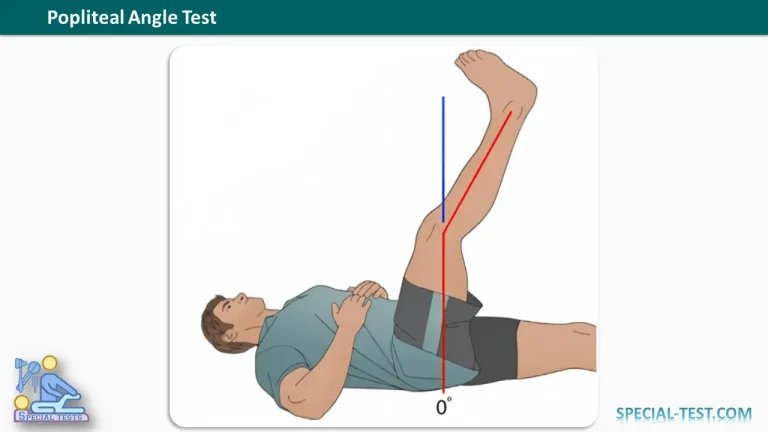
What is the "Popliteal Angle Test" used for?
- The popliteal angle test is used very commonly for the assessment of hamstring contracture in patients with cerebral palsy.
How to perform the "Popliteal Angle Test"?
- The child lies supine, and the examiner flexes the hip joint to 90° while the contralateral hip is in neutral position and the limb is extended at the knee. The examiner gradually extends the knee with hip flexed at 90°.
- When the examiner feels a substantial resistance to knee extension, the acute angle formed between the long axis of the femur and tibia is measured.
What is the positive result?
Normal values of Popliteal Angle:
- Between the ages of 1 and 3 years, the mean angle was 6 degrees (range, 0-15).
- At age 4, the angle rose to 17 degrees in girls and 27 degrees in boys (range, 5-45).
- At greater than or equal to 5 years the mean angle was 26 degrees with little change (range, 0-50).
A popliteal angle of greater than 50 degrees in the above age groups indicates abnormal hamstring tightness.
Test Accuracy
- Because of poor interobserver reliability of popliteal angle measurement, this should not be the only variable in clinical decision making in CP patients.
References
- Popliteal Angle Test – Orthofixar
- Sports Performance Bulletin
- Ten Berge SR, Halbertsma JP, Maathuis PG, Verheij NP, Dijkstra PU, Maathuis KG. Reliability of popliteal angle measurement: a study in cerebral palsy patients and healthy controls. J Pediatr Orthop. 2007 Sep;27(6):648-52. doi: 10.1097/BPO.0b013e3180dca15d. PMID: 17717465.