Placing Reaction
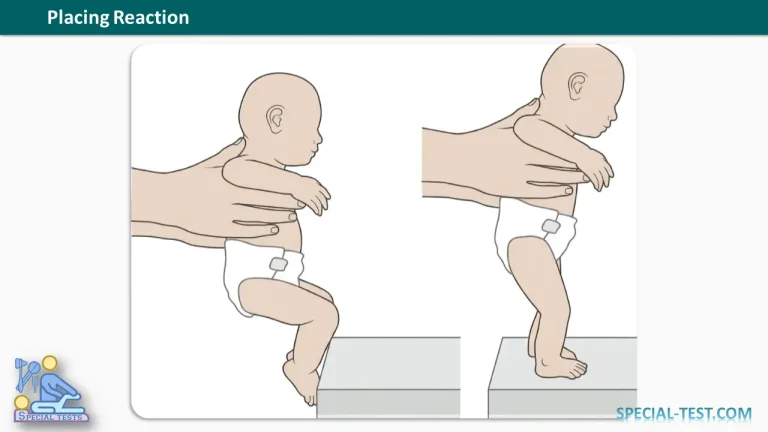
How to perform the "Placing Reaction"?
The placing reaction is tested separately for the lower and upper limbs:
- To elicit the placing reaction for the lower limbs, the examiner supports the patient upright by holding the infant under the axillae with the examiner’s thumbs supporting the back of the head and the infant facing away (vertical suspension position). The anterior aspect of the distal tibia or dorsal surface of one foot is then brought against the edge of the examining table. The infant will spontaneously flex the hip and knee, dorsiflex the ankle, and place the foot on the table, extending the lower limb on active or passive contact of the sole with the table. The process is then repeated with the other foot.
- To elicit the placing reaction for the upper limbs, the infant is held at the waist and facing away from the examiner, and the dorsum of the infant’s ulna is placed against the edge of the table. The infant will respond by flexing the elbow and placing the hand on the table. In older children, these responses must be differentiated from voluntary placing.
What is the positive result?
- The placing reaction is normally present at birth in full term neonates.
- Upper limb placing usually disappears by 2 to 4 months of age and lower limb placing by 1 to 2 months of age, but both responses may persist up to 12 months of age or older.
- If the reflex is absent at birth, the infant may have neurologic dysfunction.