McCarthy Test
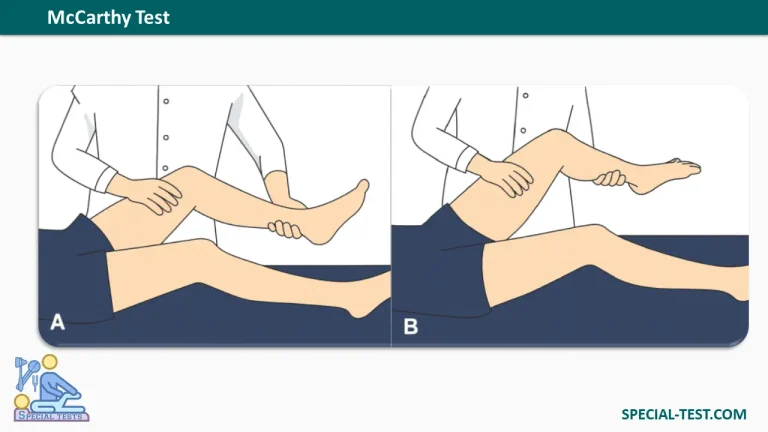
What is the "McCarthy Test" used for?
- Acetabular labral tears and intra-articular hip pathology
How to perform the "McCarthy Test"?
- The patient lies supine on the examination table with both hips fully flexed. This position places the femoral head anteriorly and tensions the acetabular labrum.
- The examiner begins with the unaffected (“good”) hip.
- Keeping the opposite hip fully flexed, the examiner extends the test hip from the flexed position. Extension is performed twice:
- First with the hip in lateral rotation,
- Then with the hip in medial rotation.
- After assessing the good hip, the maneuver is repeated on the affected side using the same sequence:
- Hip flexion → extension in lateral rotation → extension in medial rotation.
- This pattern simulates the arc of movement that occurs during normal gait.
What is the positive result?
The McCarthy test is considered positive when the maneuver reproduces:
- The patient’s characteristic pain (especially groin pain), and/or
- A palpable or audible “pop” during hip extension.
A positive result suggests:
- Possible labral tear
- Intra-articular mechanical dysfunction
- Impingement phenomena within the hip joint.