Ligamentum Teres Test
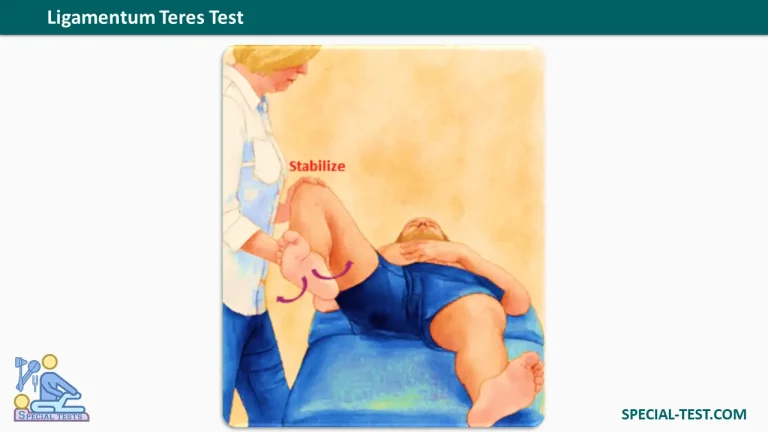
What is the "Ligamentum Teres Test" used for?
- Assess the integrity and irritability of the ligamentum teres of the hip
How to perform the "Ligamentum Teres Test"?
- The patient lies supine on the examination table. The pelvis should remain stable with no rotation or compensatory movement.
- The clinician stands beside the hip being examined, ensuring full control of hip and leg movement.
- Flex the knee to 90° and passively flex the hip to approximately 70°. Confirm that the pelvis remains neutral and does not rotate.
- Abduct the hip maximally. Adduct the hip to 30° short of the previously reached full abduction. This position places optimal tension on the ligamentum teres.
- In this position, perform full internal (medial) and external (lateral) rotation of the hip. These movements maximally stress the ligamentum teres without causing impingement from surrounding structures.
What is the positive result?
The test is considered positive if pain is reproduced during either:
- Medial rotation, or
- Lateral rotation
in the final test position.
Pain suggests:
- Ligamentum teres sprain or tear
- Intra-articular irritation or synovitis
- Possible associated microinstability of the hip.
Test Accuracy
- Sensitivity: 90%
- Sensitivity: 85%