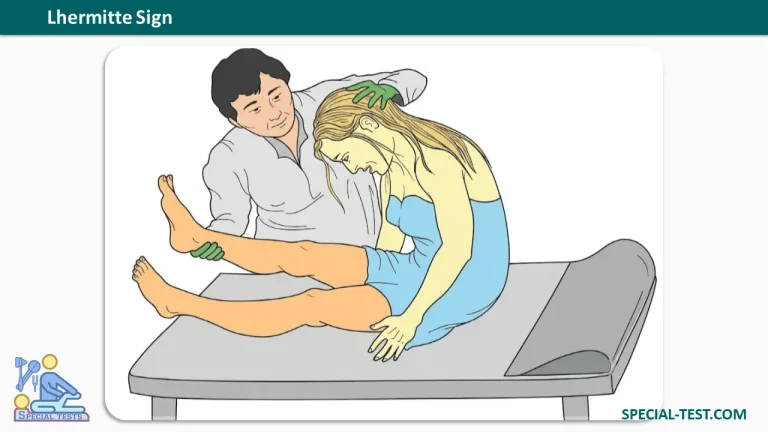
Lhermitte Sign
What is the "Lhermitte Sign" used for?
- Lhermitte Sign differentiates between spinal cord lesions and peripheral nerve root lesions.
How to perform the "Lhermitte Sign"?
- The patient sits with outstretched legs on the examination table.
- The examiner grasps the patient’s foot with one hand and places the other on the back of the patient’s head.
- The examiner then simultaneously flexes the outstretched leg at the hip and increasingly flexes the cervical spine.
What is the positive result?
The Lhermitte test is positive if an acute pain occurs that radiates into the upper or lower extremity.
- This suggests dural or meningeal irritation of the spinal cord (root irritation) or possibly cervical myelopathy.
- If the patient were to actively bend the head toward the breast, then this would be the Soto-Hall test.
- Maximally flexing the cervical spine places strong tension on the spinal cord.
A positive Lhermitte sign can indicate stenosis of the cervical spinal canal:
- The patient describes a sudden, generalized electric shock in the arms and trunk, especially when inclining the head.
Differential diagnosis for patients with a positive Lhermitte Sign:
- Brachial plexus lesion
- Irritated cervical root syndrome
- Multiple sclerosis
- Spinal tumor.
- Amyotrophic lateral sclerosis.
Test Accuracy
- Sensitivity: 3 – 17%
- Specificity: 97% (for non-specific compressive myelopathy)
References
- Clinical Tests for the Musculoskeletal 3rd Ed. Book