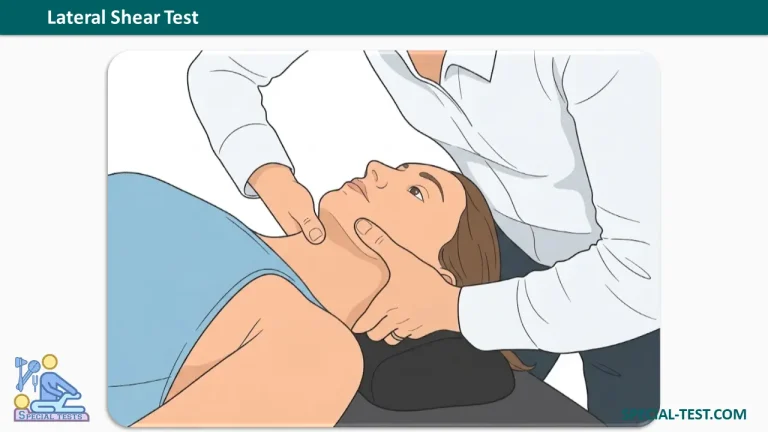
Lateral Shear Test
What is the "Lateral Shear Test" used for?
- Lateral Shear Test is used to determine instability of the atlanto-axial articulation caused by odontoid dysplasia.
How to perform the "Lateral Shear Test"?
- The patient lies supine with the head supported.
- The examiner places the radial side of the second metacarpophalangeal (MCP) joint of one hand against the transverse process of the atlas and the MCP joint of the other hand against the opposite transverse process of the axis.
- The examiner’s hands are then carefully pushed together, causing a shear of one bone on the other.
What is the positive result?
- Normally, minimal motion and no symptoms (spinal cord or vascular) are produced.
- This test is positive if a lateral translation occurs between the segments.
Test Accuracy
- The side-bending stress test and the lateral shear test both showed a sensitivity of 80% and a specificity of 76.9%