Lachman Test
What is the "Lachman Test" used for?
- Assess the integrity of the anterior cruciate ligament (ACL)
How to perform the "Lachman Test"?
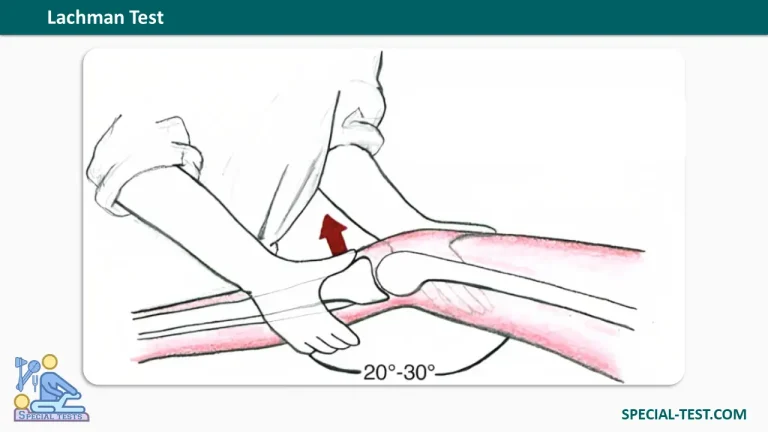
- The patient is positioned supine with the injured knee flexed to 20 to 30 degrees while also slightly externally rotating the injured leg to relax the iliotibial band.
- The examiner then uses one hand to stabilize the distal femur while using the other hand to grasp the proximal tibia.
- Next, an anterior force is applied to the proximal tibia in an attempt to sublux the tibia forward while keeping the femur stabilized
What is the positive result?
- The test is considered positive if there is excessive anterior translation of the proximal tibia greater than the uninjured side and also a lack of a firm endpoint.
- Endpoints are graded from “hard” to “soft,” and have been nominally classified as :
- A (firm, hard endpoint)
- B (absent, soft endpoint).
Test Accuracy
- Sensitivity: 87 %
- Specificity: 93 %
References
- Dutton’s Orthopaedic Examination, Evaluation, And Intervention 3rd Edition.
- NCBI – Skills in Rheumatology