Published August 21, 2026Read time 1 min readReaders 20
What is the "Internal Rotation Resistance Stress Test" used for?
Differentiate between internal and classic outlet impingement
How to perform the "Internal Rotation Resistance Stress Test"?
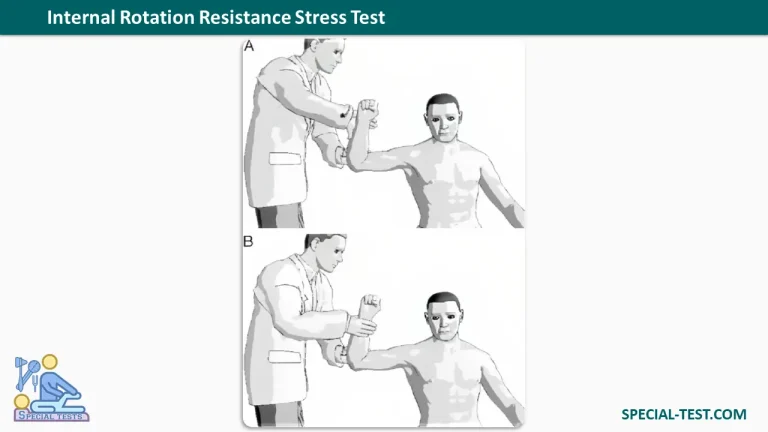
The test is performed with the patient seated and the examiner standing behind the patient.
The patient’s arm is positioned in 90 degrees of abduction in the coronal plane and approximately 80 degrees of external rotation.
A manual isometric muscle test is performed for external rotation and compared with one for internal rotation in the same position.
What is the positive result?
If a patient with a positive impingement sign has good strength in external rotation and weakness in internal rotation, the test is positive.
A positive internal rotation resistance stress test suggests internal impingement,
and a negative test (more weakness in external rotation) suggests classic outlet impingement.
Test Accuracy
Sensitivity: 88 %
Specificity: 96 %
References
Campbel’s Operative Orthopaedics Book
Tennent, T Duncan et al. “A Review of the Special Tests Associated with Shoulder Examination.” The American Journal of Sports Medicine 31 (2003): 154 – 160.