Published July 24, 2026Read time 1 min readReaders 18
What is the “Hyperextension Internal Rotation Test” used for?
Hyperextension Internal Rotation Test (HERI Test) is designed to assess the inferior glenohumeral ligament and inferior capsule with decreased risk of dislocation.
How to perform the “Hyperextension Internal Rotation Test”?
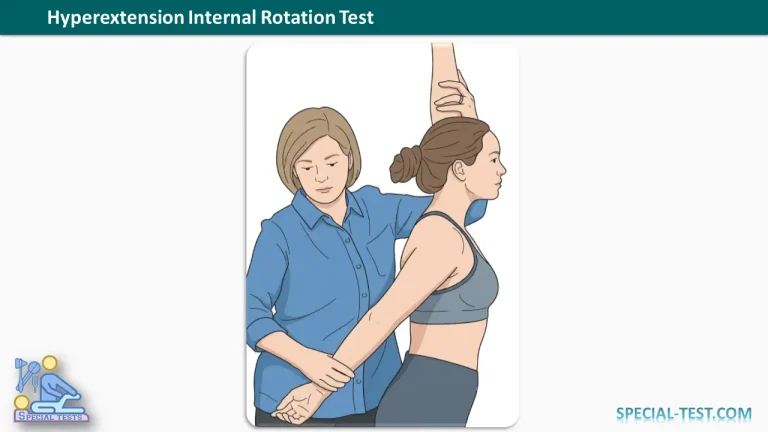
The examiner stands behind the patient.
Starting with the normal shoulder, the examiner carefully elevates the patient’s non-test limb to maximum elevation to prevent movement of the thoracic spine and scapulothoracic joint while at the same time medially rotating the test arm and extending it maximally
This must be done carefully as the patient may become apprehensive when the injured arm is elevated,
Then the problem shoulder is tested.
What is the positive result?
For a positive test, the extension of the affected arm must be greater than 10° relative to the normal arm.
References
Lafosse T, Fogerty S, Idoine J, Gobezie R, Lafosse L. Hyper extension-internal rotation (HERI): A new test for anterior gleno-humeral instability. Orthop Traumatol Surg Res. 2016 Feb;102(1):3-12. doi: 10.1016/j.otsr.2015.10.006. Epub 2015 Dec 22. PMID: 26726100. Pubmed