Goldthwait Test
What is the "Goldthwait Test" used for?
- Help differentiate sacroiliac (SI) joint dysfunction from lumbar spine pathology in patients presenting with low back pain or posterior pelvic pain.
- It is also useful for identifying symptoms related to nerve root irritation, particularly when pain radiates along the distribution of the sciatic nerve.
How to perform the "Goldthwait Test"?
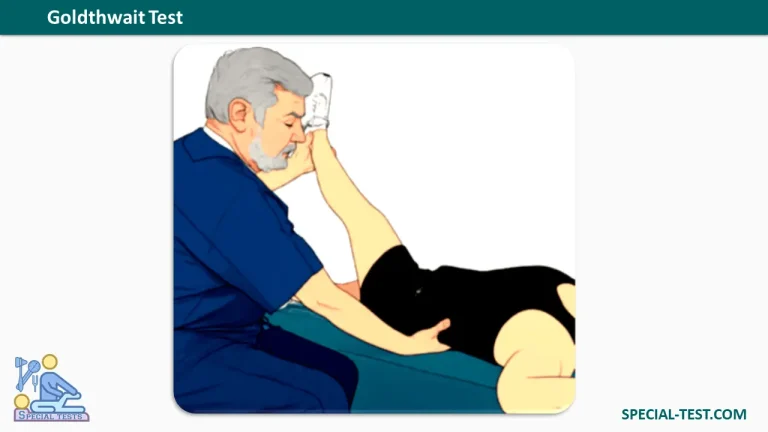
- The patient lies supine on the examination table. The lower limbs should be relaxed, and the examiner stands to the patient’s side.
- The examiner places one hand beneath the patient’s lumbar spine, positioning the fingertips in successive interspinous spaces (L5–S1, L4–L5, L3–L4, L2–L3). This allows the examiner to palpate for segmental movement of the lumbar vertebrae during the maneuver.
- With the other hand, the examiner performs a straight-leg raise (SLR), gradually elevating the patient’s lower limb while monitoring the lumbar spine movement with the palpating hand.
What is the positive result?
1. Pain occurs before lumbar interspinous movement
- Suggests sacroiliac joint dysfunction.
- Reason: If the SI joint is irritated, stress from the initial leg elevation is transmitted to the SI joint before the lumbar spine begins to move.
2. Pain occurs during palpable lumbar interspinous movement
- Indicates lumbar spine pathology, such as:
- Facet joint dysfunction
- Intervertebral disc involvement
- Segmental instability
3. Radiating pain along the sciatic nerve distribution
- Suggests neurological involvement, such as:
- Nerve root irritation
- Disc herniation
- Radiculopathy