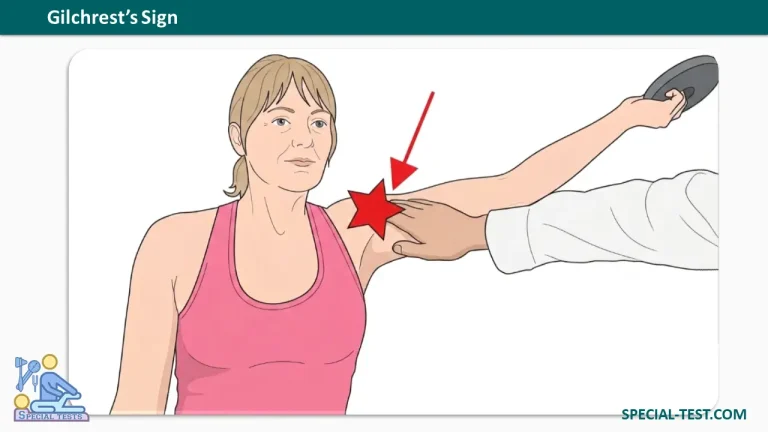
Gilchrest’s Sign
What is the “Gilchrest’s Sign” used for?
- Bicipital paratenonitis or tendinosis
How to perform the “Gilchrest’s Sign”?
- While standing, the patient lifts a 2-kg to 3-kg (5-lb to 7-lb) weight overhead.
- The arm is laterally rotated fully and lowered to the side in the coronal plane.
What is the positive result?
- A positive test is indicated by discomfort or pain in the bicipital groove.
- A positive test indicates bicipital paratenonitis or tendinosis.
- In some cases, an audible snap or pain may be felt at between 90° and 100° abduction.