Feagin Test
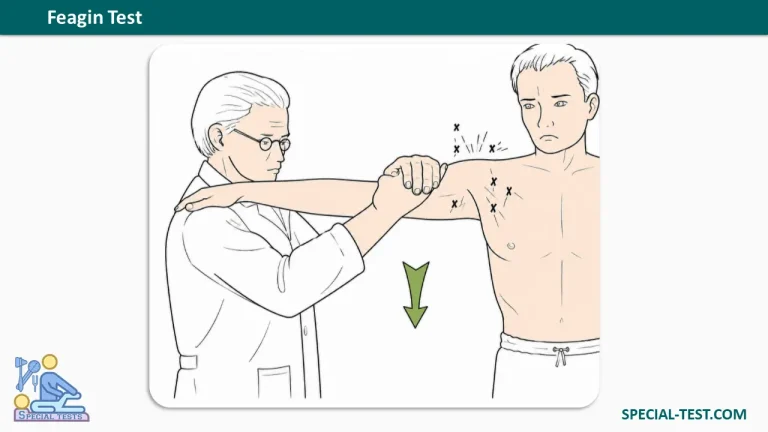
What is the “Feagin Test” used for?
- It’s a modification of the sulcus sign test
- Used for shoulder multidirectional instability
How to perform the “Feagin Test”?
- The patient stands with the arm abducted to 90° and the elbow extended and resting on the top of the examiner’s shoulder.
- The examiner’s hands are clasped together over the patient’s humerus, between the upper and middle thirds.
- The examiner pushes the humerus down and forward.
The test can also be done with the patient in a sitting position:
- In this case, the examiner holds the patient’s arm at the elbow (elbow straight) abducted to 90° with one hand and arm holding the arm against the examiner’s body.
- The other hand is placed just lateral to the acromion over the humeral head.
- Ensuring the shoulder musculature is relaxed, the examiner pushes the head of the humerus down and forward.
- Doing the test this way often gives the examiner greater control when doing the test.
What is the positive result?
- A look of apprehension on the patient’s face indicates a positive test and the presence of inferior capsular laxity.
- If both the sulcus sign and Feagin test are positive, it is a greater indication of multidirectional instability rather than just laxity, but it should only be considered positive if the patient is symptomatic (e.g., pain/ache on activity, shoulder does not “feel right” with activity).
Test Accuracy
- Sensitivity: 30%
- Specificity: 90%
References
- Gaskill TR, Taylor DC, Millett PJ. Management of multidirectional instability of the shoulder. J Am Acad Orthop Surg. 2011;19:758–767. Pubmed
- Orthopedic Physical Assessment by David J. Magee, 7th Edition.