Elbow Range of Motion
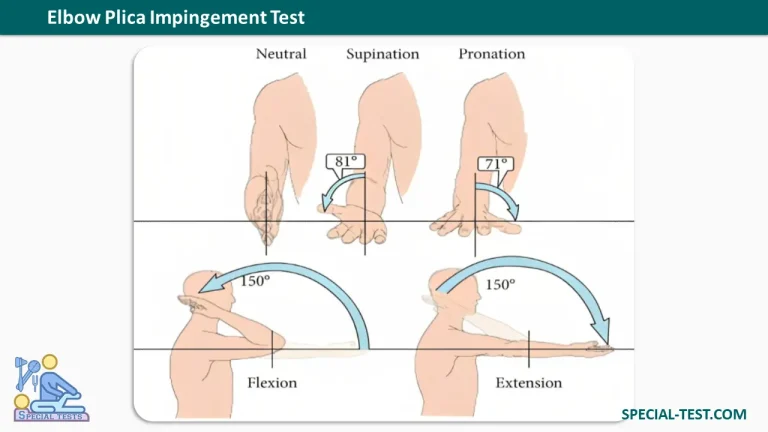
The elbow is a complex synovial joint that allows the upper limb to position the hand in space. It consists of three articulations enclosed within a single capsule:
- Humeroulnar joint
- Humeroradial joint
- Proximal radioulnar joint
Together, these joints permit two primary types of movement:
- Flexion and extension
- Forearm pronation and supination
Assessment of elbow range of motion (ROM) is an essential component of orthopedic and rehabilitation examinations. It helps diagnose joint stiffness, fractures, arthritis, nerve injuries, tendon disorders, and monitor recovery following surgery or trauma.
Normal Elbow Range of Motion
Normal elbow motion varies slightly among individuals, but the following values are widely accepted in orthopedic practice.
Functional Elbow Range of Motion
Although the elbow is capable of moving through a larger arc, most activities of daily living (ADLs) require a much smaller functional range.
A classic biomechanical study by Morrey et al. demonstrated that approximately:
- 30° to 130° of elbow flexion-extension
- 50° of pronation
- 50° of supination
are sufficient for the majority of daily activities, including:
- Eating
- Personal hygiene
- Dressing
- Using a telephone
- Writing
- Computer work
Loss of motion beyond these functional limits often leads to significant disability and may require rehabilitation or surgical intervention.
Measuring Elbow Range of Motion
Elbow ROM is typically measured using a goniometer.
Flexion and Extension
Patient Position
- Sitting or supine
- Shoulder in neutral rotation
- Arm adducted against the body
- Forearm supinated
Goniometer Landmarks
- Fulcrum: Lateral epicondyle of the humerus
- Stationary arm: Along the humerus toward the acromion
- Moving arm: Along the radius toward the radial styloid
Normal Values
- Extension: 0°
- Flexion: 140°–150°
Some individuals exhibit 5°–10° of physiologic hyperextension, particularly females and children.
Measuring Forearm Pronation
Patient Position
- Elbow flexed to 90°
- Arm adducted to the side
- Wrist in neutral position
Goniometer Placement
- Fulcrum: Just proximal to the ulnar styloid
- Stationary arm: Perpendicular to the floor
- Moving arm: Across the dorsal forearm
Normal ROM
- Approximately 70°–90°
Measuring Forearm Supination
The patient remains in the same position used for pronation measurement.
Goniometer Placement
- Fulcrum: Medial to the ulnar styloid
- Stationary arm: Vertical
- Moving arm: Across the volar forearm
Normal ROM
- Approximately 80°–90°
Factors Affecting Elbow Range of Motion
Several conditions may reduce elbow motion, including:
- Elbow fractures
- Elbow dislocation
- Post-traumatic stiffness
- Osteoarthritis
- Rheumatoid arthritis
- Heterotopic ossification
- Capsular contracture
- Cubital tunnel syndrome with pain limitation
- Tendon injuries
- Burns around the elbow
- Prolonged immobilization
Early mobilization after injury, when appropriate, is important to minimize stiffness.
Clinical Significance
Restriction of elbow ROM may significantly impair upper-limb function. Even relatively small losses of extension or forearm rotation can interfere with occupational and recreational activities.
During orthopedic examination, ROM should be compared with the contralateral side and evaluated together with:
- Pain
- End-feel
- Crepitus
- Joint stability
- Muscle strength
- Neurovascular status
Both active and passive ROM should be documented, as discrepancies between them may indicate muscular weakness, tendon injury, pain inhibition, or mechanical block.
Normal End Feel
The normal end feel of elbow movements includes:
| Movement | Normal End Feel |
|---|---|
| Flexion | Soft (muscle approximation) |
| Extension | Firm (capsular or ligamentous stretch) |
| Pronation | Firm |
| Supination | Firm |
An abnormal hard or empty end feel may indicate fracture, loose bodies, osteophytes, severe pain, or joint pathology.
Key Points
- Normal elbow flexion-extension ranges from 0° to 150°.
- Functional elbow motion for most daily activities is 30°–130°.
- Normal forearm pronation is approximately 70°, while supination is approximately 80°.
- A goniometer is the standard instrument for measuring elbow ROM.
- Loss of functional ROM can substantially affect independence and quality of life.
- Both active and passive ROM should be assessed during every comprehensive elbow examination.
References
- Morrey BF, Askew LJ, Chao EY. A biomechanical study of normal functional elbow motion. Journal of Bone and Joint Surgery Am. 1981;63(6):872–877.
- American Academy of Orthopaedic Surgeons (AAOS). Clinical examination of the elbow.
- Norkin CC, White DJ. Measurement of Joint Motion: A Guide to Goniometry. 5th Edition. F.A. Davis.
- Copaci D, Cano-Marin E, Moreno L, Blanco D. New Design of a Soft Robotics Wearable Elbow Exoskeleton Based on Shape Memory Alloy Wire Actuators. Applied Bionics and Biomechanics. 2017;2017:1605101.